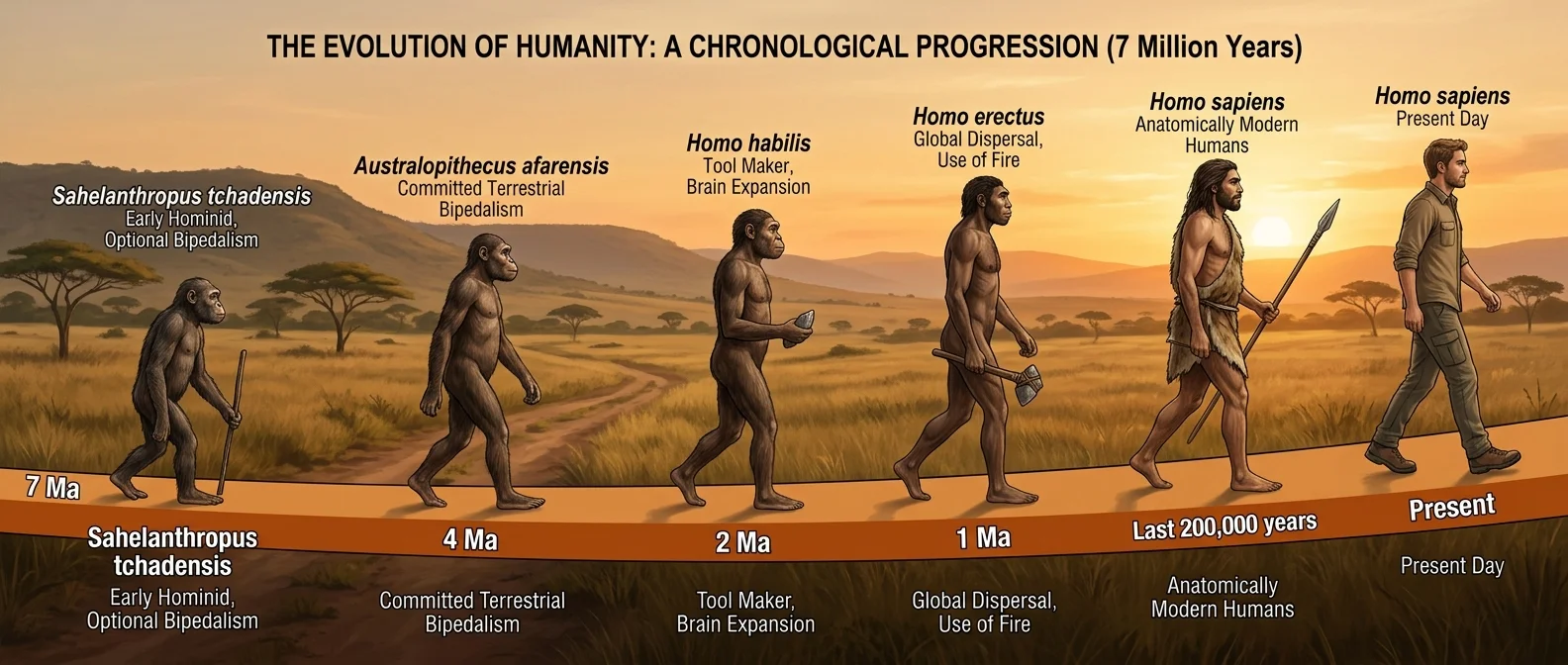
In the Djurab Desert of Chad, beneath layers of dust and forgotten centuries, a chimp-sized skull waited 7 million years to reveal a secret: its owner walked upright. Sahelanthropus tchadensis, known as “Toumai,” may not have looked human — but its legs had already begun writing the first chapter of a story that would lead to pyramids, symphonies, and nuclear reactors.
📖 Read more: Archaeopteryx: The First Bird That Ever Flew
First Steps: Sahelanthropus Walked Upright
In January 2026, Scott Williams' team from New York University published the strongest evidence yet that Sahelanthropus tchadensis was bipedal in Science Advances. Using 3D imaging, they identified a femoral tubercle on the thighbone — the attachment site for the iliofemoral ligament, the strongest ligament in the human body, crucial for posture and walking.
"Sahelanthropus tchadensis was essentially a bipedal ape with a chimp-sized brain that likely spent significant time in trees," Williams explains. The analysis revealed three key features: the femoral tubercle (unique to hominins), femoral anteversion (natural twisting of the thigh that directs feet forward), and gluteal muscles similar to early hominins. This discovery places bipedalism at the very base of the human evolutionary tree.

From Trees to Savanna: 7-4 Million Years Ago
After Sahelanthropus (7 million), came Orrorin tugenensis (6 million, Kenya) and Ardipithecus ramidus (4.4 million, Ethiopia). “Ardi,” a female Ardipithecus discovered in 1994, revealed a creature living in a forested environment that walked upright on the ground but climbed trees. Her feet had grasping big toes — like a second pair of hands.
These early hominins didn't descend from trees because the savanna “called” them. Recent 2023 research suggests bipedalism likely evolved within the trees — to reach high fruit while standing on branches, as orangutans do today in Sumatra. The abandonment of forests was gradual, driven by climate changes that formed the Great Rift Valley of East Africa and thinned forest cover 3-4 million years ago, creating a mosaic of forest and increasingly sparse savanna.
Lucy and the Australopithecines: 4-2 Million Years
"Lucy" (Australopithecus afarensis), discovered in Ethiopia in 1974, lived 3.2 million years ago. She stood just 3.5 feet tall with a 400 cm³ brain — one-third the size of ours.
The Australopithecines represent a critical stage — fully bipedal but with small brains, initially without tools. The Laetoli footprints in Tanzania (3.6 million years), discovered by Mary Leakey in 1978 in volcanic ash, show walking nearly identical to modern humans — without a grasping big toe. Several species coexisted in the same time and place: A. afarensis, the more gracile A. africanus (South Africa), the robust Paranthropus boisei (with massive molars and sagittal crest for tough foods), and the mysterious A. sediba (2 million, South Africa), which shows bridge characteristics toward Homo.
Genus Homo: Tools, Fire, Brain
2.8 million years ago, Homo habilis appeared — the first “toolmaker,” discovered by Louis and Mary Leakey at Olduvai Gorge, Tanzania. The first stone tools (Oldowan, 2.6 million) were simple stones broken for sharp cutting edges, but even this “simple” technology required understanding fracture angles and selecting appropriate stone. The brain was growing: from 400 cm³ in Australopithecus to 600 cm³ in H. habilis and 900 cm³ in Homo erectus (1.9 million).
Homo erectus was the first great explorer — leaving Africa 1.8 million years ago (Dmanisi, Georgia) and spreading across Asia (Java, Beijing), where it survived until 100,000 years ago. It likely mastered fire 1 million years ago, though evidence of controlled use appears 400,000 years ago at Schöningen, Germany, where the oldest wooden spears were also found. Acheulean tools (handaxes, 1.7 million) show abstraction, planning, and foresight — cognitive abilities unthinkable for their predecessors. Meat and cooking, according to Leslie Aiello's “Expensive Tissue” hypothesis, provided the calories the brain needed to grow — a brain that consumes 20% of the body's energy while comprising just 2% of its weight.

📖 Read more: The 10,000-Year Milk Mutation That Changed Human History
Homo sapiens Born in Africa
According to Jean-Jacques Hublin's landmark study (Max Planck) in Nature (2017), the oldest Homo sapiens fossils were found at Jebel Irhoud, Morocco, dated to 300,000 years — 100,000 years earlier than previous finds at Omo Kibish, Ethiopia. The skulls showed modern faces but archaic braincase shapes.
"We thought there was a cradle of humanity 200,000 years ago in East Africa, but new data reveals Homo sapiens spread across the entire African continent 300,000 years ago," Hublin stated. The earliest fossils are now found on three continents: Jebel Irhoud (Morocco, 300,000), Florisbad (South Africa, 260,000), and Omo Kibish (Ethiopia, 195,000) — suggesting complex pan-African evolution, not a single “cradle.”
Out of Africa and the Encounters
70,000-100,000 years ago, Homo sapiens left Africa — likely in multiple migration waves, initially through the Sinai Peninsula and later via the Bab-el-Mandeb Strait. In Europe and Western Asia, they encountered Neanderthals (Homo neanderthalensis), who had lived there for over 300,000 years and were excellent large-game hunters. In Asia, they met the Denisovans, known mainly from DNA of a single finger bone in a Siberian cave. The three groups didn't just coexist — they interbred.
Today, every non-African population carries 1-4% Neanderthal DNA, while Melanesian and Australian populations bear 3-6% Denisovan DNA. These “ancient gifts” include genes for high-altitude adaptation (EPAS1 in Tibetans, from Denisovans), immune response (HLA genes, from Neanderthals), but also disease susceptibility — including more severe COVID-19 reactions (a chromosome 3 sequence, Neanderthal inheritance, according to Svante Pääbo's 2020 Nature study). Pääbo, founder of paleogenetics, was awarded the 2022 Nobel Prize in Physiology.
The Brain: From 400 to 1,400 cm³
The most dramatic change over 7 million years is the more than tripling of brain size: from 350-400 cm³ in Sahelanthropus to 600 cm³ in Homo habilis, 900 cm³ in Homo erectus, and finally 1,350-1,400 cm³ in modern Homo sapiens. But size doesn't explain everything — Neanderthals had larger brains on average (1,600 cm³), yet went extinct 40,000 years ago. Structure matters more: the globular braincase shape of Homo sapiens, unlike the elongated Neanderthal skull, suggests different internal architecture — possibly larger parietal lobes, important for social intelligence and abstract thought.
Hublin's Jebel Irhoud study revealed exactly this: the earliest Homo sapiens skulls had modern faces but archaic braincases — meaning brain evolution continued within our own species. As Philipp Gunz explains: "Face morphology was established early, while brain shape evolved within the Homo sapiens lineage."
What Makes Us Human: Genes and Culture
The genetic distance between humans and chimps is just 1.2% in coding DNA — but this translates to roughly 35 million different nucleotides in a 3-billion-base genome. Critical genes like FOXP2 (language and speech), ASPM and MCPH1 (brain size), and HAR1 (neocortex development) show accelerated evolution in the human lineage. “Human Accelerated Regions” — DNA segments stable across millions of species but rapidly changing exclusively in humans — number over 2,700, many related to neural networks.
However, what truly sets us apart isn't just genes but cumulative culture: the ability to learn, record, and transmit knowledge to each generation through language, writing, and now digital media. No other species builds upon previous knowledge with such speed and precision. Our evolution is now cultural, not biological — and this makes the last 50,000 years more radical than the previous 7 million.
Sources:
- Williams, S.A. et al. “Earliest evidence of hominin bipedalism in Sahelanthropus tchadensis.” Science Advances, 2026 — ScienceDaily, New York University
- Hublin, J.-J. et al. "New fossils from Jebel Irhoud, Morocco and the pan-African origin of Homo sapiens." Nature, 2017 — ScienceDaily, Max-Planck-Gesellschaft