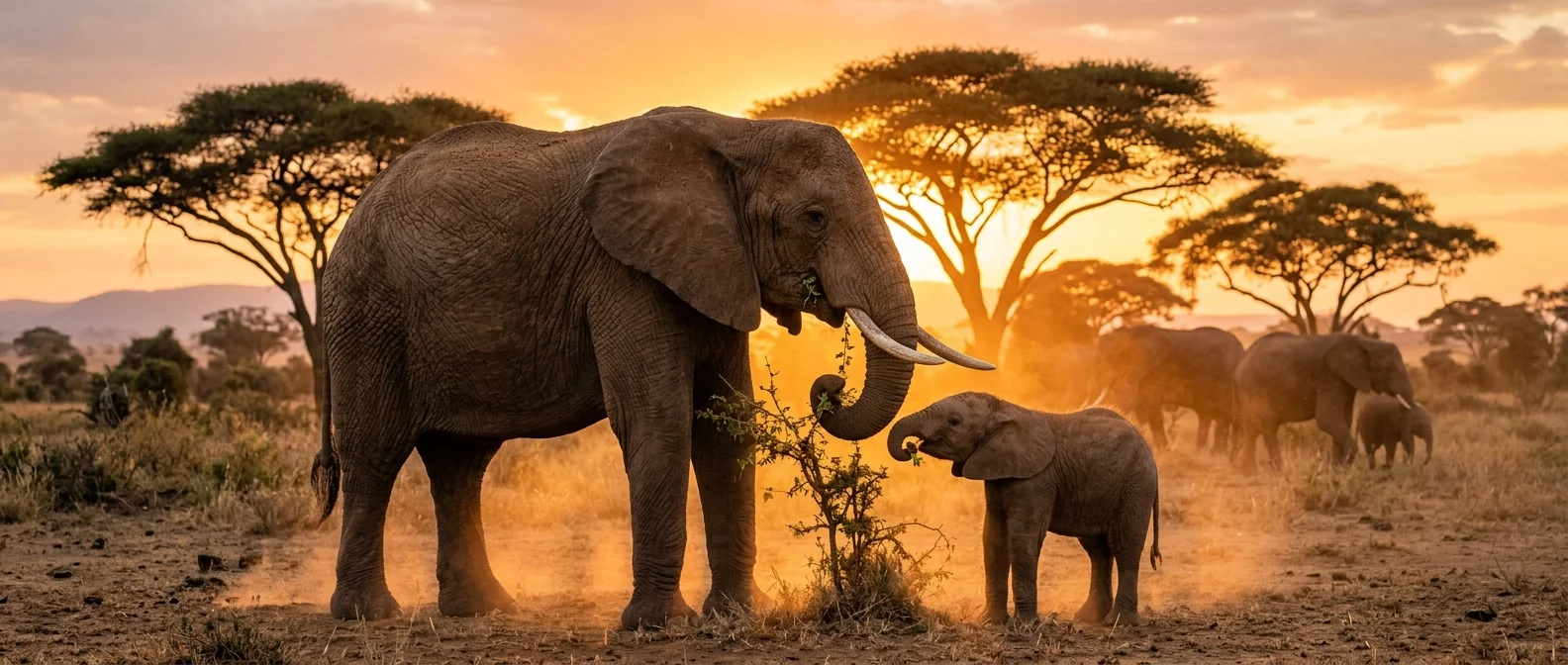
In a Kenyan savanna, an elderly female elephant stops abruptly. She hears something — a low rumble, invisible to human ears. She turns, flaps her ears, and changes course. Behind her, the young follow without hesitation. What you just witnessed isn't mere instinct — it's knowledge passed down from generation to generation.
📖 Read more: Whales Change Their Songs: Culture Beneath the Waves
🐘 Matriarchy as a Knowledge System
Elephants (Elephas maximus and Loxodonta africana) live in societies always governed by a leader — an elderly female, the matriarch. She's not chosen randomly. Her position is based on decades of experience and knowledge that no other elephant possesses. Unlike many mammals where physical strength dominates, here wisdom rules. The oldest isn't the strongest — she's the most knowledgeable.
The matriarch remembers water sources, migration paths, and danger zones. This knowledge isn't written in any DNA — it's transmitted through observation, mimicry, and social interaction. Young herd members watch, memorize, and apply what they learn.
🗣️ The Language We Can't Hear
Elephants communicate with infrasound — low-frequency sounds below 20 Hz, invisible to human ears but detectable across kilometers. A 2024 study in Communications Biology, led by Vesta Eleuteri from the University of Vienna, revealed something remarkable: greetings between elephants aren't random — they're deliberate and adaptive.
The research team observed nine semi-wild elephants in Zimbabwe and discovered that the combination of ear flapping with low rumbling was the most common greeting. Even more impressive: elephants adapted their communication method depending on the moment. If the other elephant was already looking, they used visual gestures. If looking elsewhere, they chose touch or sound.
“It's amazing how much they rely on body language, but this is often overlooked” — Vesta Eleuteri, University of Vienna
👶 How the Young Learn
A newborn elephant knows nothing — it doesn't know where to find water, which plants are poisonous, or how to face a predator. It learns all this by observing its mother, aunts, and the matriarch. It's a form of social learning that resembles human education more than anything else in the animal kingdom.
The herd functions like a mobile school. Older females don't just care for the young — they actively guide them. Within months, a calf is trained in using its trunk with its 40,000 muscles, learns to recognize dozens of herd members, and begins understanding social hierarchy. Learning never stops — it continues for decades.
📖 Read more: DNA Test Reveals You're Not Your Own Mother — Chimerism

🧠 Memory That Saves Lives
The phrase “an elephant never forgets” isn't hyperbole. Research has shown that matriarchs remember water sources they haven't visited in decades. During droughts, this memory becomes the difference between life and death for entire herds. A matriarch can lead her group to a water source 100 kilometers away that she hasn't visited in 20 years. The hippocampus — the brain structure related to memory — is proportionally larger in elephants than in most mammals.
Memory alone isn't enough — it must be transmitted. Young elephants follow the matriarch on migrations of hundreds of kilometers, imprinting every path, every landmark, every hidden spring in their minds. Studies show that herds with elderly matriarchs — over 55 years old — respond much more effectively to threats than those with younger leaders.
Water Sources
The matriarch remembers dozens of water sources within hundreds of kilometers
Migration Paths
Routes used by previous elephant generations are transmitted through observation
Danger Zones
Areas with predators or human presence are systematically avoided
⚰️ Death Rituals — Culture on Four Legs
One of the most striking proofs of cultural behavior in elephants concerns how they handle death. A 2024 study in the Journal of Threatened Taxa, led by Parveen Kaswan and Akashdeep Roy, documented five cases of Asian elephants (Elephas maximus) burying their calves in irrigation canals of tea plantations in West Bengal, India. All calves were under one year old, and in each case, death was natural.
Herd members carried the dead calves with their trunks or feet for up to 48 hours, placed them upside down in the canals, and covered them with soil. Afterward, they trumpeted and roared — sounds that, according to researcher Akashdeep Roy, express “pain and tribute to the dead calf.” Remarkably: after each burial, the herd systematically avoided that path — even if it was a route they used daily.
"They know their actions very well. They chose the tea plantations deliberately, because they couldn't dig in the forest or bury in villages with human presence" — Akashdeep Roy, Indian Institute of Science Education and Research
📖 Read more: Dream Recording Technology: Neuroscience Breakthrough 2026
🔊 Multimodal Communication — Beyond Sound
Elephant communication isn't limited to sounds. Eleuteri's study revealed they use multimodal communication — combining sound, touch, visual signals, and olfactory information simultaneously. Just as a human might wave and shout “Hello!” at the same time, elephants flap their ears while producing deep rumbles. This complexity indicates conscious communication intent.
Smell plays an equally critical role in knowledge transmission: elephants can recognize age, kinship, and even social group through scent — both in relatives and humans. Their nose, essentially the trunk, contains more olfactory receptor genes than any other mammal. Every encounter between members becomes a silent lesson in social navigation for the herd's young, who observe and store every reaction.

🛡️ When the Matriarch Dies, Culture Dies
Knowledge isn't just about locations — it's about crisis responses. In zoos, elephants have been observed forming protective circles around young members during earthquakes. This collective response isn't spontaneous — it's transmitted knowledge, the result of generations of experience.
Poaching doesn't just kill elephants — it kills generations of knowledge. Every matriarch that falls victim to poachers takes decades of memories with her. Herds that lose their elderly leader make worse decisions, react slowly to dangers, and struggle to locate resources. It's not just an animal that's lost — it's an entire library.
Herd With vs Without Matriarch
With Elderly Matriarch
- Faster threat recognition
- Effective water finding during drought
- Higher calf survival rates
- Organized social structure
Without Matriarch
- Disorientation during migration
- Increased mortality during drought
- Social instability within herd
- Reduced adaptation ability
🔮 A Future That Depends on Us
Species conservation alone isn't enough — we need cultural conservation. Continuous populations, without habitat fragmentation, allow uninterrupted knowledge transmission between generations. Protecting an individual elephant isn't sufficient if the social structure surrounding it isn't protected. Migration corridors, protected reserves, and anti-poaching efforts are the three foundations of this endeavor.
Elephants show us something profound: that culture isn't exclusively a human privilege. Animals that greet their friends, bury their children, and transmit knowledge across three generations aren't just “smart” — they're carriers of a culture millions of years old. And the responsibility for its continuation now rests in our hands.