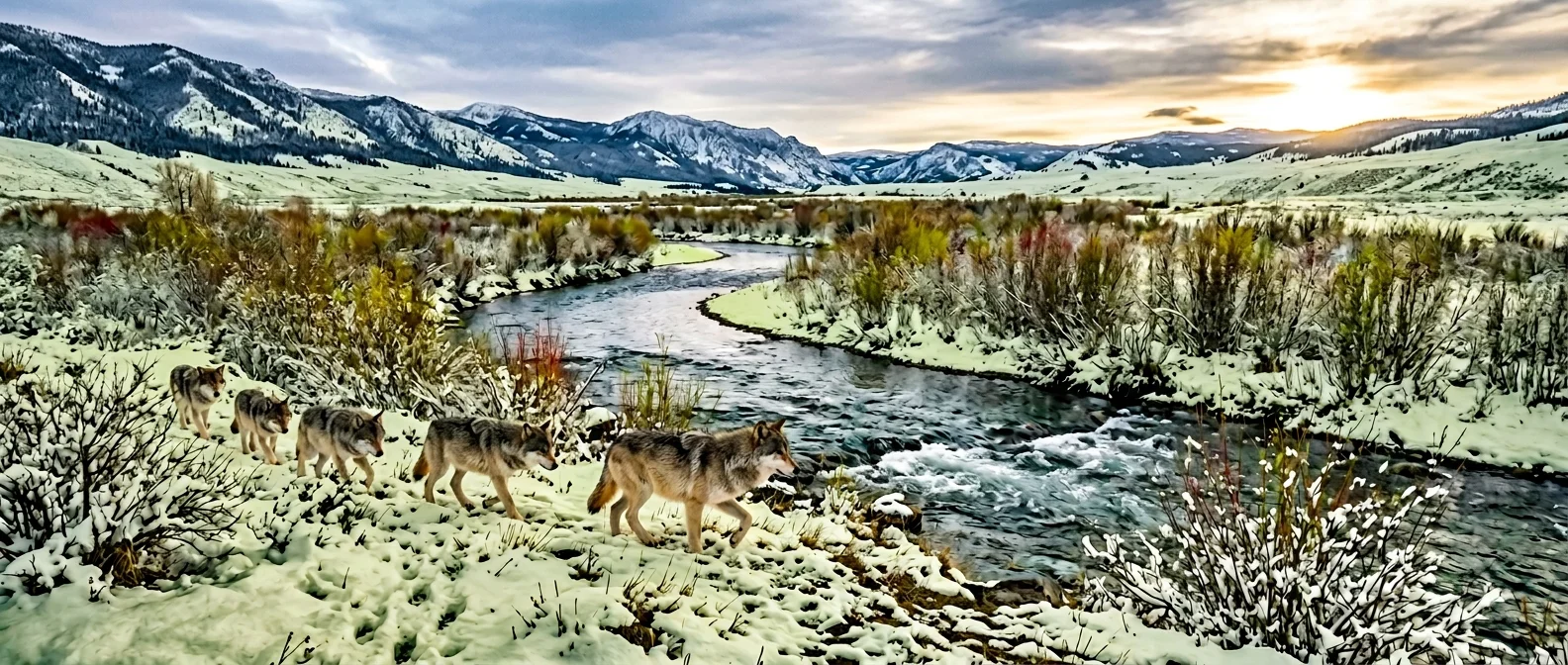
In the 1990s, 31 gray wolves were released into Yellowstone National Park after 70 years of absence. No one imagined these predators would change not just deer populations, but the entire landscape of the park — including the flow of its rivers. How is this possible?
📖 Read more: Cuttlefish Wave Their Arms: Do They Actually Communicate?
🐺 The Great Return
From the late 1800s, large predators in Yellowstone were systematically targeted. By the 1920s, gray wolves (Canis lupus) had virtually disappeared from the park. Their extinction created massive ecological imbalance: elk populations (Cervus canadensis) exploded, decimating vegetation and threatening dozens of other species.
In the 1990s, the U.S. government made a bold move: wolf reintroduction to Yellowstone. The first wolves came from Canada and were released into the park. What followed was what ecologists call a “trophic cascade” — a chain reaction that reshaped the entire ecosystem, from prey animals to rivers.
🦌 The Chain Reaction
The mechanism was simple in theory but stunning in practice. Wolves hunted elk. Elk, under hunting pressure, stopped grazing in open valleys near rivers — areas where they were vulnerable. This meant tree species that elk had been destroying — especially willows and aspens — regenerated dramatically.
According to a study published in January 2025, between 2001 and 2020 there was a 1,500% increase in willow canopy volume — a staggering number. Trees flourished again along riverbanks, stabilizing them and preventing erosion. This wasn't just cosmetic — it was structural for the entire ecosystem.

🌳 The Trees That Came Back
Before wolves, willows and aspens in Yellowstone were in tragic condition. Elk consumed them before they could even grow, leaving riverbanks bare. With wolves' return, pressure on elk reduced browsing and trees found space again. Their roots stabilized riparian zones, significantly reduced erosion, and created shade that lowered water temperature — beneficial for fish and amphibians.
🦫 Beavers Rebuild
With willow regeneration came the return of another crucial species: beavers. Beavers need trees to build their dams, and the abundance of willows gave them the materials they needed again. Beaver dams created small lakes and wetlands, which in turn attracted fish, frogs, birds, herons, and dozens of insect species. Entire new habitats were born thanks to this chain reaction that started with wolves.
Beaver dams even affected river geomorphology. Flows slowed significantly, waters spread over larger areas creating floodplain meadows, and banks stabilized further through the combined action of roots and dams. Some researchers believe Yellowstone's rivers literally changed course — and the beginning of this change was a pack of wolves.
💡 What is a Trophic Cascade?
It's the chain reaction in the food web where removal or addition of a top predator causes ripples at every level. In Yellowstone: wolves → fewer elk → more trees → more beavers → changed rivers → new habitats.
🏔️ A “System in Flux”
"Yellowstone is a fascinating system because it has the full suite of large predators and migratory ungulates that North America once had," said Chris Wilmers, an ecologist at the University of California, Santa Cruz. "Many of these species are returning — wolves were reintroduced, cougar and grizzly bear numbers are recovering — so it's a system in flux."
However, the story isn't as simple as it first appears. Some scientists question how strong the trophic cascade really is and whether wolves are the main drivers of change. Daniel MacNulty argues that many other factors must be considered — climate change, the action of other predators like bears and cougars, human hunting outside the park — before attributing change exclusively to wolves. The debate remains open and lively.

🐾 Wolves vs Cougars: The New Balance
An extremely detailed 2026 study in PNAS, based on 9 years of GPS data from wolves and cougars (Puma concolor), revealed how Yellowstone's two top predators coexist. Wolves occasionally kill cougars, but the reverse never happens. Wolves dominate due to pack strength — cougars always hunt alone, putting them at a disadvantage in direct confrontation.
Between 1998 and 2024, elk decreased from 95% to 64% of wolves' diet, and from 80% to 53% of cougars' diet. Cougars turned to mule deer (smaller), while wolves turned to bison. "Wolves and cougars were 6 times more likely to interact when cougars killed elk instead of mule deer," explained Wesley Binder of the University of Oregon.
Pack vs Solitary
Wolves hunt in groups (6-10 members), while cougars hunt alone. This gives wolves an advantage in confrontations.
Diet Shift
Cougars turned to smaller prey, reducing conflicts with wolves by 6 times.
Escape Terrain
Cougars avoid wolves by climbing trees and using rough, rocky terrain.
Stable Coexistence
Today, both wolves and cougars have stable populations in Yellowstone.
📊 Numbers That Tell the Story
⚖️ Before vs After Wolves
Before: Elk overpopulation, minimal vegetation near rivers, beaver extinction, bank erosion. After: Reduced elk population, 1,500% increase in trees, beaver return, stream stabilization, new habitats for fish and birds. The difference? 31 wolves.
The GPS study analyzed nearly 4,000 observation points across Yellowstone. Results show that prey and landscape diversity is key to stable coexistence of multiple apex predators. In less diverse landscapes without rocks and trees for refuge, cougars would have much more difficult survival conditions alongside wolf packs.
🌍 Why This Story Matters
Yellowstone's story proves that a single species can change an entire ecosystem — from trees to rivers. It's perhaps the most striking example of trophic cascade in the world, and continues to be intensively studied. "We're always trying to understand what the impact of large predators is on prey, and what the interactions are between them," said Wilmers. “It's the beginning of revealing this story between wolves and cougars.” And Yellowstone is the perfect laboratory to observe these complex dynamics in real time.
Despite scientific debate about the exact intensity of the phenomenon, one thing is certain: wolves changed Yellowstone. Even if they're not the sole drivers of ecosystem recovery, it's undeniable that their return triggered changes that wouldn't have happened otherwise. And if nature can self-restore so dramatically when given a chance, perhaps we should wonder how many other ecosystems are waiting for their own second chance.