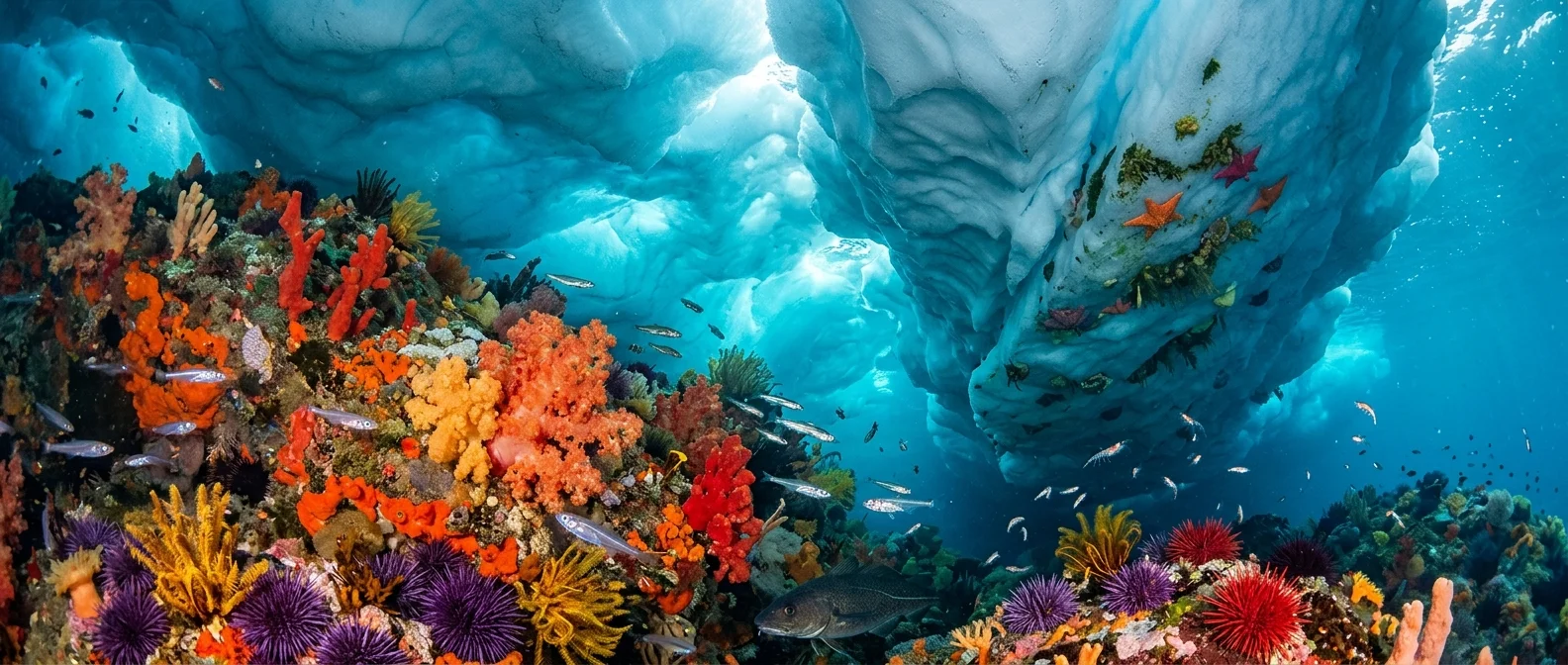
Picture a continent buried under 2 kilometers of ice. Temperatures hitting −89.2°C. Eternal darkness beneath nearly 4 kilometers of frozen water. No sunlight, no atmospheric oxygen, no sign of life — you'd think. Yet beneath Antarctica's ice, scientists have discovered entire ecosystems that shouldn't exist. Bacteria that feed on rock. Sponges living 260 km from open ocean. Lakes buried for 30 million years, teeming with life.
This isn't science fiction — it's the reality of an invisible biosphere. Get ready for an exploration mission beneath the ice, step by step, into the most inaccessible places on Earth.
🧊 Step 1: The Scale — A Planet Hidden Beneath Ice
Antarctica is a continent of superlatives. The coldest, driest, windiest place on Earth. Ice covers 98% of its surface, averaging 1,800 meters thick. These 29 million cubic kilometers of ice contain 90% of all ice on the planet and 80% of its fresh water. If it melted, sea levels would rise 45–60 meters.
Beneath this ice mass, the story gets strange. Geothermal energy from the rocky bedrock, combined with pressure from overlying ice, creates something unexpected: liquid water. Lakes, rivers, wet networks — an entire hydrological system that never sees sunlight. By 2022, scientists had identified 773 subglacial lakes globally, the vast majority in Antarctica. Additional lakes exist beneath Greenland's ice (64), Iceland's glaciers (6), and mountain glaciers (26).
The first detection of these lakes came in the 1960s, using airborne radio-echo sounding (RES) — radio waves transmitted from aircraft and reflected at ice-water boundaries. Australian glaciologist Gordon Robin and British researcher Charles Swithinbank, working with the British Antarctic Survey, were the first to document these hidden lakes in 1970. Today, satellite laser altimetry tracks ice height changes, revealing which lakes fill and drain — evidence they're connected in open networks.
The scale is staggering. The largest subglacial lake, Lake Vostok, contains more water than Lake Ontario. The entire network may hold as much liquid water as the Great Lakes combined, all of it sealed beneath ice older than most mountains on Earth.

🧊 Step 2: Lake Vostok — The 5,400 Cubic Kilometer Mystery
Beneath Russia's Vostok Station, at roughly 4 kilometers depth, lies the largest subglacial lake ever discovered. Lake Vostok stretches over 240 kilometers long, with a maximum width of 50 kilometers, in an elliptical shape. It contains approximately 5,400 cubic kilometers of water — a massive underground oceanic system hidden beneath an ice layer older than many mountains on Earth.
How did it form? Most scientists believe volcanic activity beneath the ice melted portions of it. Some argue the lake has been isolated from Earth's atmosphere for over 30 million years — since the East Antarctic ice sheet formed. Others calculate a younger age, perhaps 400,000 years. Either way, any creatures inside this lake — if they exist — evolved independently from every other life form on Earth, under 350 atmospheres of pressure.
The Russian drilling mission began in 1990. After decades of slow drilling through ice, in February 2012 the drill reached liquid water at 3,769 meters depth. Concerns about contamination — the drill used kerosene and Freon as antifreeze fluids — were mitigated when pressurized water rose up the borehole, pushing the fluids away before freezing into a 30–40 meter ice plug. In January 2013, an ice core was extracted from this plug. The Russian team announced they found bacterial DNA — at least one type that matched no known microorganism. The discovery was later disputed due to possible sample contamination, but the promise remains alive.
🧊 Step 3: Psychrophiles — Life at 0°C and Below
How can anything live in these conditions? The answer lies in organisms we call extremophiles — creatures that don't just tolerate extreme environments, but thrive in them. The term comes from Latin “extremus” and Greek “philos” — one who loves extremes.
Psychrophiles develop optimally below 15°C, with maximum tolerance at 20°C and minimum growth at 0°C or lower. Piezophiles thrive under tremendous hydrostatic pressure — ideal conditions for the bottom of subglacial lakes. Oligotrophs survive in environments nearly devoid of nutrients. Endoliths live inside rocks, between mineral crystals.
Beneath Antarctic ice, without sunlight, photosynthesis is impossible. Every food chain must be based on chemosynthesis — deriving energy from chemical reactions instead of light. Microbes that oxidize iron, sulfur, or ammonia can form the base of entire ecosystems. And this is exactly what appears to happen in subglacial lakes — worlds that function without sun, without photosynthesis, without anything we take for granted about life.
Studying these organisms isn't just biological curiosity. NASA considers Antarctica's subglacial lakes a precursor to exploring Europa, Jupiter's moon. Europa has a frozen surface and — possibly — an ocean of liquid water beneath it. If life can survive 4 kilometers under Antarctic ice, maybe it can survive there too.
🧊 Step 4: Life Beneath Icebergs — Sponges, Anemones, Ghost Fish
Life beneath ice isn't limited to microbes. Recent years have seen drilling through Antarctic ice shelves reveal something remarkable: multicellular organisms in places no one expected. The British Antarctic Survey (BAS) in 2021, drilling through 900 meters of ice in the Filchner-Ronne Ice Shelf, found sponges and stationary organisms rooted to rock — 260 kilometers from the nearest open ocean. It was the first time such organisms were found so far from free-flowing seawater.
In Antarctic waters, near ice shelves, sponges, corals, bryozoans, hydrozoans, isopods, polychaete worms, sea urchins, starfish, and pycnogonids (sea spiders) already thrive. The seafloor below about 15 meters depth — beyond the iceberg scour zone — hosts communities of complexity rivaling tropical reefs.
The discovery challenges assumptions about life's limits. These organisms survive in near-freezing water, with minimal food input from surface productivity, in complete darkness for months. They represent evolutionary adaptations to one of Earth's most extreme marine environments — and they're thriving.

🧊 Step 5: Ghost Fish — Blood Without Hemoglobin
In the frozen waters of the Southern Ocean, one fish family has achieved something unique in the animal kingdom: the Channichthyidae, known as icefish or crocodile icefish, have no red blood cells or hemoglobin in their blood. They're the only vertebrates on Earth with “white blood.”
How do they survive without the basic oxygen carrier? Waters around Antarctica are exceptionally rich in dissolved oxygen — cold water holds far more O₂ than warm water. Icefish compensate for the lack of hemoglobin with larger hearts and wider blood vessels in their gills, circulating greater blood volume. There are 16 known species, all in the Southern Ocean.
But it's not just icefish. The superfamily Notothenioidea — Antarctic perches — comprises nearly three-quarters of the 90+ bottom fish species in the zone. Most produce antifreeze glycoproteins that prevent ice crystal formation in their blood. Endemism reaches 90% — nine out of ten species are found nowhere else on the planet. This confirms Antarctica's geological and biological isolation over millions of years.
🧊 Step 6: Frozen Seals, Krill, and the Ice Food Chain
Life beneath and around Antarctic ice is sustained by a microscopic creature: krill (Euphausia superba), a shrimp barely 2–3 centimeters long. Krill form massive, dense swarms — dense enough that a blue whale, using baleen as filters, can consume over a ton in minutes. During the 3–4 months cetaceans spend in Antarctic waters, the original population of rorquals alone consumed an estimated 150 million tons of krill. This number speaks for itself about this ecosystem's productivity.
Four seal species breed almost exclusively in the Antarctic zone: the Weddell seal (about 1,000,000 individuals), crabeater seal (about 8,000,000), leopard seal, and rare Ross seal (50,000–220,000). The Weddell seal stands out as the only one that can survive beneath stable ice even in winter — it maintains open breathing holes by scraping ice with its teeth. The leopard seal, equipped with powerful jaws and massive canine teeth, is one of the few predators of adult penguins.
Then there's the emperor penguin — the continent's sole guardian during the great winter night. While nearly all birds abandon Antarctica each autumn, following the ice line northward, emperors stay behind. About 600,000 birds, in over 40 colonies, face temperatures below −40°C, months of darkness, and winds over 200 km/h — to incubate a single egg on their feet.
The Antarctic biosphere, from chemosynthetic bacteria in buried lakes to whales in the Southern Ocean, proves something radical: life doesn't need warmth, light, or comfort. It needs only water, energy, and time. And beneath Antarctica's ice, all three exist in abundance. What awaits our discovery may change not only biology, but how we search for life on other planets.