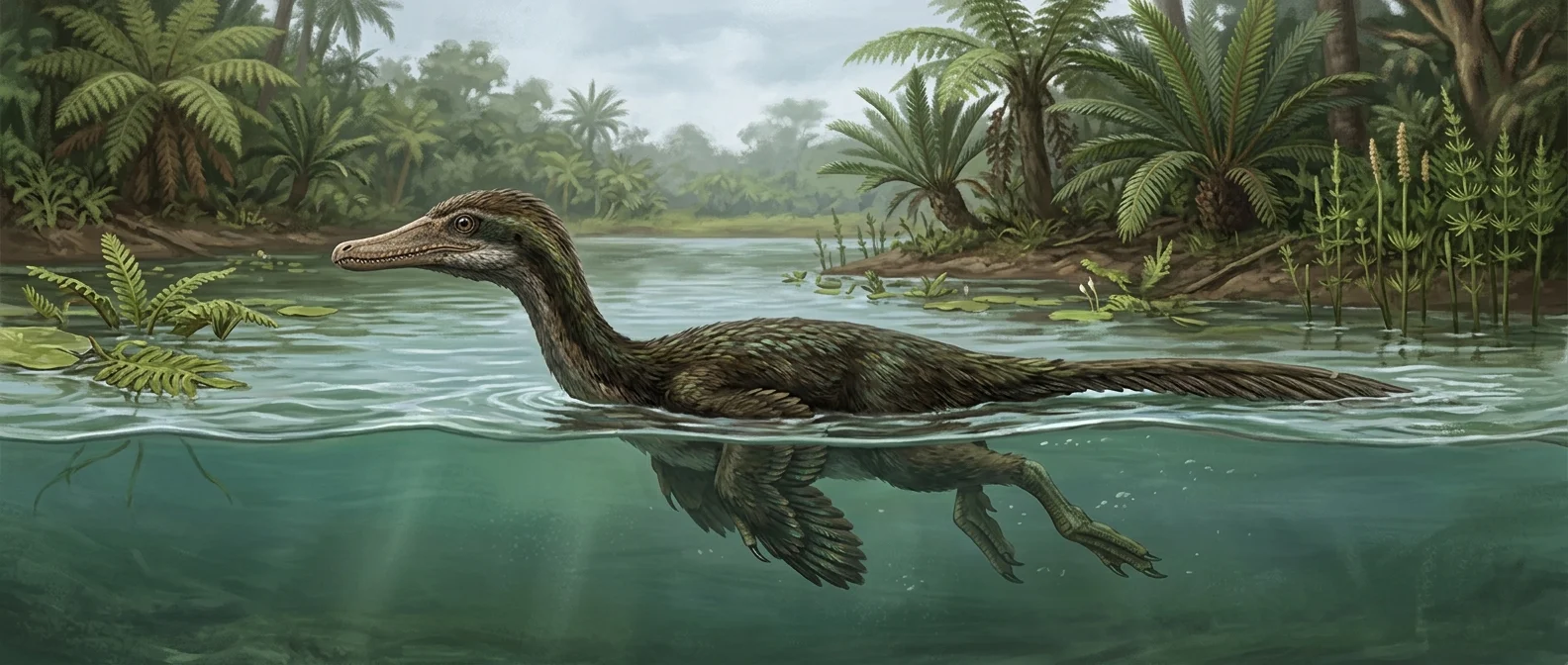
If someone asked you to imagine the weirdest possible dinosaur, you probably wouldn't think of this: a theropod with a swan's neck, flippers instead of arms, a snout packed with nerve sensors like a crocodile's, and a body designed for swimming. Yet Halszkaraptor escuilliei was real — a tiny dromaeosaurid from the Late Cretaceous that lived in Mongolia about 75 million years ago, looking like evolution decided to build a duck from spare dinosaur parts.
🦢 An Impossible Mosaic: Halszkaraptor's Anatomy
Halszkaraptor, formally described in 2017 by Italian paleontologist Andrea Cau and colleagues in Nature, represents one of the most stunning discoveries in modern paleontology. At just 60 centimeters long — about the size of a large duck — this tiny dinosaur combined features that had never been found together in any theropod.
Its neck was long and curved like a swan's — completely unusual for dromaeosaurids, a family of predatory dinosaurs known for members like Velociraptor (just 1.8 meters, 7 kilograms). Its forelimbs were flattened like flippers — not bird wings, but paddles. And its snout was riddled with microscopic cavities for sensory nerves — a neurovascular system equivalent to modern crocodiles that detect vibrations in water. This system would have allowed it to detect prey movements underwater even in complete darkness — a hunting tool extremely rare among theropods.
🔬 The Scan That Revealed the Truth
Halszkaraptor's fossil had a turbulent history before reaching scientists' hands. Found in Mongolia's Djadokhta Formation — the same formation that gave the world Velociraptor — it initially ended up with illegal fossil dealers. French collector François Escuillié acquired it and returned it to Mongolia, giving scientists the chance to study it.
But there was a problem: the fossil was embedded in hard rock and looked too bizarre — so bizarre that many experts suspected it was fake. In paleontology, “composite” fossils — constructions from bones of different animals glued together — aren't rare, especially in fossils from illegal excavations. The suspicion was justified.
The solution came from the European Synchrotron (ESRF) in Grenoble, France — one of the world's most powerful X-ray facilities. Through extremely high-resolution scanning, researchers examined every millimeter of the interior without removing a single piece of rock. The scan revealed that the bones were authentic, intact, with no signs of glue or artificial connection, and belonged to a single animal. Halszkaraptor was real — and even stranger than anyone imagined.
🏊 What Does “Semi-Aquatic Dinosaur” Mean?
Halszkaraptor wasn't marine like mosasaurs or ichthyosaurs — those had specialized fully for ocean life. Halszkaraptor was something different: a semi-aquatic dinosaur that spent time both on land and in water, hunting fish and small aquatic creatures in rivers and lakes. Like a modern duck or swan — but with sickle claws on its feet like Velociraptor.
This lifestyle was completely unknown among theropod dinosaurs before Halszkaraptor's discovery. Theropods — the group including everything from tiny Microraptor to massive Tyrannosaurus Rex — were obligate bipedal terrestrial hunters. Their hind legs served for support and movement, while small forelimbs were adapted for grasping prey. Even Spinosaurus, believed to hunt fish, did so mainly strategically from riverbanks or with dives — not swimming like a duck. Halszkaraptor completely overturned this pattern, showing that at least one theropod lineage adopted a fully semi-aquatic lifestyle.
🐊 Terrestrial vs Semi-aquatic Theropod
Velociraptor (Terrestrial)
- Short, muscular neck
- Forelimbs: grasping prey
- Snout: land hunting
- 1.8 m length, 7 kg
Halszkaraptor (Semi-aquatic)
- Long, curved swan neck
- Forelimbs: swimming flippers
- Snout: water sensors
- ~60 cm length
🧬 The Family: Dromaeosaurids — Cretaceous Hunters
Halszkaraptor belongs to dromaeosaurids (Dromaeosauridae) — the same family as Velociraptor, Deinonychus, and Utahraptor. These small to medium theropods were active hunters equipped with sharp, curved teeth and the iconic sickle claw on their second toe — a weapon designed to slash flesh.
Halszkaraptor's discovery was so surprising that an entire new subfamily was created for it: Halszkaraptorinae. This means semi-aquatic adaptation wasn't necessarily an isolated phenomenon — it may represent an entire dinosaur lineage that explored aquatic environments, whose members simply haven't been discovered yet.
🌊 A Window into Unknown Worlds
Halszkaraptor reminds us of something fundamental: dinosaur diversity was far greater than we imagine. Every new discovery overturns old assumptions. Who would have expected a theropod with flippers? Who would have imagined a dromaeosaurid swimming in rivers and diving for fish? With over 1,000 known dinosaur genera — and estimates that we know only 10-25% of actual diversity — what we know is just the tip of the iceberg.
Mongolia's Djadokhta Formation, where Halszkaraptor was found, is one of the world's richest dinosaur fossil deposits. It gave science Velociraptor (1.8 m, 7 kg, carnivorous hunter), Protoceratops, Oviraptor, and dozens of other genera. Every time someone digs there, they discover something new — and sometimes, something unthinkable.
Dinosaur fossils have been recovered from every continent except Antarctica, and the number of known genera exceeds 800, with new names added yearly. However, known species are estimated to represent less than 0.0001% of individuals that ever lived. Halszkaraptor was one such unexpected find: a duck-dinosaur that no science fiction scenario could have imagined before a synchrotron beam revealed it.
🔮 Epilogue: Evolution Dares
Halszkaraptor escuilliei isn't just a weird dinosaur. It's proof that evolution doesn't follow paths — it tries everything. It creates swimming predators, flying hunters, plant-eating giants. Every ecological niche, every lifestyle, every available resource — evolution sends someone to exploit it. 75 million years ago, in a Mongolian river, that “someone” was a dinosaur smaller than a duck with a swan's neck and swimming flippers. And that was as natural as anything else in life's history. If birds are living dinosaurs that conquered the air, Halszkaraptor shows that some dinosaurs were simultaneously exploring the waters — filling every possible ecological niche that nature offered.