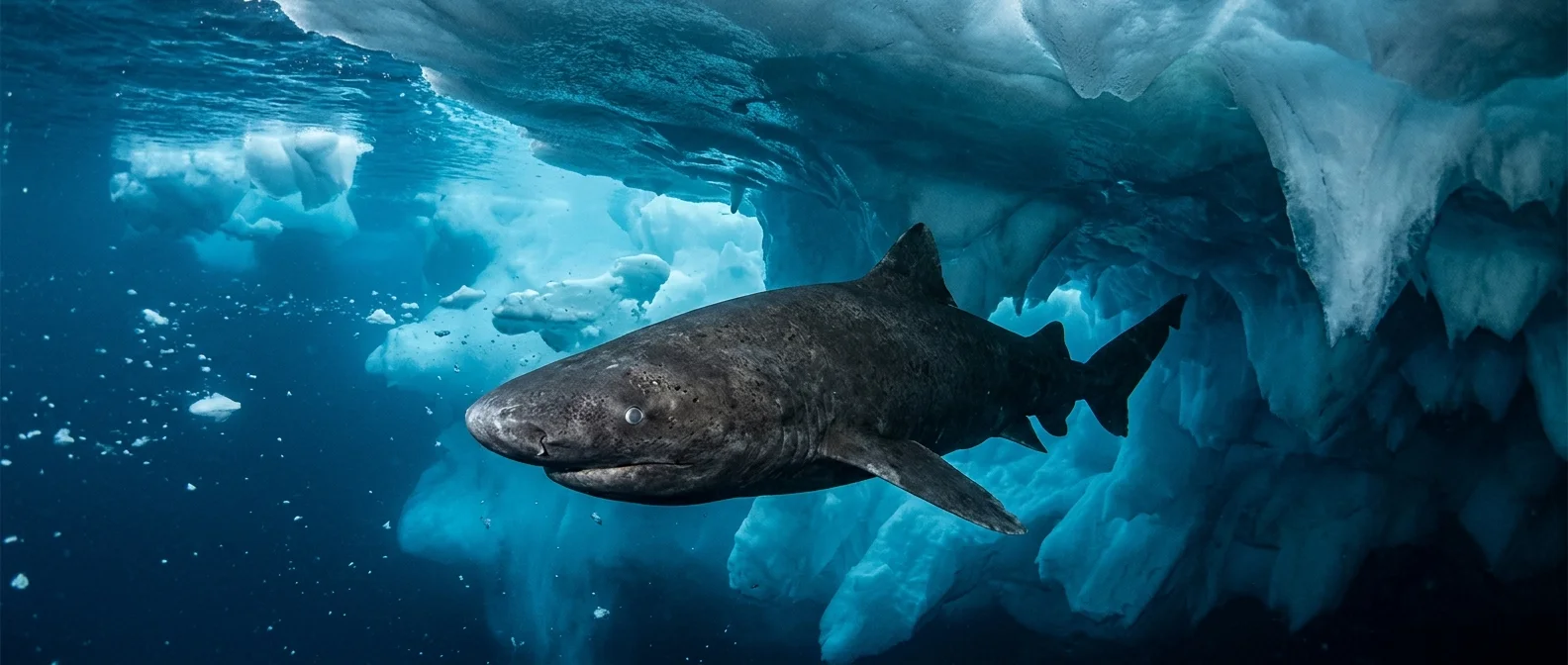
Imagine a creature born before Columbus discovered America — and still swimming today. One that grows so slowly it needs 150 years to reach sexual maturity. That hunts in near-freezing temperatures at depths of 2,200 meters, moving at just 3 kilometers per hour. This isn't science fiction. This is the superpower profile of the Greenland shark — the slowest, longest-lived vertebrate on the planet.
Somniosus microcephalus (genus Somniosus, family Somniosidae, order Squaliformes) inhabits the Arctic Ocean and North Atlantic — from Baffin Bay to the Barents Sea. Recent findings show it may be found much farther south, in deep cold waters across the globe. Every “superpower” it possesses is a lesson in evolutionary biology. Let's open the file.
🦸 Superpower 1: Near-Immortality — 500+ Year Lifespans
No other known vertebrate lives this long. A 2016 study in Science used radiocarbon dating of carbon-14 isotopes in the eye lens core — the only body part that doesn't regenerate after birth. The results were shocking: the largest shark in the study was estimated between 272 and 512 years old. The average placed its birth around 1505 — four decades before Shakespeare was born.
How is this possible? The answer lies in slow metabolism. In waters ranging from -1°C to 10°C, every cellular function slows dramatically. Less cellular damage, fewer free radicals, less DNA wear. In 2024, scientists sequenced the Greenland shark genome and discovered multiple copies of genes that regulate inflammation and repair DNA — a genetic anti-aging toolkit built into every cell. These genes — in multiple copies, unlike most vertebrates — give the organism redundant repair capacity: if one pathway fails, a second takes over. It's like having five backup generators on a ship — you rarely need them all, but their existence keeps you unsinkable for centuries.

🦸 Superpower 2: Cold Resistance — Below 0°C Survival
Most sharks avoid freezing waters. Somniosus microcephalus prefers them. It's found from the surface to 2,200 meters deep, in temperatures that would kill most fish. Its flesh contains high concentrations of urea and trimethylamine-N-oxide (TMAO) — substances that act as natural antifreeze, stabilizing proteins at extremely low temperatures.
These same substances make its flesh toxic. Greenlandic fermented shark (hákarl) requires months of drying and fermentation before becoming edible. Raw flesh causes symptoms similar to intoxication — the Inuit know it as “drunk shark meat.” Toxicity is inseparable from survival: the same chemical cocktail that keeps it alive in the Arctic's black sea poisons those who eat it unprocessed.
🦸 Superpower 3: Stealth Mode — Slow-Motion Hunting
With maximum speeds under 3 km/h, the Greenland shark is possibly the slowest shark in the world. Yet their stomachs have contained remains of seals, small whales, eels, rays, smaller sharks — even terrestrial animals (horses, reindeer) that likely fell through ice. How does such a slow predator catch seals?
The dominant theory: it hunts sleeping prey. Arctic seals sleep in water, floating vertically. The shark approaches silently — its slow movement creates no detectable hydrodynamic waves — and strikes before the seal awakens. Inertia becomes a superweapon: the sound you don't make can't betray you. Alternatively, much of its diet consists of carrion — it's simultaneously hunter and scavenger, depending on opportunity.
The variety of its diet is surprising: stomachs have contained remains of polar bears, reindeer, horses — mammals that likely drowned and sank to the Arctic seabed. Smaller sharks, eels, rays, cephalopods, even seabirds have been recorded in its hunting menu. This flexibility — anything that sinks becomes food — is perhaps the most important survival adaptation: in an environment where food is scarce, you can't be selective.

🦸 Superpower 4: Invisible Reproduction — 150-Year Mystery
We know little about their reproduction — and this isn't accidental. Females reach sexual maturity only after exceeding 4 meters in length. This takes about 150 years. Consider this: a shark born before the French Revolution is only now able to reproduce.
They are ovoviviparous — eggs hatch inside the mother's body. Each litter produces an average of 10 young. The type, duration, and quality of parental care remain unknown. Experts speculate that — like most shark species — the young are independent from birth. No live reproductive event has ever been documented on video or photograph. The reproduction of Earth's longest-lived vertebrate remains completely unseen.
🦸 Superpower 5: Blindness as Advantage
Nearly every adult Greenland shark carries a parasite: the copepod Ommatokoita elongata, a microscopic crustacean that attaches to the eye's cornea. The parasite feeds on corneal tissue, causing slow but permanent blindness. At depths where almost no light penetrates, vision loss isn't necessarily a disadvantage. The shark detects prey through smell, lateral line (sensory cells that detect water vibrations), and electroreceptors.
An alternative hypothesis goes one step further: the parasite emits slight bioluminescence, inadvertently functioning as “bait” that attracts smaller fish near the shark's mouth. If true, then the same parasite that blinds the host simultaneously feeds it — a biological design paradox that hasn't been definitively proven but remains one of the most compelling scenarios in Arctic ecology.
What's certain is that at depths of 1,000-2,200 meters, vision is nearly useless anyway. The copepod Ommatokoita elongata reaches 3 centimeters in length and doesn't detach naturally — once established, it remains for life. Nearly every large specimen examined carries at least one such parasite. The shark has fully compensated: its lateral line is unusually sensitive, detecting vibrations smaller than those produced by a shrimp tail beat at distances of dozens of meters.
🦸 Superpower 6: Survival Despite Humans
The IUCN classifies the Greenland shark as Vulnerable since 2020. This isn't coincidental. From the 19th century to 1960, they were commercially fished for their liver oil — a large specimen yields about 114 liters. In the early 1900s, up to 30,000 individuals were caught annually. Norway was still exterminating them in the 1970s, considering them a threat to fisheries.
Today, intentional fishing is minimal (under 100 individuals annually in Arctic subsistence communities), but about 1,200 are caught accidentally in fishing nets each year. For a species that needs 150 years to reproduce, every adult death is a demographic catastrophe. A shark killed today may have been born before Napoleon — and the population cannot replace this loss on a human timescale. The planet's slowest creature asks for something very simple: patience.
Studying this animal transcends biology. Pharmacological research is intensely interested in the mechanisms that prevent cellular aging in these 500-year-old bodies. If we understand how DNA repair genes function so effectively, we might gain tools against neurodegenerative diseases or cancer. The Greenland shark isn't just a swimming fossil — it's a living time capsule of half a millennium, and every cell holds secrets we still don't know how to read.