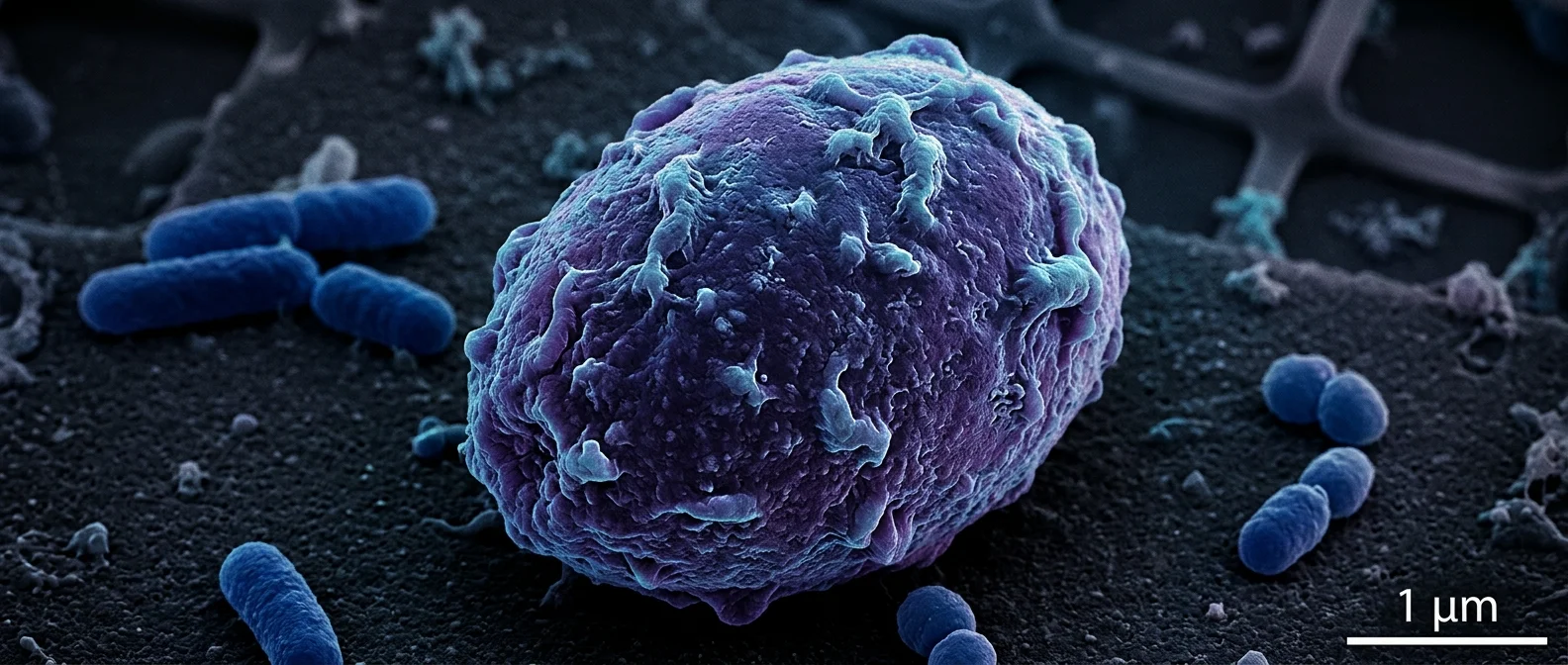
In 1992, a microbiologist in Bradford, England examined a water sample from a cooling tower. Under the microscope, he saw something infecting amoebae that looked like a bacterium — spherical, 750 nanometers, visible with Gram staining. He named it “Bradfordcoccus” and filed it away in a -80°C freezer. Ten years later, Didier Raoult in Marseille revealed it wasn't a bacterium at all — it was a virus. The largest virus ever discovered — and simultaneously one of the most groundbreaking discoveries in 21st-century biology.
Mimivirus: The Discovery That Changed Everything
La Scola et al. published in Science in 2003 the Mimivirus (Acanthamoeba polyphaga mimivirus) — “mimicking microbe virus,” a virus that mimics a microbe. At 750 nm in diameter, it was larger than many bacteria (Mycoplasma genitalium is only 300 nm, Rickettsia 400 nm). Its genome was even more shocking: 1.2 million base pairs (Mb) and 979 protein-coding genes — multiples of a typical virus (e.g., HIV: 9,700 bp, influenza: 13,600 bp). Among the genes were aminoacyl-tRNA synthetases, DNA repair enzymes, and capsid proteins that create a “virus factory” (viroplasm or viral factory) inside the host amoeba — a structure resembling a cell nucleus, with its own membrane and DNA replication. The discovery overturned the basic rule: viruses = small, simple, dependent.
Pandoravirus: Breaking Every Limit
Ten years later, Philippe et al. (Science, 2013) announced Pandoravirus salinus — found off the coast of Chile. With a 2.5 Mb genome and 2,556 genes, it surpassed many eukaryotic parasites. Its morphology was amphora-shaped (1 μm length, 500 nm width) with a pore (ostiole) at one end, through which it injects genomic material into the amoeba — completely different from any known virus. The stunning part: 93% of its genes had no homologs in any database — meaning they don't resemble anything known in biology — not viral, bacterial, or eukaryotic. These “orphan genes” suggest an unexplored genetic heritage possibly older than the three known kingdoms. This led Raoult to propose a “4th domain of life” alongside Bacteria, Archaea, and Eukaryotes — a proposal that remains controversial but shows how disruptive giant viruses are. Later, Pandoravirus dulcis was found in freshwater from a Melbourne lake, with 2,541 genes — proving this isn't an isolated phenomenon but an entire lineage of giant viruses.

Pithovirus: Revival from Ice
In 2014, Legendre et al.'s team extracted from 30,000-year-old Siberian permafrost Pithovirus sibericum — and it infected amoebae in the lab. At 1.5 μm length, it was the largest virus by physical size. Two years later, Mollivirus sibericum was found in the same sample. The ability of these viruses to “revive” after millennia raises concerns: as permafrost melts due to climate change (Siberia is warming 2-3 times faster than the global average), ancient pathogens may be released. However, giant viruses infect amoebae, not humans — the real threat may come from bacteria (anthrax Bacillus anthracis was found in a thawed reindeer in 2016 in Siberia). Pithovirus belongs to an entirely new family — its genome is only 610 kb, much smaller than Pandoravirus, proving that physical size doesn't always correlate with genomic size. The most significant finding: these viruses had maintained their infectivity for thirty thousand years at -18°C.
Genome: Why So Many Genes?
The genes of giant viruses are an enigma. Mimivirus has translation genes (tRNA, aminoacyl-tRNA synthetases) found in no other virus — as if taking “steps” toward independence. Two hypotheses compete: the reduction hypothesis (giant viruses derive from free-living cells that simplified, like mitochondria) and the expansion hypothesis (small viruses that “stole” genes from hosts through horizontal transfer). Phylogenetic analyses (Moreira & López-García, 2009) mainly support expansion: many Mimivirus genes resemble eukaryotic ones, suggesting extensive gene theft during long coevolution with amoebae. A third hypothesis (Forterre, 2006) proposes that giant viruses derive from an ancient pro-eukaryotic cell that lost metabolism but retained reproductive machinery. Medusavirus (2019), named after Medusa because it “petrifies” the amoeba nucleus, carries histone genes — proteins thought exclusively eukaryotic — suggesting that gene exchange between giant viruses and hosts was bidirectional.

Virophages: Viruses That Infect Viruses
The world of giant viruses became even stranger with the discovery of Sputnik (La Scola et al., 2008) — a small viral particle (50 nm) that infects Mamavirus (a Mimivirus relative) inside the amoeba. Sputnik cannot reproduce alone: it needs the giant virus's “virus factory,” just as a virus needs a cell. Its presence reduces Mamavirus production by 70% and increases morphologically abnormal particles — it functions as a parasite of a parasite. Virophages have been found in lakes, seas, and even Antarctic samples. Mavirus, another virophage, integrates into the host DNA and activates only when the giant virus infects the cell — functioning as the amoeba's “immune system” against the giant virus. This tripartite relationship (amoeba → giant virus → virophage) constitutes one of the most complex parasitic networks in biology.
Are They Alive? The Philosophical Question
Giant viruses rekindle a classic question: what is life? “Classical” viruses are considered non-living — they lack metabolism, don't reproduce independently. But Mimivirus has protein synthesis genes, Pandoravirus has a genome larger than parasitic bacteria, and Tupanvirus (2018) has an almost complete translation apparatus — 70 tRNA genes and 20 aminoacyl-tRNA synthetases. Raoult proposed the term TRUC (Things Resisting Uncompleted Classification) for entities that don't fit the living/non-living dichotomy. Some biologists consider giant viruses “retired cells” — remnants of a fourth group that became dependent on parasitism. Tupanvirus, the only giant virus that simultaneously infects multiple amoeba species (Acanthamoeba, Vermamoeba), has a translation machine so complete that theoretically it would need only ribosomes to reproduce autonomously — a final step no virus has taken yet, though it seems theoretically feasible.
Ecological Role and Future
Giant viruses aren't rare curiosities — they're everywhere. Metagenomic analyses reveal giant virus sequences in oceans, lakes, soils, and even the human gut. The GVDB database catalogs over 2,000 genomes. In oceans, giant viruses control phytoplankton populations — a process affecting carbon cycling and oxygen production. Cafeteria roenbergensis virus (CroV) infects marine flagellates and regulates their populations, affecting entire microbial ecosystems. Amoebae hosting giant viruses function as evolutionary “training grounds” — bacterial pathogens like Legionella pneumophila and Mycobacterium evolve inside amoebae, acquiring the ability to infect human macrophage cells.
Biotechnological Applications
Each new discovery (Klosneuvirus 2017, Tupanvirus 2018, Medusavirus 2019) adds complexity. The potential for biotechnological applications exists: giant virus genes could serve in gene therapy (large DNA capacity), enzyme biotechnology, or even designing new antibiotics — the cell lysis enzymes (lysins) used by giant viruses could target resistant bacteria. Researchers are also examining giant virus capsids as drug delivery vehicles — their large capacity (compared to adenoviruses) promises more effective gene therapy. The taxonomic challenge remains: in 2023, the ICTV officially recognized “Nucleocytoviricota” as a separate viral phylum, while new metagenomics tools reveal hundreds of new genomes annually in soil and ocean samples. The world being revealed shows that the original definition “virus = small dependent particle” was simplistic — biology, as always, is more imaginative than any theory. In the depths of every ocean, in every drop of lake water, giant viruses are quietly changing how we understand life on Earth.
Sources:
- La Scola, B. et al. “A giant virus in amoebae.” Science, 299(5615), 2033, 2003.
- Philippe, N. et al. "Pandoraviruses: amoeba viruses with genomes up to 2.5 Mb reaching that of parasitic eukaryotes." Science, 341(6143), 281-286, 2013.