In April 2025, at the Philadelphia Zoo, a tortoise that had lived there since 1932 became a mother for the first time. Her age? Approximately 100 years. Her name — Mommy — wasn't always literal. Now it is.
📖 Read more: Four-Eyed Prehistoric Creature: The Ancestor We All Share
🐢 The Archipelago Named After Tortoises
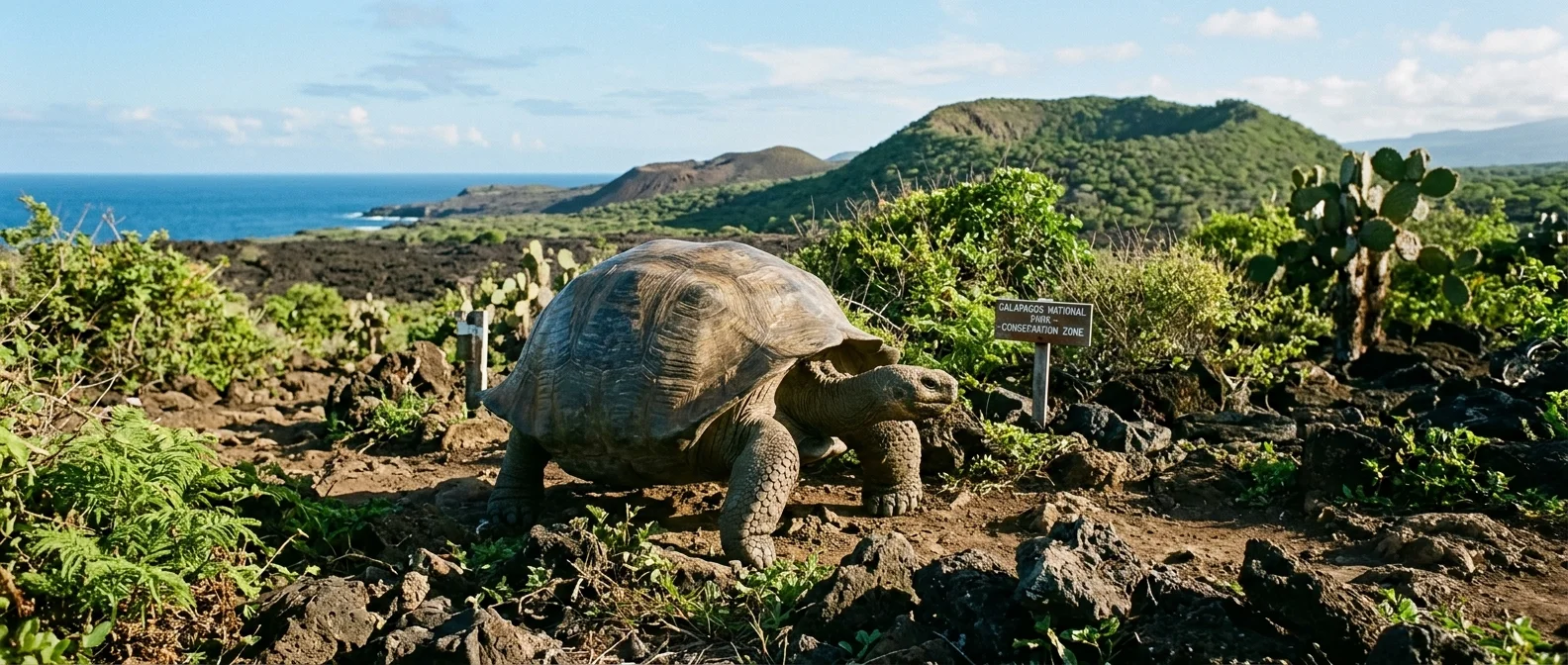
When Spanish sailors explored the Galápagos Islands in 1535, they found massive tortoises moving slowly among cacti and volcanic rocks. There were so many that they named the entire archipelago after them — the word galápago means tortoise in Spanish. At that time, at least 250,000 giant tortoises inhabited the islands. Today, approximately 15,000 remain.
Galápagos tortoises (Chelonoidis nigra) are the largest terrestrial reptiles on the planet. Males reach 1.8 meters in length and 260 kilograms in weight, according to the San Diego Zoo Wildlife Alliance. They live on average over 100 years, while the greatest documented age belongs to Harriet, a tortoise that died at Australia Zoo in 2006 at age 175.
⏳ Why Do They Live So Long?
The longevity of giant tortoises isn't just a statistical quirk. There's biological foundation. Reptiles generally have slower metabolism than mammals, which translates to less oxidative stress in their cells. Tortoises take it a step further: their ability to store large amounts of water in their bodies and survive up to a year without food or water indicates an extremely efficient energy management mechanism.
Here's where it gets interesting. Unlike mammals, reptiles don't always show characteristic signs of aging — a condition biologists call “negligible senescence.” Jonathan, a Seychelles tortoise (Aldabrachelys gigantea hololissa) on Saint Helena Island, was likely born around 1832. At age 191, he's blind from cataracts and has lost his sense of smell. His libido? Thriving, according to his veterinarian, Joe Hollins.
🧬 Negligible Senescence
Many reptiles exhibit “negligible senescence” — minimal signs of biological deterioration over time. Tortoises don't just slow aging. In some cases, they seem to ignore it entirely.
🏝️ The Slaughter That Nearly Wiped Them Out
From the 17th to 19th centuries, pirates, whalers, and traders killed hundreds of thousands of giant tortoises. Estimates suggest 100,000 to 200,000 deaths, according to the Galápagos Conservancy. They killed them for meat, but also for their oil, which they used as fuel for lamps.
The story of Lonesome George became a symbol of this catastrophe. The last representative of the species Chelonoidis abingdonii from Pinta Island, he died in captivity in 2012, at approximately 100 years old. With his death, an entire species vanished from the planet.
Invasive species continue to threaten. Wild pigs, dogs, cats, rats, goats, and donkeys — all introduced by humans — eat eggs, hatchlings, and compete with tortoises for food.

🔬 A Genetic Puzzle with 13 Pieces
Today there are 13 living species of Galápagos tortoises — and each evolved on a different island. The process began 2-3 million years ago, when their ancestors migrated from South America via ocean currents. The islands functioned as natural evolution laboratories — exactly what impressed Charles Darwin when he visited in 1835.
Two basic morphotypes emerged: tortoises with domed shells, living in cooler areas, and tortoises with saddleback shells, inhabiting dry coastal environments. The shape isn't random. Saddleback tortoises have an opening in the front part of their shell that allows them to stretch their necks upward — essential for reaching tall cacti.
One species, Chelonoidis donfaustoi, wasn't even recognized as separate until 2015. Researchers discovered that tortoises on Santa Cruz Island were actually two different species — something no one had suspected for decades.
Domed Shell
Live in cool, humid areas. Feed on grass close to the ground. Larger in size.
Saddleback Shell
Live in dry coastal zones. Can stretch necks for cacti. Smaller body size.
👶 Mother at 100 — And That's Not Unusual
In Philadelphia, a tortoise named Mommy had lived at the zoo since 1932. No one knew exactly how old she was — but estimates put her around 100. For 92 entire years, every visitor to the Philadelphia Zoo had seen her. No one expected what followed.
Abrazzo, a male of approximately the same age, was transferred to Philadelphia in 2020 from Riverbanks Zoo in South Carolina. In November 2024, Mommy laid 16 eggs. The eggs were moved to an artificial incubator — half at temperatures below 28°C (for males) and half above 29.5°C (for females). Initially, only females hatched.
"Before the babies, there were only 44 western Santa Cruz tortoises in all U.S. zoos combined," explained Ashley Ortega, Species Survival Plan coordinator for Galápagos tortoises at Gladys Porter Zoo. “These new additions represent a new genetic line.”
"The team in Philadelphia accomplished something considered impossible."
— Ashley Ortega, Species Survival Plan, Gladys Porter Zoo🌱 7,000 Tortoises in the Wild — The Great Return
In 1959, Ecuador's government established Galápagos National Park to protect the ecosystem. Since then, captive breeding programs have changed everything. The Galápagos Conservancy has bred over 7,000 tortoises in captivity and released them all into the wild.
The most impressive story belongs to Chelonoidis hoodensis, a species from Española Island. It started with just 14 individuals. Today it numbers over a thousand. Fourteen tortoises saved an entire species.

In 2021, scientists confirmed another discovery: a female tortoise of the species Chelonoidis phantastica, thought extinct, was found on Fernandina Island. It was the first confirmed appearance in over 100 years. She was moved to a breeding center, and researchers found tracks suggesting she might not be alone.
🌍 The Slow Power of Evolution
Galápagos tortoises aren't just ancient creatures kept alive with artificial help. They're active members of their ecosystem. They feed on grass, leaves, and cacti, rest 16 hours a day, and disperse seeds through their droppings — a function that cannot be replaced by any other animal on the islands.
They also have a symbiotic relationship with finches, which feed on ticks hiding in the folds of their skin or on their shells. This interaction reaches the point where tortoises rise on their legs and stretch their necks — a posture that signals to birds they're ready for “cleaning.”
Slow Metabolism
Travel at 0.26 km/hour. Can live without food or water for up to a year.
Seed Dispersal
Seeds passing through their digestive system germinate more easily. Without tortoises, the entire plant landscape changes.
🔮 A Future That Depends on Us
Today, most giant Galápagos tortoises are classified as “vulnerable” or “critically endangered” on the IUCN Red List. They're legally protected by both Ecuador's legislation and the CITES Convention, which prohibits all international trade.
Mommy in Philadelphia, Jonathan on Saint Helena, the 7,000+ tortoises that returned to the islands — every story proves something simple. That conservation works. But it only works when humans decide to act. Fourteen tortoises were enough to save a species. If no one had found them in time, they would no longer exist.