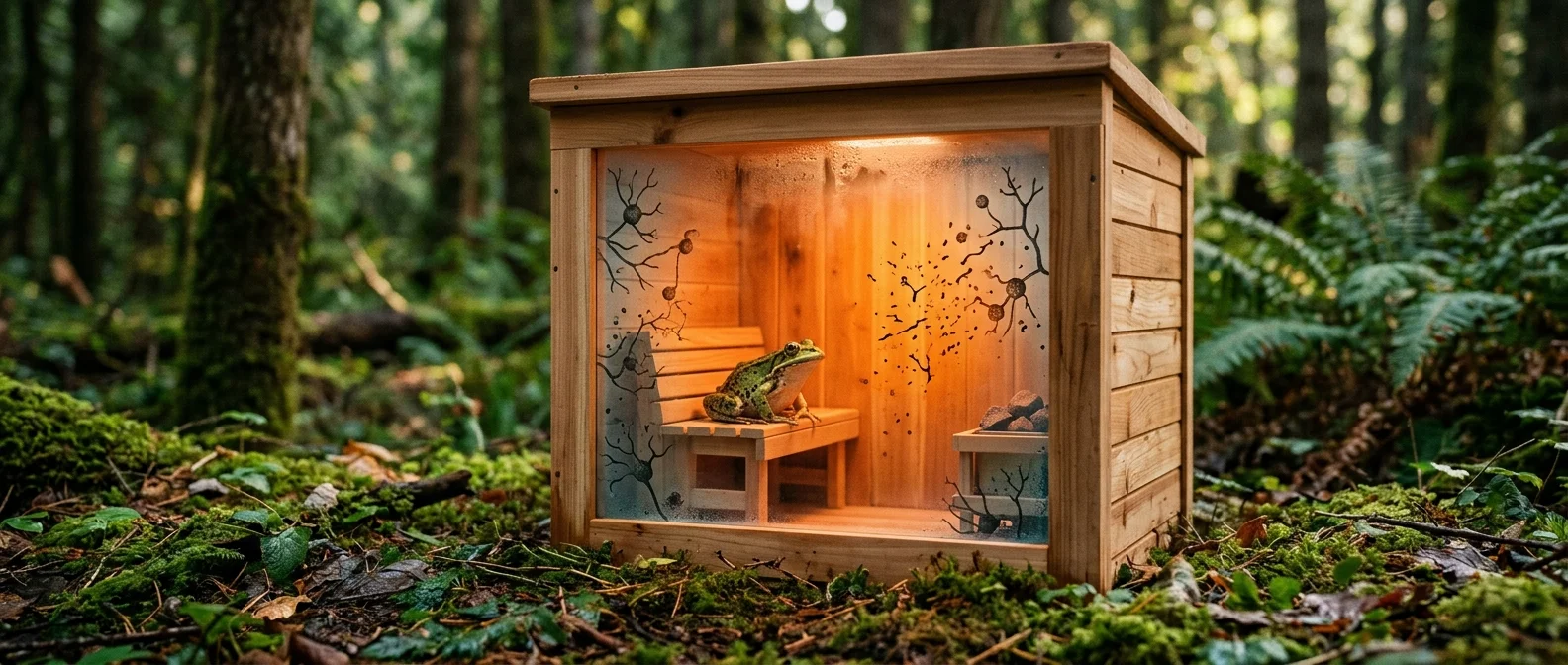
In an Australian rainforest, a tiny frog climbs onto a sun-baked rock. It's not sunbathing — it's doing chemotherapy. The rock reaches 30°C, hot enough to kill the fungus that's wiping out amphibians across the planet. While millions of frogs die from chytridiomycosis, some have discovered a simple secret: mini-saunas made of warm rocks, hot springs, and sun-drenched clearings.
The Fungus Killing Amphibians Worldwide
Batrachochytrium dendrobatidis (Bd) is the most destructive pathogen ever recorded in wildlife history. It belongs to chytrid fungi (Chytridiomycota) — an ancient group that's existed for 500 million years and is the only one producing motile zoospores with flagella (almost all other fungi spread through airborne spores). The Scheele study in Science (2019) — the largest assessment of pathogen damage to wild fauna — documented that Bd is responsible for declining over 501 amphibian species across 6 continents. At least 90 species are now considered extinct and 124 declined by over 90%. No other single pathogen — virus, bacterium, or parasite — has caused such massive biodiversity loss in recorded history.
Bd attacks the keratin layer of skin — critical for amphibians since they breathe through it and absorb water (frogs don't drink — they absorb moisture through skin). The fungus's zoospores (motile spores with flagella) invade keratinocytes, multiply inside sporangia, and burst the cell releasing new zoospores. The cycle takes 4-5 days. The result: skin thickening (hyperkeratosis) that disrupts osmotic regulation — the frog dies from cardiac arrest due to electrolyte imbalance (hypokalemia).
Thermal Refugia: The Frogs' “Sauna”
Bd thrives at 17-25°C and dies above 28-30°C — in 4 hours at 30°C, 95% of zoospores die. This temperature sensitivity is its Achilles heel. Researchers in Australia, Central America, and Europe discovered that frog populations in areas with access to thermal microhabitats — sun-heated rocks, clearings, shallow ponds, hot springs — show significantly lower Bd loads (measured with qPCR on skin swabs) and higher survival rates.
The idea was inspired by "behavioral fever": ectothermic animals (that don't internally regulate temperature) seek warm spots to raise body temperature and fight infections. Locusts do it, lizards too — but discovering that frogs use this strategy against a pandemic fungus was groundbreaking.

Artificial Saunas: Bricks and Greenhouses
The transition from observation to action was swift and ingenious. Research teams in Australia placed artificial thermal refugia — black bricks that absorb heat, stone slabs, even small greenhouses made from transparent acrylic sheets — in habitats of threatened species. Results were encouraging: frogs using the refugia showed 60-80% reduction in Bd loads, while populations in areas without refugia continued declining. The cost is minimal: a black brick costs less than $1, needs no electricity, requires no maintenance, and works autonomously for years.
The key is temperature cycling: the frog doesn't need permanent heat — just a few hours daily above 25°C to kill sporangia before they can release new zoospores. The “sauna” must be near water (frogs dehydrate quickly) and provide hiding spots from predators (birds, snakes).
The Bd Story: From Korea to the World
Whole-genome genetic analyses traced Bd's origin to the Korean Peninsula — likely in the late 19th or early 20th century. The panzootic lineage (BdGPL — Global Panzootic Lineage) spread worldwide through amphibian trade: millions of Xenopus laevis (African clawed frog) were exported alive for pregnancy tests (Hogben test, 1930s-1960s): pregnant women's urine caused ovulation in Xenopus, confirming pregnancy. Xenopus carries the fungus without symptoms — a perfect asymptomatic carrier. Later, pet trade, frog legs, and laboratory specimens spread Bd to every continent except Antarctica.
In 2013, a second species was discovered: Batrachochytrium salamandrivorans (Bsal), which attacks salamanders — particularly in Europe, where fire salamander populations (Salamandra salamandra) were wiped out in Belgium and the Netherlands.

Natural Resistance: Antimicrobial Peptides in Skin
Some frogs don't need saunas — they have built-in antifungal systems in their skin. Many amphibians' skin produces antimicrobial peptides (AMPs) — small proteins, usually 10-50 amino acids, that puncture Bd membranes and cause cell lysis. Species like Litoria caerulea (Australian tree frog) produce caerin 1.1 — a peptide lethal to Bd even at low concentrations. The African Xenopus produces magainin — an antimicrobial so potent it was studied as a drug against resistant bacteria (MRSA). Over 600 different AMPs have been cataloged in amphibians — one of nature's richest sources of antimicrobials.
Meanwhile, the skin's microbial community (microbiome) plays a crucial role. Bacteria of the genus Janthinobacterium lividum produce violacein — a purple antifungal compound that inhibits Bd by disrupting zoospore membranes. Probiotic therapy (bathing frogs in J. lividum cultures for 24 hours before release) is already being tested in North America and Australia as a rescue strategy, with encouraging results mainly in tree frogs. The challenge is that bacteria must permanently establish in the microbiome — something that depends on temperature, pH, and skin structure of each species.
Climate Change: Friend or Foe?
The climate-Bd relationship is paradoxically complex and doesn't follow simple predictions. Warmer temperatures could theoretically kill the fungus — but climate change also increases cloud cover in tropical mountains (cloud forests), lowering microhabitat temperatures and increasing humidity — ideal conditions for Bd. In Costa Rica, where Bd wiped out 40% of amphibian species in the 1980s, the worst losses occurred in mountain forests above 500m elevation — precisely where temperatures are ideal for the fungus and thermal refugia are rare. Climate change may thus simultaneously help (warming lowlands) and harm (changing mountain microclimates).
Vaccines and Gene Therapy
Researchers are testing amphibian vaccination: exposure to dead zoospores (fungus killed with heat or formaldehyde) or live attenuated strains activates immunological “memory” in some species. The immune response relies mainly on IgY antibodies (mammalian IgG equivalent) and increased lymphocytes in skin. Effectiveness varies dramatically between species — Litoria caerulea develops strong immunity, while in Atelopus zeteki (Panamanian golden frog) the immune response isn't sufficient — perhaps because Bd evolved to locally suppress immune response through immunosuppression.
Gene editing (via CRISPR) is being examined in early stages: enhancing expression of antimicrobial peptide genes or modifying keratin to reduce zoospore binding. Practical application in wild populations, however, remains distant — but mini-saunas work now, are cheap, and can be installed tomorrow.
Hope in Thermal Refugia
The solution doesn't always need high technology. Sometimes, a warm rock in the right place is enough. In Queensland, populations of Litoria nannotis (waterfall frog) stabilized after thermal refugia placement near streams. In Mexico, the critically endangered Ambystoma altamirani benefits from similar interventions in mountain streams. The strategy is already being applied in Spain for the midwife toad (Alytes obstetricans) and in Panama for golden frogs (Atelopus zeteki) — one of the planet's most threatened species. Dozens of captive populations (assurance colonies) are maintained in zoos worldwide, waiting for the moment when thermal refugia will make their return to the wild safe. The battle against Bd hasn't been won — but the frogs showed us the way: sometimes, nature heals itself if you give it the right tools.
Sources:
- Scheele, B.C., Pasmans, F., et al. (2019). “Amphibian fungal panzootic causes catastrophic and ongoing loss of biodiversity.” Science, 363(6434), 1459-1463. DOI: 10.1126/science.aav0379
- Sauer, E.L., Sperry, J.H., et al. (2024). “Thermal refugia enable frog resistance to chytrid fungus.” Nature. DOI: 10.1038/s41586-024-07582-y