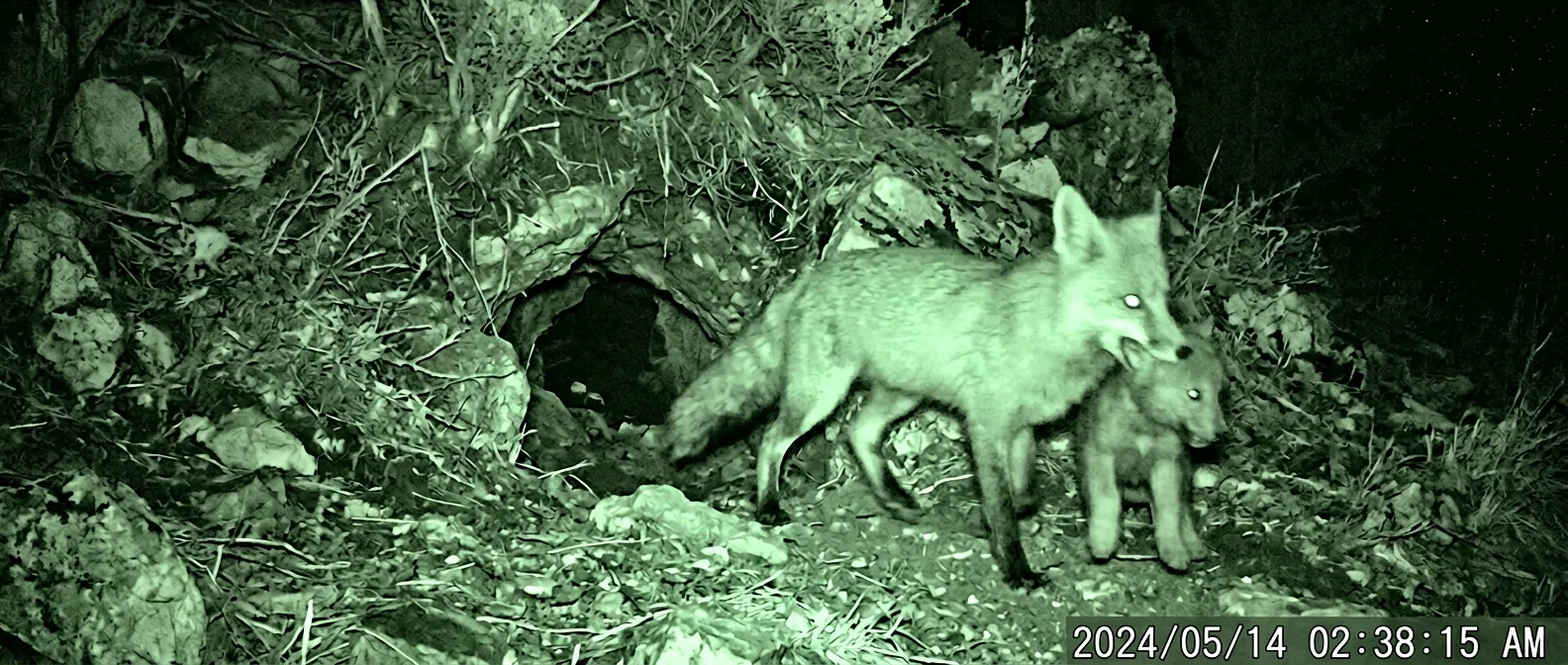
A night vision camera at a nature reserve near Rome captured something no one had ever filmed before: a red fox boldly entering a wolf den and snatching a newborn pup. What does this shocking footage reveal about predator-prey relationships in European forests?
📖 Read more: Dolphins Sleep with Half Their Brain Awake
🦊 The Scene That Stunned Scientists
In May 2025, at the Castelporziano Presidential Estate — a nature reserve just 25 kilometers from Rome — a night vision camera recorded “striking” footage. A red fox (Vulpes vulpes) invaded a secondary den of gray wolves (Canis lupus) and seized a wolf pup roughly one month old. In the video, the fox appears to drag the small pup spasmodically backward, exiting the den.
The study documenting this event was published on February 13, 2026, in the scientific journal Current Zoology. This marks the first time such predation has been recorded on video globally — an upending of everything we knew about fox-wolf relationships.
🐺 Monitoring the Wolf Den
Scientists were monitoring a pack of gray wolves at Castelporziano as part of a long-term research program led by Marco Apollonio, professor at the University of Sassari. They had spotted a female wolf with a swollen belly, while GPS data showed she repeatedly visited a secondary den — a sign she had already given birth.
The team, supervised by Celeste Buelli, a doctoral student, placed night vision cameras around the den to monitor birth and pup survival. Tracking birth rates and survival is vital for understanding long-term population dynamics — but it's not easy. What they ultimately captured on camera left them speechless.

📹 What the Night Vision Camera Recorded
In the black-and-white night vision footage, the fox appears silently at the wolf den entrance. It makes an initial attempt to drag the pup, fails, and retreats. On the second, more determined attempt, it manages to grab the small pup and begins pulling it spasmodically outward, moving backward. The video cuts there, without showing if the fox managed to escape completely with its prey. However, in later footage captured by the same camera, only one pup appears in the den — there had been two before.
Rudy Brogi, co-researcher at the University of Sassari, explained to Live Science that the fox likely ate the wolf pup. Foxes are opportunistic predators — they don't depend on a specific prey species but adapt their diet according to food availability.
🔬 An Upset in the Food Chain
David Macdonald, a zoologist at Oxford University with decades of fox research, commented that competing species may kill or prey on each other — but this “generally involves larger canids harassing or killing smaller ones.” Here, exactly the opposite happens: a smaller canid preys on the young of a much larger one, exploiting the absence of adult wolves to enter the den. The fox exploited the vulnerability of a newborn pup that couldn't even react.
Could the fox simply be removing a future competitor, rather than seeking food? Brogi considers this scenario unlikely, as foxes often benefit from wolves by eating the remains of their hunts. Eliminating a future wolf would remove a food source. Most likely, the fox treated the pup as immediate food — an opportunity it couldn't ignore.
🏛️ The Castelporziano Reserve
The Castelporziano Presidential Estate is one of central Italy's most important nature reserves. It spans thousands of hectares of Mediterranean forest, coastal zones, and meadows, just kilometers from the Mediterranean Sea. It provides a unique habitat where wolves, foxes, wild boar, and dozens of other species coexist in a relatively closed and protected ecosystem, away from human interference.
Continuous wolf monitoring there is part of a broader University of Sassari program aimed at understanding wolf population dynamics in Italy. The country has experienced significant gray wolf recovery in recent decades — from a few hundred in the 1970s to over 3,300 today — making such studies crucial for biodiversity management and reducing human-wolf conflicts.

🦊 The Red Fox: A Brilliant Predator
⚖️ Fox vs Wolf: Who Wins?
In a head-to-head confrontation, an adult gray wolf (30-80 kg) overwhelmingly dominates a red fox (3-14 kg). However, the fox compensates with agility, cunning, and opportunism. In this case, the fox didn't need to defeat anyone — it targeted a helpless one-month-old pup, proving that strategy beats size.
Distribution
Forests, grasslands, mountains, deserts — even urban areas on every continent. IUCN status: Least Concern.
Diet
Rodents, rabbits, birds, frogs, worms, fruits, garbage — and now wolf pups.
Reproduction
Winter mating, births of 2-12 kits. Born brown or gray — red fur after the first month.
Intelligence
Legendary cunning — mark territories with urine, use tail as signal and heater.
📊 Why Do Wolf Pups Die?
Mortality in wolf pups is extremely high: each year, 40% to 60% of newborn pups don't survive. Main causes are starvation, disease, extreme weather, and poor physical condition. Until now, predation by smaller carnivores wasn't considered a significant factor — this video shows it may play a small but real role in mortality rates.
💡 Why is this recording so rare?
Direct observations of wolf pup deaths are extremely rare because the young live their first weeks inside hard-to-access dens. Celeste Buelli called the footage “striking” — an “intense event with a very young animal” rarely captured on camera.
Whether this behavior is common remains uncertain and requires significantly more data. Brogi noted it's “reasonable” that it happens more often than reported in literature, but extensive data from “multiple dens and contexts” is needed to draw safe conclusions. A single recording, however impressive, isn't enough for definitive conclusions about this phenomenon's frequency.
🌍 What This Discovery Means
This video didn't just change the data on fox-wolf relationships — it changed how we understand food chains in European ecosystems. The idea that only larger predators kill smaller ones isn't always true. In nature, opportunity matters as much as size. A small, cunning, and fast predator can become lethal to the young of a much larger mammal — if the timing is right and the parents are absent.
The return of wolves to Italy and other European countries brings new dynamics to ecosystems. As wolf populations increase, every mortality factor becomes more significant for their conservation. Recording such rare interactions helps biologists better understand how these species' coexistence evolves — and how we can manage their populations most effectively for the biodiversity of the entire continent.
Sources:
- Live Science — 'Striking' footage captures the moment a red fox preys on a wolf pup
- National Geographic — Red Fox Facts