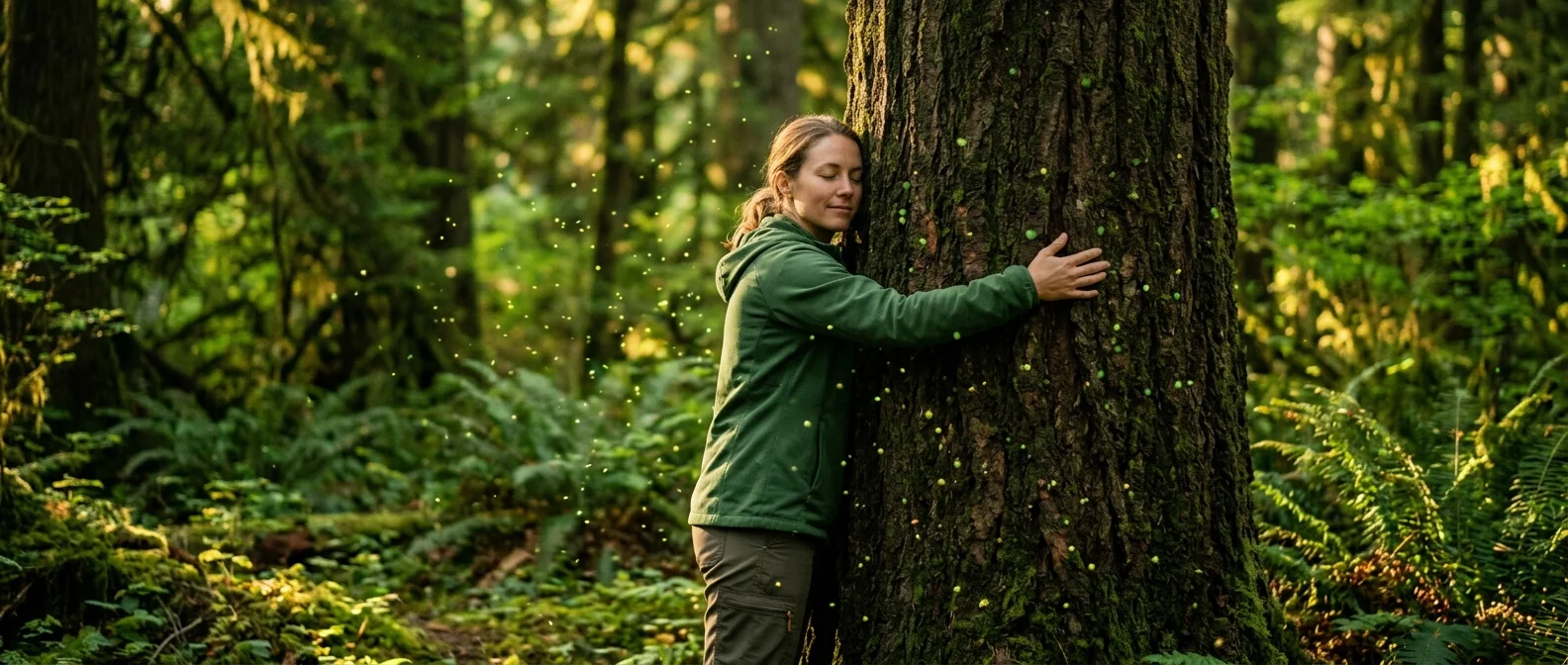
Walk into a pine forest and something shifts. The air smells like wet earth and resin, sound drops away, your breathing deepens. This isn't just a "nice feeling" — it's biology. The Japanese call this experience shinrin-yoku, "forest bathing," and scientific studies show trees actually reduce cortisol, blood pressure, inflammation — even boost your immune system's killer cells. You don't need pills. You need forest. And science proves it. You don't even need tropical rainforest — any Greek pine grove will do on a weekend. What's remarkable is that science confirms what our grandmothers always knew: trees heal.
📖 Read more: Antarctica Loses Ice the Size of 2 Countries
📖 Read more: Forest Die-Off Crisis: Why Millions of Trees Are Dying
Shinrin-Yoku: The Japanese Forest Bath
Forest therapy was born in Japan in 1982, when the Forest Agency introduced the term shinrin-yoku as a public health program. The idea was simple: slow walk through forest, no phone, no destination, no rush. Just senses. Today, Japan has 62 certified "therapeutic forests" and shinrin-yoku is recognized medical practice. This isn't hiking or exercise — it's slow, mindful presence in nature. The Japanese Society of Forest Medicine spent millions on clinical studies over the past 20 years, and results were consistently positive. Between 2004 and 2012, over 100 published studies confirmed shinrin-yoku benefits across different populations: office workers, elderly, children, type 2 diabetes patients. Shinrin-yoku has now spread to 19 countries, with certified forest therapists in Germany, Australia and Canada.
Cortisol and Blood Pressure: What the Data Shows
Qing Li's study in Environmental Health and Preventive Medicine (2010) measured salivary cortisol levels in 280 adults before and after three-hour forest walks — the reduction averaged 16%, significantly greater than equivalent urban walks. Simultaneously, blood pressure dropped 2-5 mmHg, heart rate variability improved (a sign of calm), and urinary adrenaline levels were lower. This reduction wasn't just psychological — it was measurable in blood and urine, with lab precision. Effects lasted at least 7 days after the forest visit. In a controlled study, people who walked in shopping malls for the same duration showed no improvement — the forest made the difference, not movement.

📖 Read more: 385-Million-Year-Old Forest Discovered Hidden in Stone
NK Cells: Trees Boost Your Immune System
Something that surprised even skeptical researchers: after a three-day forest program, Natural Killer (NK) cells — the ones that recognize and destroy cancer cells and virus-infected cells — increased 50% and stayed elevated for 30 days. The cause? Phytoncides — volatile compounds like α-pinene, limonene and camphor that coniferous trees emit. In vitro experiments showed phytoncides increased NK cells even in closed rooms. This means trees don't just calm you psychologically — they literally strengthen your body's defenses. This is perhaps the most stunning finding of forest therapy: that simple presence in forest enhances anti-cancer immune activity without any drug. The NK cell increase comes with increased granulysin and perforin proteins, which help destroy cancer cells and virus-infected cells.
📖 Read more: Insect Apocalypse: Will the Food Chain Collapse?
Phytoncides: The Chemistry of Forest
Phytoncides are volatile organic molecules that trees emit for self-protection — against fungi, bacteria and insects. In dense coniferous forest, their concentration can reach several micrograms per cubic meter of air. The human body inhales them and responds: proteins controlling anti-cancer activity (granzymes, perforins) increase, while cortisol and adrenaline decrease. Pines, firs, cypresses and eucalyptus produce the most phytoncides — that's why coniferous forests are considered more "therapeutic" than deciduous ones. However, deciduous forests also offer benefits: green color, leaf sounds, humidity and lighting have independent therapeutic value. A German study found even the sound of rain on leaves lowers heart rate — something no city sound achieves.
📖 Read more: Kazakhstan Plants 37,000 Trees to Restore Tigers After 70 Years
Mental Health: Depression, Anxiety, ADHD
Forest therapy doesn't just help the body. Studies in Scandinavia, South Korea and Germany show improvement in depressive symptoms, insomnia, anxiety disorders — even ADHD in children. A University of Illinois study (2009) showed 20 minutes of play in green space reduced ADHD symptoms with effectiveness similar to medication. "Attention Restoration Theory" (ART) explains why: nature doesn't require directed attention — it lets the brain rest. In an age of overstimulation, constant connection and information overload, forest functions as digital detox — without therapy stigma. The difference is measurable in sound: in forest, noise drops to 35-40 dB (like whisper), while urban streets reach 75-85 dB. This acoustic calm allows the nervous system to shift into parasympathetic mode — the mode of rest and repair.

📖 Read more: Spiders Mimic Ants: The Perfect Disguise
Hospitals and Green: The Ulrich Study
Roger Ulrich published a landmark study in Science in 1984: patients who see trees from hospital windows recover faster, need fewer painkillers and have fewer complications compared to those facing walls. This study changed hospital design worldwide. Today, many hospitals in Japan, Scandinavia and the US incorporate therapeutic gardens. Biophilic architecture — bringing nature into buildings and care spaces — is now considered good medical practice, and more architects use it. In Spain, Vall d'Hebron Hospital in Barcelona has a therapeutic garden where patients spend time daily, and recovery outcomes are measurably better.
📖 Read more: Squirrels Plant Millions of Trees by Accident
Greece: Firs, Pines, Therapeutic Trails
Greece has ideal conditions for forest therapy: dense fir forests in Parnon, cedar forests in Crete, pine forests in Evia and aromatic maquis in Mani. Greek conifers produce phytoncides in high concentrations, especially during warm months. Small forest therapy programs already exist on Olympus and in Rhodope, though without official state recognition yet. The Greek Forest Therapy Society advocates for integration into mental health programs. Greek forests have very high phytoncide concentrations due to temperature and sunshine — ideal conditions for biological activity. Compared to Scandinavia, Greek forests have the advantage of sun — light enhances vitamin D, complementing phytoncide benefits.
Forest or Pill? The Answer Isn't Simple
Forest therapy doesn't replace medication — but complements it. In Scotland, doctors already "prescribe" nature walks to patients with depression and chronic pain. In Japan, insurance companies cover forest therapy programs. Data shows just 2 hours in forest per week is enough for measurable benefits. This isn't luxury — it's public health. Every tree cut doesn't just remove oxygen — it removes a healing opportunity. Forest therapy isn't luxury — it's prevention. And in Greece, where 60% of land is forested, the "medicine" is already free — just walk to the nearest forest and breathe slowly. Every time you ignore a forest 20 minutes from home, you ignore free therapy that science has already documented. The human-forest relationship isn't romantic — it's biochemical. Trees speak to us through volatile molecules, colors, sounds — and our bodies respond with calm, health and empowerment. The simplest way to start? Find pines. Walk slowly. Breathe deeply.
"If a doctor could prescribe a forest, it would be the most effective medicine in the world."
— Qing Li, immunologist, Nippon Medical School, TokyoSources:
- Li, Q. — "Effect of forest bathing trips on human immune function", Environmental Health and Preventive Medicine, 2010
- Ulrich, R. S. — "View through a window may influence recovery from surgery", Science, 1984