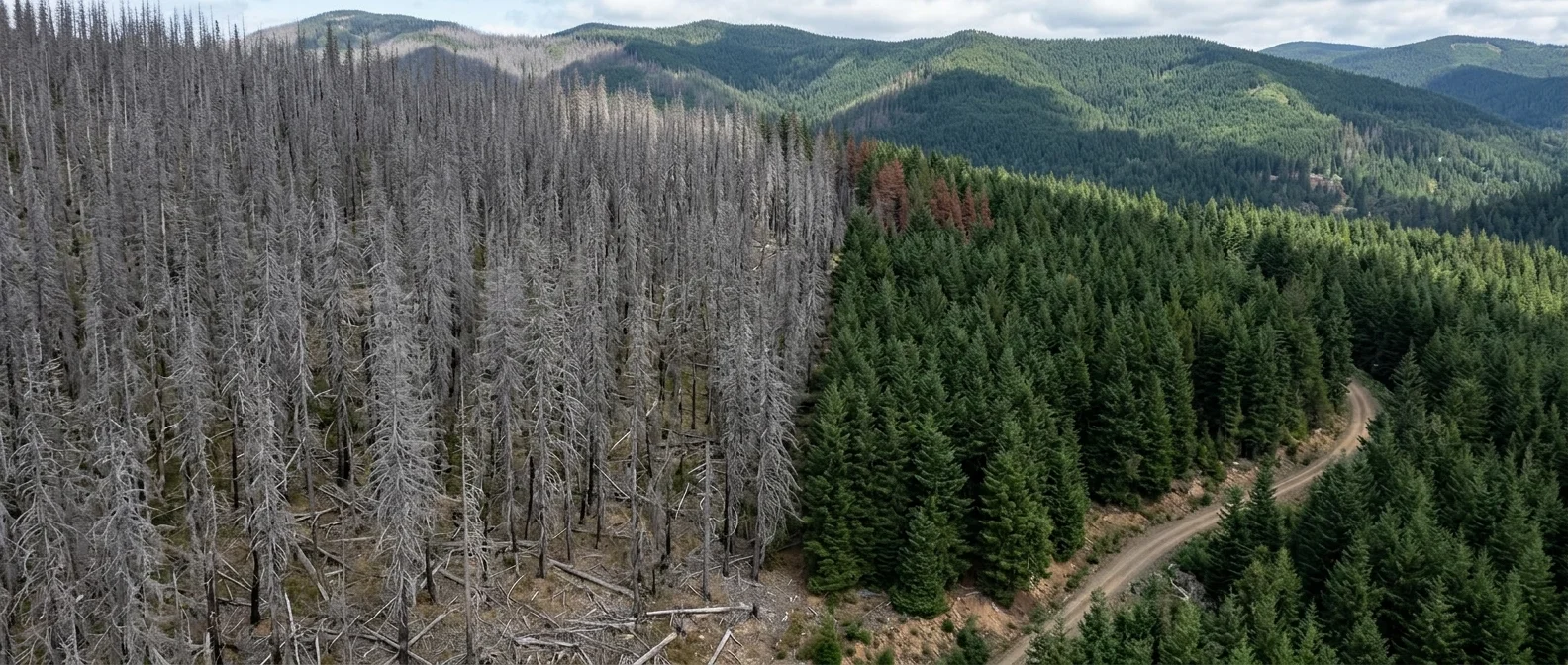
Driving down the highway between two mountains I remembered as green, half the trees were now brown. Nobody was talking about it — no headlines, no documentaries, no alarm bells. Forests are dying silently, without fire, without screams. And this death accelerates every year. What we see on the hillsides is just the tip of a crisis unfolding beneath the bark.
📖 Read more: Kazakhstan Plants 37,000 Trees to Restore Tigers After 70 Years
The Silent Forest Pandemic
From North America to Siberia and from Mediterranean Europe to the Amazon, forests face mass tree mortality on a scale never recorded in modern history. In the western United States alone, over 129 million trees died between 2010 and 2021 according to satellite estimates from the U.S. Forest Service (USFS). Germany announced that only 21% of its trees showed no signs of damage in 2022 — the lowest percentage since measurements began in 1984. This crisis isn't caused by one factor but by a combination of forces that amplify each other, creating what scientists call “multifactorial forest mortality.” The most disturbing aspect isn't the rate — it's the geographic scale. This isn't a local phenomenon. Forests in completely different climates, with completely different species, are simultaneously suffering from similar symptoms.
Bark Beetles: The Invisible Executioners
The European spruce bark beetle (Ips typographus) was once a rare phenomenon — small outbreaks that healthy forests handled easily. Today, this microscopic beetle the size of a grain of rice kills millions of trees annually in Central Europe. The Czech Republic has lost over 150 million cubic meters of timber in one decade — more than the entire annual normal harvest. The problem? Mild winters stopped killing the larvae. Previously, temperatures below -4°F for several days would wipe out populations. Now, beetles reproduce two or even three times per summer season instead of once. And a single female can lay 100 eggs under the bark. The wooden “galleries” that larvae carve disrupt nutrient flow in the tree, causing slow strangulation. Within weeks, the bark peels away and the tree dies standing, like a skeleton.

Drought: When Trees Die of Thirst
Trees can't move. When drought hits, their only defense is to close their stomata — the microscopic openings in leaves that exchange gases. This stops photosynthesis but prevents water loss. If drought continues, trees begin showing "hydraulic failure": air bubbles form inside wood vessels (xylem), disrupting water flow from roots to leaves. A study published in Nature (Choat et al., 2012) analyzed 226 tree species and found that 70% already operate close to their hydraulic safety margin — even under normal conditions. A prolonged drought is enough to push them beyond the point of no return. Trees that suffered hydraulic failure don't recover — even if it rains again, damaged vessels don't repair themselves. The 2018 drought in Germany killed trees whose roots had been in the same soil for centuries.
Climate Change: The Risk Multiplier
Climate change doesn't kill trees directly — it amplifies every other threat. Higher temperatures increase water evaporation from soil, making droughts worse. Warmer winters allow bark beetles to multiply unchecked. Wildfires become more frequent and intense. The landmark study by Allen et al. (2010) in Forest Ecology and Management documented episodes of mass tree mortality on every forested continent. Australia saw massive eucalyptus die-offs in the Murray-Darling basin, Siberia is losing taiga areas larger than small countries, and in the Mediterranean, pines suffer from temperatures they haven't faced in their evolutionary history. Climate change's role is no longer debatable — it's the central lever behind the forest crisis.
📖 Read more: Mediterranean Corals Turn White: What's Happening in 2026
Wildfires: The Self-Feeding Cycle
Dead trees don't disappear — they become fuel. A slope full of dry trunks is a bomb waiting for a spark. In California, the largest wildfires in state history (Camp Fire 2018, Dixie Fire 2021) erupted in areas with massive accumulations of dead biomass. But fire doesn't end the cycle — it restarts it. Burned forests lose their shade, soil heats up more, moisture evaporates faster, and young trees trying to sprout face much harsher conditions. In some areas of the Rocky Mountains, post-fire forests no longer regenerate — they're permanently replaced by shrubland or bare soil. This non-regeneration is considered one of the most disturbing phenomena in modern ecology — it signals permanent change in the vegetation type a landscape can support.

What We Lose With the Forests
Every tree is a small factory. It absorbs CO₂, produces oxygen, filters water, stabilizes soil, and hosts hundreds of species. Earth's forests absorb about 2.6 billion tons of CO₂ annually — nearly 30% of human emissions. When they die, they don't just stop absorbing — they start emitting. The decomposition of billions of dead trees releases massive amounts of stored carbon. Siberia provides a disturbing example: the taiga, the largest terrestrial ecosystem, is beginning to transform from a “carbon sink” to a “carbon source” — a reversal that could dramatically accelerate global warming. Meanwhile, forest loss increases soil erosion, lowers water tables, and destroys habitats for thousands of species that depend exclusively on forest cover.
Is There Hope? What Can Be Done
Reforestation isn't enough if we plant the wrong trees in the wrong places. Spruce monocultures in Germany — millions of trees planted in rows like soldiers — proved to be a buffet for bark beetles. The solution lies in "forest transition": replacing monocultures with mixed forests of multiple species, adapted to future climate conditions. Countries like Slovenia and Austria are already implementing this model. Satellite monitoring technology now allows us to detect early signs of tree stress before they become visible to the naked eye. But real change starts with us — reducing emissions, sustainable forestry, and resistance to virgin forest logging can still make a difference. And perhaps the most important change is the simplest: learning to see forests — really see them. Not as scenery but as living ecosystems that need care and protection.
Time Is Running Out — The Silence Must Break
Forests don't cause earthquakes, don't flood cities, don't appear on news bulletins. They die slowly, tree by tree, slope by slope, until one day you look at a mountain you see every morning and don't recognize it. Forest mortality represents a fundamental failure in our relationship with nature — we take forests for granted until they disappear. Every tree that falls silently is another proof that the climate crisis isn't a future threat — it's happening now, right before our eyes. The question isn't whether we can reverse the damage. The question is whether we'll choose to try before it's too late.
«A forest doesn't disappear in one day — it disappears in a thousand days of indifference.»
— Craig D. Allen, USGS researcher, forest mortality specialistSources:
- Allen, C.D. et al. — «A global overview of drought and heat-induced tree mortality reveals emerging climate change risks for forests», Forest Ecology and Management, 2010
- Choat, B. et al. — «Global convergence in the vulnerability of forests to drought», Nature, 2012