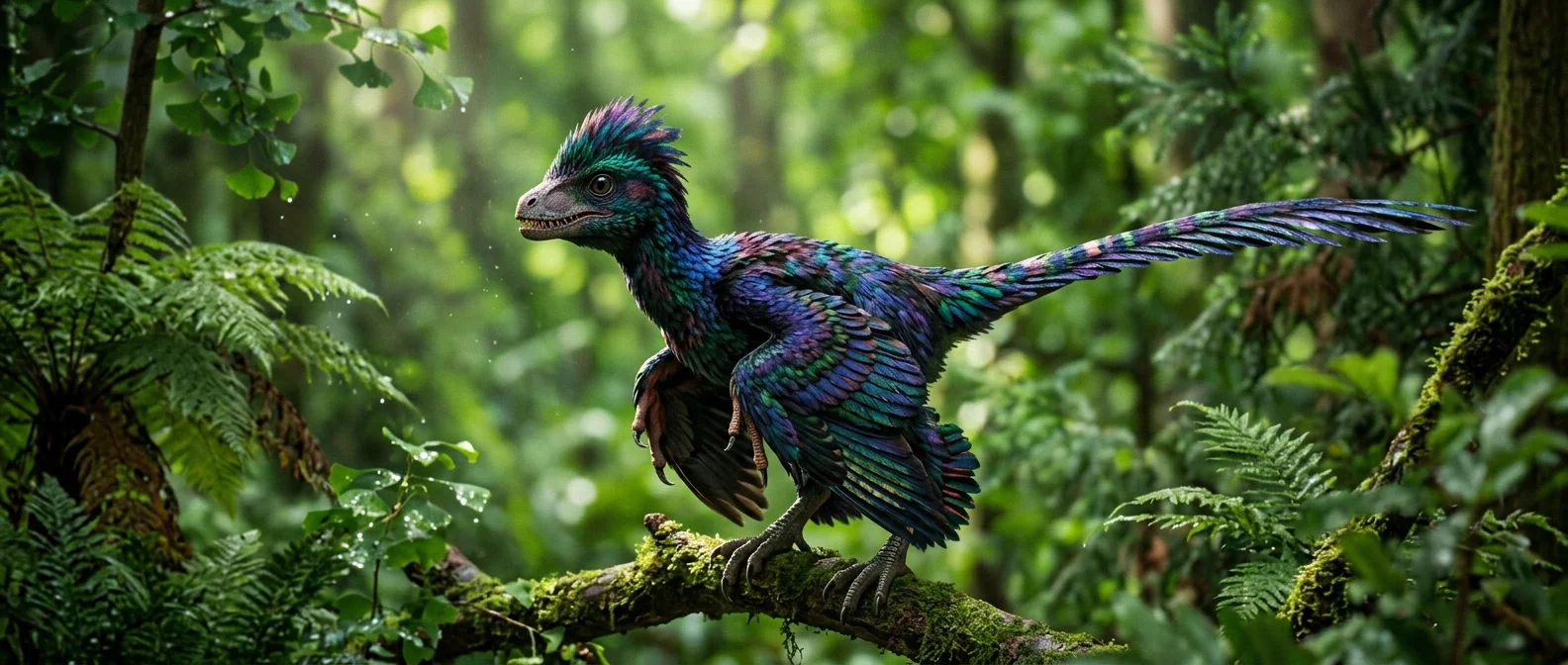
The Discovery That Rewrote Biology Textbooks
For over a century, our image of dinosaurs remained fixed: massive reptiles with smooth, scaly skin in drab greens and browns. A Hollywood-inspired vision—impressive but completely wrong. Today we know many dinosaurs had feathers. Not necessarily flight feathers—but all kinds of feathered structures, from fine filamentous fuzz to full plumage. This discovery didn't arrive overnight. It came in waves, each more revolutionary than the last.
1860: Archaeopteryx and the First Clue
The story begins in Bavaria, Germany, in the early 1860s. Within limestone deposits from the Late Jurassic period, skeletons of a small creature with complete feathers were discovered—Archaeopteryx. It was a being that combined reptilian features (teeth, vertebral tail, claws on wing fingers) with bird characteristics (flight-capable feathers). It was considered the first known bird—and simultaneously opened a question: if birds descended from dinosaurs, when did feathers first appear?
For decades, Archaeopteryx remained unique—a “peculiar fossil” without similar finds. No other Mesozoic reptile had been found with integumentary coverings. The origin of birds remained a mystery.
1970: John Ostrom and the Bird-Dinosaur Connection
The first major breakthrough came in the 1970s when American paleontologist John Ostrom, studying a small theropod dinosaur he named Deinonychus, reached an explosive conclusion: birds don't just resemble dinosaurs—they are dinosaurs. Ostrom proposed that feathers might have evolved as extensions of fringed reptilian scales—an idea that became widely accepted at the time. However, there was no evidence. No dinosaurian relative of Archaeopteryx had been found with any kind of body covering.
1996: China Changes Everything — Sinosauropteryx
In 1996, during the annual meeting of the Society of Vertebrate Paleontology in New York, Chinese paleontologist Chen Pei-ji presented photographs of an astonishing fossil. A small carnivorous dinosaur from the Jehol deposits of Liaoning, northeastern China, dated to the Early Cretaceous (~126 million years ago). It was named Sinosauropteryx—"Chinese lizard wing."
What made the find historic: the head, neck, back, and tail of the animal were covered with dense, short fuzz of dark filamentous structures. These weren't feathers in the modern sense—they lacked branches, barbs, or aerodynamic structure. They were something more primitive: simple keratinous filaments, like coarse hair. But they were undeniably integumentary—they belonged to the animal's body, not the sediment.
After Sinosauropteryx: A Wave of Discoveries
After 1996, Liaoning began producing feathered dinosaur fossils at a pace no one expected. Each new find added a piece to the puzzle.
Caudipteryx: An oviraptorosaur with long feathers on its fingers and wrists—structures resembling modern bird feathers but without flight capability. Related fossils from Mongolia have been found sitting atop egg nests, with fingers spread like a brooding parent over the eggs. This connection suggests that an early function of long feathers was incubation—warming and protecting eggs.
Microraptor: Discovered in 2000 in the same deposits. It had long feathers on both arms and legs—a four-winged creature. Some researchers proposed that flight evolved through a stage of four-winged gliding. However, Microraptor's phylogenetic position shows it diverges from the line that led to birds—so its four-winged state is likely an independent evolution.
Confuciusornis: A bird more advanced than Archaeopteryx, with a short tail and pygostyle (fusion of terminal vertebrae). Some specimens bear two long tail feathers shaped like teardrops—likely sexually dimorphic features. Unlike modern birds, Confuciusornis grew slowly—taking several years to mature, like other small dinosaurs.
🪶 Early “Feathers”
- Simple filamentous (hair-like)
- No branches or barbs
- Function: thermal insulation
- Possible color signaling
🕊️ Advanced Feathers
- Central shaft (rachis) + barbs
- Hooked barbules (aerodynamic)
- Function: flight + insulation
- Asymmetrical (for aerodynamics)
Yutyrannus: The Giant with Feathers
If Sinosauropteryx was small (about the size of a turkey), 2012 brought a find that shocked everyone. Three skeletons of a tyrannosaur from Liaoning deposits revealed that this animal—Yutyrannus huali, meaning "beautiful feathered tyrant"—was covered with filamentous feathers 6–8 inches long. The stunning part: Yutyrannus weighed about 3,000 pounds. It's the largest feathered animal ever found in Earth's history.
This discovery demolished the idea that only small dinosaurs had feathers. If a 1.5-ton tyrannosaur had filamentous covering, then the original function of feathers—thermal insulation—applied even to large warm-blooded animals. The existence of such covering also suggests these dinosaurs were warm-blooded—insulation makes no sense in cold-blooded animals.
Before Dinosaurs: Feathers Are Even Older
The most recent revolution came in 2019: feathers didn't even evolve in dinosaurs. Pterosaurs—a related but separate group of flying reptiles—were also found with branched feathery structures (pycnofibers), dated to 160 million years ago. This means the origin of feathers traces back to a common ancestor of dinosaurs and pterosaurs—some archosaur from at least 250 million years ago.
Today, some studies hypothesize that all dinosaurs may have had some type of feathered covering on at least parts of their bodies—the same way all mammals have hair, but not all are furry. Even ornithischian dinosaurs (herbivores, non-theropods) have been found with similar structures. The image of the “naked” dinosaur now belongs to the past.
«The first feathers had nothing to do with flight. Their original function was insulation, possibly coloration for camouflage or display. Flight came much later—and only in one lineage: what we now call birds.»
— Britannica, Feathered DinosaurWhat This Means for How We See Dinosaurs
The discovery of feathered dinosaurs doesn't just change morphology. It changes physiology—if they had insulation, they were likely warm-blooded. It changes behavior—incubating eggs with feathered arms shows parental care. It even changes aesthetics: color studies of melanosomes in feathered dinosaurs reveal that some had red, black, or even iridescent tones—like modern tropical birds.
Sinosauropteryx appears to have been reddish-brown on the back and light-colored on the belly—countershading, exactly as we saw in the mummified Borealopelta. The colors weren't random: they were survival tools, a vocabulary between predators and prey, sexual selection and species recognition.
Every time you see a sparrow hopping on your balcony, you're seeing the final link in a chain that began 250 million years ago—in dinosaurs that couldn't even fly, but something in their bodies demanded warmth, color, and a way to keep their eggs safe.