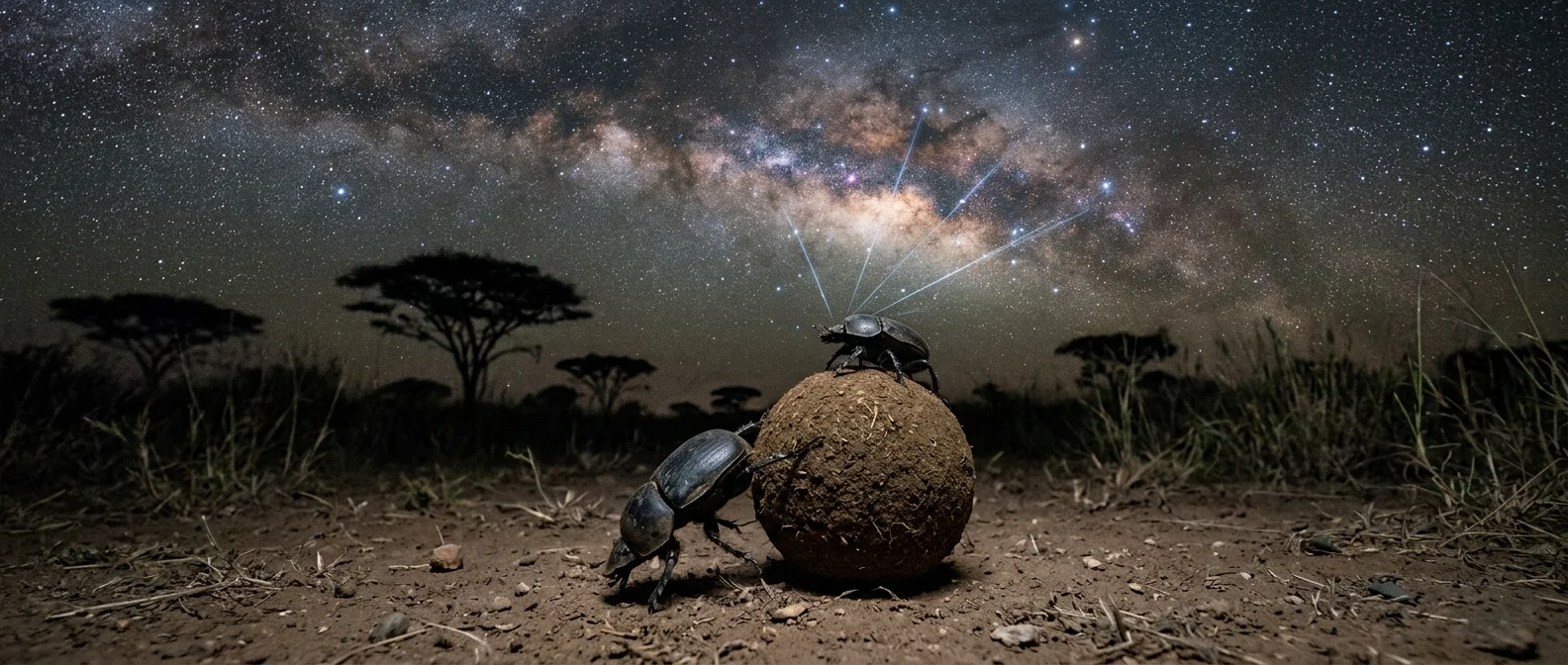
On a South African night, a dung beetle climbs atop its dung ball and begins to spin. It's not celebrating. It's photographing the sky. Its compound eyes scan the band of light stretching across the heavens — our Milky Way galaxy — and using this celestial compass, it begins rolling its ball in a perfectly straight line. This is the smallest animal proven to navigate by the stars.
📖 Read more: Mantis Shrimp: 50 MPH Punch That Boils Water
🌌 The Galaxy as Compass
In 2013, a team of scientists from Sweden's Lund University and South Africa's University of the Witwatersrand published something no one expected. Marie Dacke, Marcus Byrne, and their colleagues proved in Current Biology that the dung beetle Scarabaeus satyrus uses the Milky Way's band of light for orientation. It was the first animal in scientific history proven to navigate using the galaxy — not individual stars or the moon, but the entire luminous band.
The discovery surprised even the researchers themselves. "We were sitting in Vryburg doing experiments and the Milky Way was such a huge source of light. We thought they must be using it — they just have to!" said Byrne.
💩 Why Roll Dung Balls in Straight Lines
Let's clarify something first: dung beetles don't care about direction. They're not going somewhere specific. They just need to get away — in a straight line, as fast as possible. The reason? Competition. Once a beetle shapes its dung ball, dozens of competitors wait to steal it. A straight line is the shortest route away from the chaos.
If it rolls in circles, it'll return to the pile — and lose everything. That's why orientation is a matter of survival. Beetles roll backwards, pushing the ball with their hind legs while walking on their front ones. Inside the ball, they'll lay their eggs — the dung becomes both food and nursery for the larvae. With over 6,000 species worldwide, dung beetles serve as fundamental nutrient recyclers: they bury dozens of tons of dung per hectare annually, improving soil structure and fertility.
💃 The Dance on Top
Before starting to roll, beetles do something strange: they climb atop the ball and spin. This “orientation dance” isn't random — it's a 360-degree scan of the sky. During this dance, the beetle identifies light sources: the sun during day, the moon at night, or the Milky Way's luminous band. It locks onto a direction and follows it.
Dacke's team had already proven in previous studies that beetles use the sun, moon, and polarized light for guidance during daylight or bright nights. But what about moonless nights? The answer came inside the planetarium.

📖 Read more: Bee Crisis 2026: The Insect Apocalypse Unfolding
🔭 The Planetarium Experiment
To prove their hypothesis, researchers transported beetles inside the University of the Witwatersrand planetarium in Johannesburg. There they could control the “sky” — show the full Milky Way, remove it, or display only the brightest stars. Some beetles received tiny cardboard caps that blocked their view of the sky.
Results were crystal clear. With the full Milky Way, beetles rolled in nearly perfect straight lines. Without the galaxy — or with caps — they rolled in random, circular paths. Individual stars weren't enough. Only the luminous band in its entirety functioned as a compass. An insect with a brain of tens of thousands of neurons — compared to humans' billions — solved a navigation problem that would impress aerospace engineers.
👀 What Compound Eyes See
Dung beetles have compound eyes — hundreds of tiny lenses — but their resolution is low. They can't distinguish individual stars. What they see is a light gradient: the Milky Way's bright band stands out against the dark sky around it. This bright-dark contrast suffices for stable orientation.
A celestial body — star or planet — sits so far away that it doesn't change position relative to a beetle rolling a ball. Unlike a candle, which would force a moth into circles, the galaxy provides a stable reference point. Researchers suspect beetles follow a hierarchy: first the sun, then the moon, then polarized light, and finally the galaxy. They use whatever's available.

🌙 Light Pollution as New Threat
If beetles depend on the night sky, what happens when the sky fills with artificial light? A 2021 study showed that light pollution seriously disrupts their orientation. Beetles near urban areas lose the ability to detect the Milky Way band and roll in erratic, circular trajectories — exactly what they evolved to avoid. Light pollution doesn't just threaten astronomers — it threatens an insect serving critical ecological roles: nutrient recycling, seed dispersal, livestock parasite reduction, and soil structure improvement. In areas without dung beetles, dung accumulation becomes a health problem for animals.
📖 Read more: Blobfish: The 'Ugliest' Animal Is Actually Normal-Looking
🤖 From Beetle to Drone
A decade after the Dacke-Byrne discovery, Australian engineers decided to copy the strategy. Professor Javaan Chahl and PhD candidate Yiting Tao (University of South Australia) published in 2024's Biomimetics an artificial intelligence system that measures the Milky Way's orientation in low-light images — even with motion blur.
Camera in Motion
The Milky Way band isn't affected by motion blur — unlike individual stars
Satellite Stabilization
Backup navigation system for satellites in orbit without GPS
Night Drones
Autonomous navigation in low light — next step: algorithm in real drone
Biomimetics
Insects have solved navigation problems for millions of years with minimal hardware
"Insects have been solving navigation problems for millions of years — even ones that challenge the most advanced machines. And they solve them in a microscopic package," notes Chahl. The next step: implementing the algorithm in a real drone for night flight.
🏆 Ig Nobel Prize and Legacy
The Dacke-Byrne research won the 2013 Ig Nobel Prize in Biology-Astronomy — an award honoring studies “that first make you laugh, then make you think.” Beneath the humorous title, the discovery has real depth: it proves that complex navigation doesn't require a massive brain. A few thousand neurons, a dance, and a galaxy suffice. Nature found navigation solutions long before we invented GPS — and applied them to a creature weighing a few grams. Next time you look at the Milky Way on a starlit night, remember that somewhere nearby, a beetle is doing exactly the same thing.
🌟 “They don't care where they're going — as long as they get away”
Dung beetles don't navigate toward a destination. They navigate away — away from competitors, in a straight line. The Milky Way doesn't show them where to go. It shows them how not to come back. An evolutionary strategy 130 million years in the making.