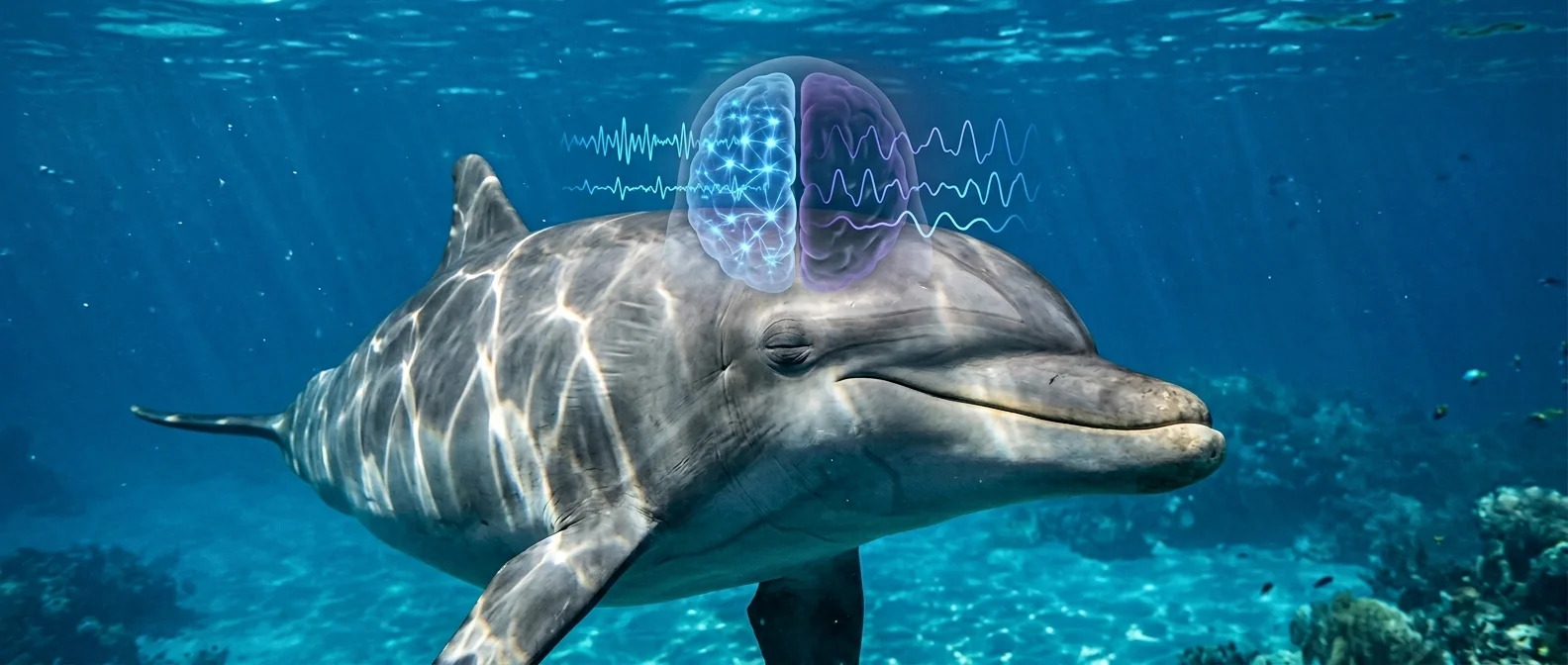
Imagine swimming in the open ocean with no land in sight, no stopping, no ability to close your eyes — for your entire life. This is the daily reality of a bottlenose dolphin. Dolphins breathe voluntarily: every breath is a conscious decision. If they fell into deep sleep like humans, they would drown. Evolution's solution is remarkable: they sleep with half their brain at a time, while the other half stays awake, controlling breathing, movement, and predator surveillance — simultaneously.
The Discovery: Electrodes in a Dolphin's Brain
The discovery happened in the Soviet Union. Neurophysiologist Lev Mukhametov at Moscow's Institute of Evolutionary Morphology and Animal Ecology placed the first systematic EEG electrodes on bottlenose dolphins (Tursiops truncatus) in 1977. The results were unprecedented: while one hemisphere showed slow delta waves (0.5-4 Hz) characteristic of deep sleep, the opposite hemisphere displayed rapid beta waves — typical of full wakefulness. The publication in Brain Research (1977) sparked skepticism: many neuroscientists considered it impossible for a mammal to “split” sleep. It took decades of replicated experiments across multiple cetacean species — bottlenose dolphins, porpoises, pilot whales (Globicephala) — for unihemispheric slow-wave sleep (USWS) to be accepted as biological reality. Today, USWS is recognized as one of the most impressive neurobiological phenomena in the animal kingdom.

Unihemispheric Sleep: How It Works
The mechanism is elegantly simple in principle, but neurologically complex. Each hemisphere sleeps independently for about 1-3 hours, then switches. Over a 24-hour cycle, each hemisphere accumulates 3-4 hours of sleep — significantly less than the 7-8 hours human brains require. The thalamus regulates sleep spindles independently for each hemisphere. The corpus callosum — the bridge between hemispheres — appears to block sleep signal transmission, allowing an asymmetric state that would be impossible in terrestrial mammals, where both hemispheres almost always synchronize sleep-wake cycles. The neurochemistry involves asymmetric adenosine release — the neurotransmitter that signals “sleep debt” — in each hemisphere separately. Recent fMRI studies in dolphins showed that the suprachiasmatic nucleus regulates circadian rhythms for each hemisphere independently — a unique finding absent in any terrestrial mammal.
One Eye Always Open
Each hemisphere controls the opposite eye (contralateral innervation). When the left hemisphere sleeps, the right eye closes — and vice versa. This means dolphins always have at least one eye open, scanning the marine horizon for predators like tiger sharks (Galeocerdo cuvier) and great whites (Carcharodon carcharias). In pods, dolphins sleep in echelon formation: positioned side-by-side with open eyes facing outward, creating a collective 360° surveillance system. Sam Ridgway (US Navy Marine Mammal Program) recorded that trained dolphins maintained full vigilance for 15 consecutive days without measurable performance decline in target detection and acoustic recognition tests — something unthinkable for any terrestrial mammal, where even 72 hours without sleep causes psychotic episodes and cognitive collapse.
Breathing: Why They Can't Sleep Deeply
Unlike terrestrial mammals, cetaceans breathe voluntarily — every breath requires conscious command. Bottlenose dolphins surface every 20-30 seconds to inhale through the blowhole at the top of their skull. Breathing isn't an automatic reflex: newborn dolphins must “learn” to breathe, with mothers pushing them to the surface in their first minutes of life. REM sleep (Rapid Eye Movement) — the phase where we dream — is essentially absent in cetaceans: only 5-10 minutes daily, compared to 90-120 minutes in humans. During REM, muscle tone is lost (atonia), which in an aquatic mammal would mean sinking and drowning — evolution simply “removed” this phase almost entirely. This means dolphins likely never dream — a question that raises philosophical issues about the relationship between consciousness and sleep.

Mother and Newborn: Sleep in Motion
The most extreme case involves newborns. A study by Oleg Lyamin (UCLA, Neuroscience & Biobehavioral Reviews, 2008) showed that newborn dolphins don't sleep at all during their first month of life — not even unihemispherically. They swim continuously beside their mother in echelon formation, exploiting hydrodynamic drafting for 20-30% energy savings. The mother doesn't sleep either during the first month. Gradually, after 4-6 weeks, the newborn begins developing USWS — first in short 5-10 minute intervals, then longer periods. This transitional period provides a unique opportunity to study how the brain “learns” to split sleep. The metabolic cost of this sleeplessness is partially offset by enhanced thermoregulation through fat — newborn dolphins fatten rapidly in their first weeks, acquiring thick blubber that functions simultaneously as thermal insulation and energy reserve for the demands of this extreme wakefulness.
It's Not Just Dolphins
USWS evolved independently across multiple taxa. Northern fur seals (Callorhinus ursinus) exhibit USWS only in water — on land they sleep normally with both hemispheres. Walruses (Odobenus rosmarus) can stay awake for 84 consecutive hours while swimming, then sleep 19 hours deeply and continuously on land with bihemispheric sleep. Frigatebirds (Fregata minor) sleep during flight — only 42 minutes daily at 3,000-meter altitude, one hemisphere at a time (Rattenborg et al., Nature Communications, 2016). Mallard ducks (Anas platyrhynchos) in formation use USWS at edge positions — with the external eye open, constantly watching for predators like foxes and hawks. Even common swifts (Apus apus) sleep in flight for months without landing — USWS allows them to maintain course and altitude without collision, essentially swimming through air for 10 months without ever touching land.
Neuroscience: What We Learn About Human Sleep
USWS research opened new questions about human sleep. The “first-night effect” — sleeping lighter in hotels — appears to reflect rudimentary USWS: the left hemisphere remains more vigilant in unfamiliar environments (Tamaki et al., Current Biology, 2016). The discovery of the glymphatic system — which “washes out” toxic protein aggregates during sleep — poses a question: how do dolphins avoid neurodegenerative diseases with half the sleep? The answer may lie in enhanced glymphatic channels or faster cerebrospinal fluid circulation. Indeed, analysis of aged dolphin brains revealed β-amyloid proteins (as in Alzheimer's), but without corresponding neurodegenerative symptoms — suggesting alternative clearance mechanisms. Military researchers (DARPA) study USWS neurochemistry to develop drugs enabling prolonged wakefulness without cognitive cost — so far without success.
Threats to Cetacean Sleep
Underwater noise disrupts USWS cycles. Military sonar (LFAS, 235 dB) causes behavioral changes in beaked whales — potentially leading to fatal strandings. Shipping generates chronic underwater noise 80-120 dB that has increased by 12 dB over the past century — doubling each decade — affecting echolocation and pod communication. Captive dolphins in aquariums show altered USWS patterns — shorter cycles, more frequent awakenings — due to artificial depth lighting and acoustic pollution from pumps. Climate change shifts the geographic and bathymetric distribution of prey, forcing dolphins into longer swimming distances and less sleep time. Initiatives like the QUIETMED program in the Mediterranean and reduced ship speed zones in British Columbia aim to reduce noise. In Greece, the Pelagos Institute researches the impact of marine traffic on bottlenose dolphins in the Corinthian Gulf — critical for mammals living at the threshold of sleep and wakefulness, in a state of permanent semi-consciousness unlike anything in human experience that awes researchers who study it.
Sources:
- Mukhametov, L.M., Supin, A.Y., & Polyakova, I.G. (1977). "Interhemispheric asymmetry of the electroencephalographic sleep patterns in dolphins." Brain Research, 134(3), 581-584.
- Lyamin, O.I., Manger, P.R., Ridgway, S.H., Mukhametov, L.M., & Siegel, J.M. (2008). “Cetacean sleep: An unusual form of mammalian sleep.” Neuroscience & Biobehavioral Reviews, 32(8), 1451-1484.