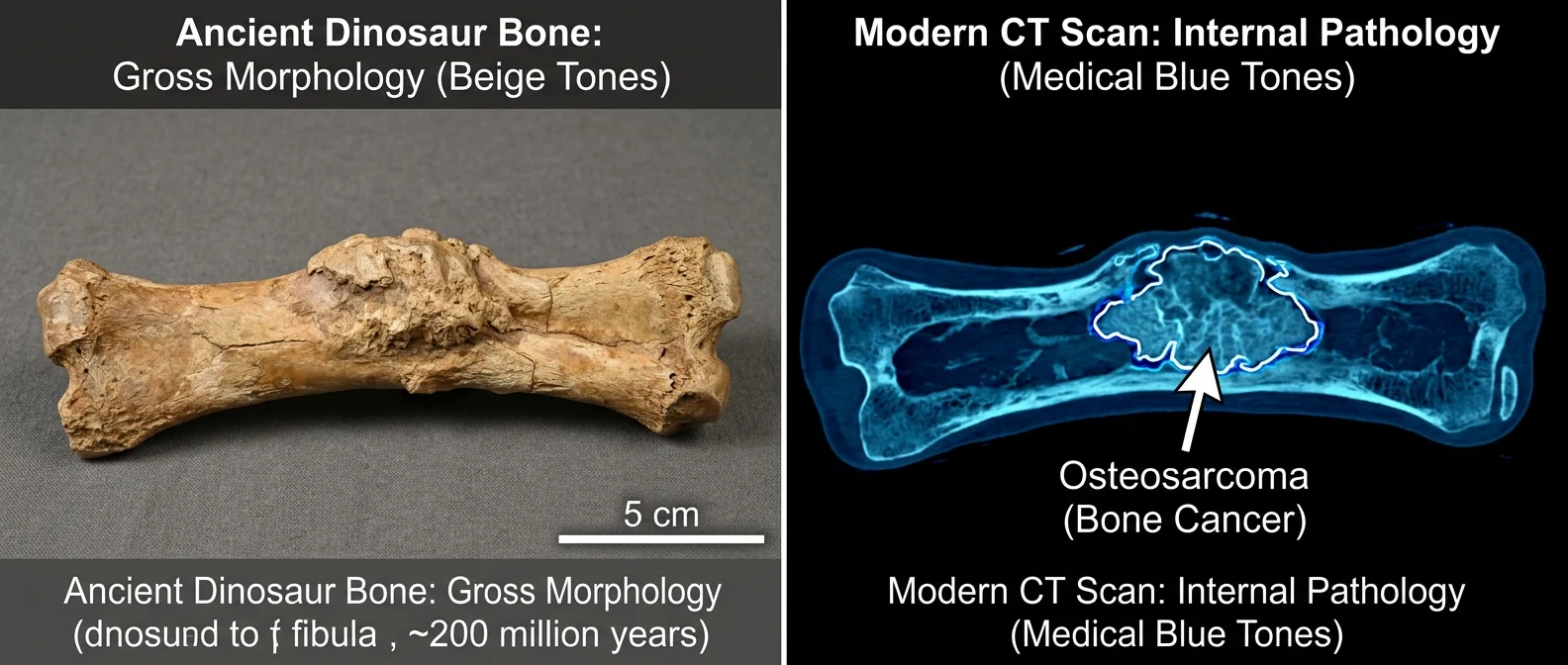
A fibula bone was discovered in Alberta's Dinosaur Provincial Park — it belonged to a Centrosaurus apertus that died 76 million years ago. For decades, paleontologists believed its deformation was a fracture from battle or a fall. In 2020, an interdisciplinary team of pathologists, surgeons, and paleontologists revealed the shocking truth: the dinosaur had osteosarcoma — aggressive malignant bone cancer, the same type that strikes children and young adults today. Cancer isn't a modern disease. It's as ancient as multicellular life itself.
First Cancer in a Dinosaur: Centrosaurus apertus
The landmark study was published in The Lancet Oncology (2020) by Ekhtiari, Evans, and Campione from the Royal Ontario Museum and McMaster University. The team used modern medical tools — micro-CT, histological thin sections, high-resolution X-rays — and compared the fossil with human osteosarcoma. The results were undeniable: the tumor had destroyed the bone cortex, creating the characteristic “sunburst pattern” — exactly like human osteosarcoma.
Centrosaurus apertus was a herbivorous ceratopsid (relative of Triceratops) that lived in herds of hundreds across the plains of present-day Alberta. Weighing about 2 tons with a distinctive single horn on its nose, the team estimates that despite the osteosarcomatous tumor in its fibula (which would have caused severe pain and lameness), the dinosaur likely survived thanks to herd protection — an ancient form of “social healthcare.” It was eventually found alongside hundreds of its kind in a bonebed (mass death from tropical flooding), proving it didn't die alone — cancer didn't kill it immediately. Mark Crowther, a McMaster pathologist, noted the diagnosis “would be immediately recognizable on X-ray to any orthopedic physician.”

Before Centrosaurus: Cancer Across All Eras
Centrosaurus wasn't the only dinosaur with cancer. Paleopathologist Bruce Rothschild, a pioneer in studying ancient animal diseases, examined thousands of fossilized dinosaur bones in museums worldwide. He found hemangiomas (vascular tumors) in hadrosaurs (Edmontosaurus), while osteomas (benign bone tumors) and exostoses were reported in allosaurs, stegosaurs, and even pterosaurs. His 2003 study in the American Journal of Physical Anthropology documented oncological lesions in 10,000+ vertebrate fossils from species that lived long before the great K-T extinction (66 million years ago). Among these, hadrosaurs showed the highest rates of neoplasms — possibly due to the large number of preserved fossils, but perhaps also genetic susceptibility.
But cancer predates even dinosaurs. A 2019 study in JAMA Oncology reported osteosarcoma in a turtle ancestor (Pappochelys rosinae) from 240 million years ago (Triassic) — the oldest known osteosarcoma in an amniote. Even earlier, neoplasms have been found in fossilized fish from 300 million years ago (Carboniferous). And micro-fossils show oncogenic changes in organisms from 1.7 billion years ago — almost immediately after the emergence of multicellular life. Cancer isn't a modern epidemic — it's as old as multicellularity.
Why Cancer Exists: The Price of Multicellularity
Cancer isn't a “malfunction” — it's an inevitable cost of multicellular life. Every time a cell divides, it copies 3.2 billion DNA bases with DNA polymerase. Even with highly efficient repair mechanisms (like mismatch repair and nucleotide excision repair), about 0.5-1 mutations per cell division remain uncorrected. In a human body with ~37 trillion cells, this means millions of somatic mutations daily. Most are harmless (in non-coding regions or synonymous changes), but if a mutation hits an oncogene (e.g., KRAS, MYC, HER2) or inactivates a tumor suppressor (e.g., TP53, RB1, BRCA1), the cell can escape control.
This mechanism exists in every multicellular organism: from sponges and corals to mammals. Plants develop galls — plant “tumors” — from bacterial infection (Agrobacterium tumefaciens, which inserts its T-DNA into the plant genome, causing uncontrolled proliferation) or viral infections. Even invertebrates like mussels exhibit transmissible cancer (leukemia-like neoplasm that spreads between individuals through seawater, discovered in 2015 in Cell). Cancer is, in a way, a cell that “remembers” how to be unicellular — and stops cooperating with its neighbors. This “evolutionary reversion” (atavism) is fundamental to modern understanding of oncogenesis.
Peto's Paradox: Why Don't Elephants Die from Cancer?
Epidemiologist Richard Peto observed something paradoxical in 1977: if cancer depends on the number of cell divisions, then large animals (more cells, more divisions, more chances for error) should have exponentially more cancer. An elephant (5 tons, ~100× more cells than humans) should theoretically be riddled with tumors. Yet — cancer rates in elephants are only ~5%, while in humans they reach 11-25%. Whales — the largest animals that ever lived, with over 100 trillion cells — have even lower rates. This remarkable evolutionary paradox bears his name: Peto's Paradox.
According to a study by Sulak, Lindblad-Toh et al. in Cell Reports (2016) from the University of Chicago, the answer lies in the TP53 gene — the “guardian of the genome.” Humans have 1 copy, elephants have 20. Additionally, elephants possess the “zombie gene” LIF6 — a pseudogene that “resurrected” evolutionarily and helps p53 trigger apoptosis in damaged cells before they become cancerous. This mechanism likely evolved in Proboscidea (trunk-bearing mammals) 25-30 million years ago.

Did Dinosaurs Have Anti-Cancer Mechanisms?
If sauropods weighed up to 70 tons — 14× more than five elephants — how weren't they riddled with cancer? Unfortunately, we can't analyze dinosaur DNA — it doesn't survive after 66 million years (despite Jurassic Park fantasies). But we can hypothesize: if elephants evolved 20 copies of TP53 in ~30 million years, sauropods — with 100+ million years of evolution toward giant size — may have developed even more powerful anti-cancer mechanisms — perhaps multiple copies of tumor suppressors, enhanced immune surveillance, or increased telomeric protection. Studies in birds (descendants of theropod dinosaurs) show enhanced DNA repair mechanisms and lower cancer rates compared to mammals of similar size, supporting this hypothesis.
Transmissible Cancer: The Most Terrifying Type
Cancer is usually considered non-contagious — but there are terrifying exceptions. DFTD (Devil Facial Tumour Disease) in Tasmanian devils is transmissible cancer: cancer cells spread through bites during fights, evading the immune system due to the population's low genetic diversity (MHC uniformity). The disease has reduced the population by 80% since 1996 and threatens the species with extinction. In dogs, CTVT (Canine Transmissible Venereal Tumor) is the oldest known transmissible cancer — it appeared ~11,000 years ago and still spreads sexually today, carrying DNA from the original “patient” — a dog that lived during the Ice Age.
What Paleontological Cancer Research Teaches Us
Studying ancient cancers reminds us that the disease isn't caused only by modern factors (smoking, radiation, chemical carcinogens). Cancer is a fundamental biological mechanism — an inevitable consequence of every multicellular organism that relies on cell division. In recent years, evolutionary oncology studies how anti-cancer mechanisms in large animals can inspire new therapies — from enhancing p53 with gene therapy to immunotherapies inspired by naked mole rats, which almost never develop cancer thanks to the hyper-hyaluronic acid (HMW-HA) they produce.
The Oldest Enemy, The Newest Hope
From 300-million-year-old fish fossils to Centrosaurus and today's Tasmanian devil, cancer proves to be the oldest enemy of multicellular life. But every species that survived millions of years developed its own “shield” — DNA repair mechanisms, tumor suppressor genes, immune surveillance (NK and T cells that detect and destroy cancer cells daily). Nature doesn't eliminate cancer — it manages it. Perhaps the future of oncology lies in the past — in genes that evolved in elephants, whales, naked mole rats, and perhaps even in dinosaurs that walked the Earth 200 million years ago.
Sources:
- Ekhtiari, S., Evans, D.C., Campione, N.E. et al. “First case of osteosarcoma in a dinosaur: a multimodal diagnosis.” The Lancet Oncology, 21(8): 1021-1022, 2020. Royal Ontario Museum & McMaster University.
- Sulak, M., Lindblad-Toh, K. et al. "TP53 copy number expansion is associated with the evolution of increased body size and an enhanced DNA damage response in elephants." Cell Reports, 2016. University of Chicago.