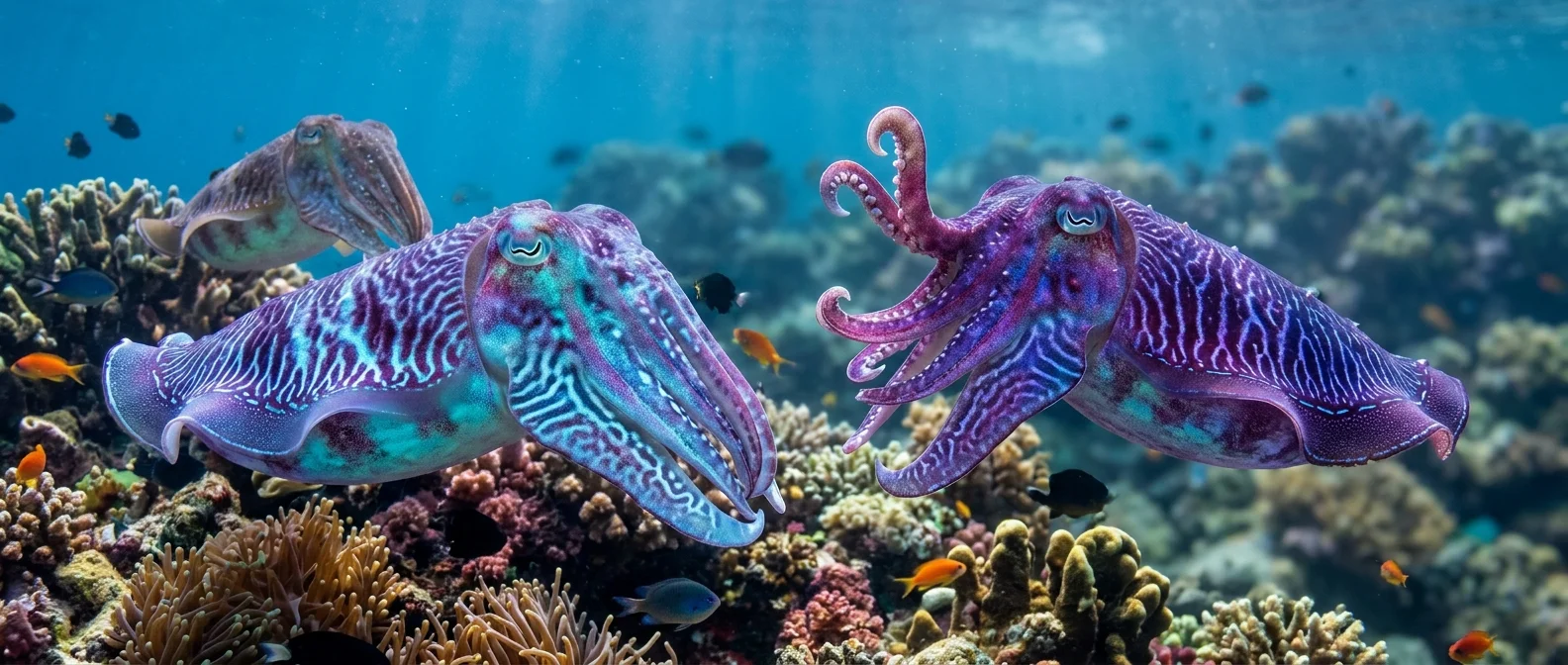
A creature with three hearts, blue blood, and an internal bone glides silently over sandy shallows in the Atlantic. It resembles a flattened torpedo-shaped jellyfish. Suddenly, its entire body transforms — zebra stripes ripple across its mantle, colors flowing like a luminous LED billboard. No other animal on Earth “speaks” through its skin with such precision. This is the cuttlefish — Sepia officinalis — and its language is literally chromatic.
📖 Read more: Octopus Rides Mako Shark: The Ocean's Most Bizarre Photo
📡 Channel 1: What Is a Cuttlefish — Identity of a Master of Disguise
The European common cuttlefish, Sepia officinalis, was described by Linnaeus in 1758. It belongs to the Cephalopoda — the same class as octopuses and squid. Its distribution covers the eastern North Atlantic, English Channel, Mediterranean, and western African coasts down to South Africa. It inhabits sandy or muddy bottoms, from the subtidal zone to depths of 200 meters.
The body is broad, dorsoventrally flattened, with an oval cross-section. Two wide fins extend along the entire length of the mantle. Eight arms and two longer tentacles surround a mouth with a beak. Internally, a lightweight internal shell — the cuttlebone — regulates buoyancy by filling or emptying chambers with gas. Maximum recorded mantle length: 60 centimeters, weighing 2 to 4 kilograms.
🪪 Biological Identity
Scientific name: Sepia officinalis (Linnaeus, 1758)
Class: Cephalopoda
Order: Sepiida
Family: Sepiidae
Maximum mantle length: 60 cm
Weight: 2 – 4 kg
Depth range: 0 – 200 m
Lifespan: 1 – 2 years
IUCN status: Least Concern (assessed 2009)
📡 Channel 2: Chromatophores, Leucophores, Iridophores — The Screen Beneath the Skin
The cuttlefish doesn't simply change color. It constructs images. Three types of cells in the skin make this possible: chromatophores (pigment sacs that expand and contract muscularly), iridophores (reflective crystals creating metallic reflections), and leucophores (white light reflectors). Their combined action produces colors, patterns, textures — even three-dimensional surface changes, like bumps or spines.
The speed of change is extraordinary. In less than a second, a cuttlefish transitions from uniform brown to zebra pattern, to mosaic, to near transparency. This isn't a chemical reaction — it's neuromuscular control. The brain sends a signal, muscles around each chromatophore contract or relax, and the image appears almost instantaneously.
Here's where it gets truly bizarre: Sepia officinalis can display different patterns simultaneously on different sides of its body. The left side might show camouflage while the right broadcasts a sexual signal. This means two “messages” are transmitted simultaneously to two different receivers. Imagine saying “I love you” to someone in front of you while writing “go away” to someone behind you — with neither seeing the other's message.

📡 Channel 3: Courtship on the Seafloor — Color as the Language of Love
Every spring and summer, cuttlefish migrate to shallow, warm waters for reproduction. Males attract females through spectacular "color parades": undulating bands run along the body, light pulses pass like waves across the mantle. Then, the male forms its arms into a “basket” formation — a gesture displaying vitality.
Females? They respond with uniform gray when receptive. Rejection means a different pattern. Mate guarding is common: males swim beside females, aggressively repelling competitors. Smaller males, however, have developed an astonishing tactic — they change their color patterns to resemble females, approaching the female undetected right under the larger male's nose. Real-time deception.
Reproduction, however, hides a tragic constant. Sepia officinalis is a semelparous species — it reproduces once and then dies. Both males and females die shortly after egg-laying. Their life cycle lasts just one to two years. Every cuttlefish you see on the seafloor knows — if we can say it “knows” — that its life is already numbered.
📡 Channel 4: Hunting, Ambush, and Learning Before Birth
The cuttlefish is an ambush predator. It sits motionless on the bottom, invisible, until a crustacean or small fish approaches close enough. Then it shoots out its two tentacles — specialized feeding tentacles with suckers at the tips — and pulls the prey to its beak in milliseconds. Alternatively, it lunges forward entirely and encircles the prey with its arms.
The diet includes crustaceans, fish, gastropods, polychaete worms, nemertines — even other cuttlefish. Let's not romanticize this. Cephalopods eat whatever fits.
The most impressive aspect here isn't the technique. It's the learning. Researchers showed that cuttlefish embryos can observe prey through the transparent egg shell, using their fully developed eyes. Hatchlings exposed to crabs during the embryonic phase preferred crabs as their first meal — compared to hatchlings without this exposure. Learning before birth. In a mollusk.
🧠 Embryonic Learning: Eyes Before the World
S. officinalis eggs are impregnated with ink during laying — initially dark, gradually becoming semi-transparent. Embryos develop full vision before hatching and can observe what moves around them. Experiments showed that hatchling cuttlefish exposed to crabs during the embryonic stage preferred crabs as first food. They're born with already-formed “preferences” — long before tasting anything.
📡 Channel 5: Ink, Deception, Self-Propulsion — Cephalopod Survival

Cuttlefish face predators with a triple system: camouflage (invisible first layer), ink ejection (disorientation), and jet propulsion via siphon (escape). The siphon — a muscular tube at the bottom of the mantle — ejects water forcefully, pushing the cuttlefish backward at high speed. Predators include sharks, dolphins, seals, and large fish.
Ink ejection doesn't just function as a “smoke cloud.” In some cases, the cuttlefish forms an ink shape resembling a body — a pseudomorph — while it slips away in the opposite direction. The predator strikes the phantom. The cuttlefish vanishes.
A cuttlefish's home range is estimated between 90 and 550 meters — that's 5,300 to 23,700 square meters of seafloor. In winter they migrate to deeper waters (100–200 meters), returning to shallows in spring.
⚔️ Two Methods of Deception
Ink Pseudomorph
The cuttlefish ejects ink in a body-shaped form — a pseudomorph. The predator attacks the phantom while the cuttlefish changes color and disappears.
Gender Mimicry
Small males change their color patterns to resemble females, approaching romantic targets undetected by larger males.
📡 Channel 6: Why It Matters — Neuroscience, Texture, and the Future
The cuttlefish isn't just a spectacle. It's a neurobiological enigma. How does a brain without a cortex — lacking the structure that in mammals relates to conscious thought — manage to encode such complex visual language? How does it control thousands of chromatophores independently, in real time, with pixel-level precision?
Current IUCN assessment classifies Sepia officinalis as Least Concern — not immediately threatened. However, it's a commercially fished species, and fishing occurs near maximum sustainable levels. Climate change is explicitly mentioned as a threat in the IUCN assessment — habitat shifts, sea temperature changes.
Somewhere in the shallow waters off a Mediterranean coast, right now, a cuttlefish is changing the pattern on its skin. Maybe it's hiding. Maybe it's flirting. Maybe it's saying something we still don't understand. What we know for certain: in a year it won't exist. But a new generation will hatch — already with eyes open, already learning.