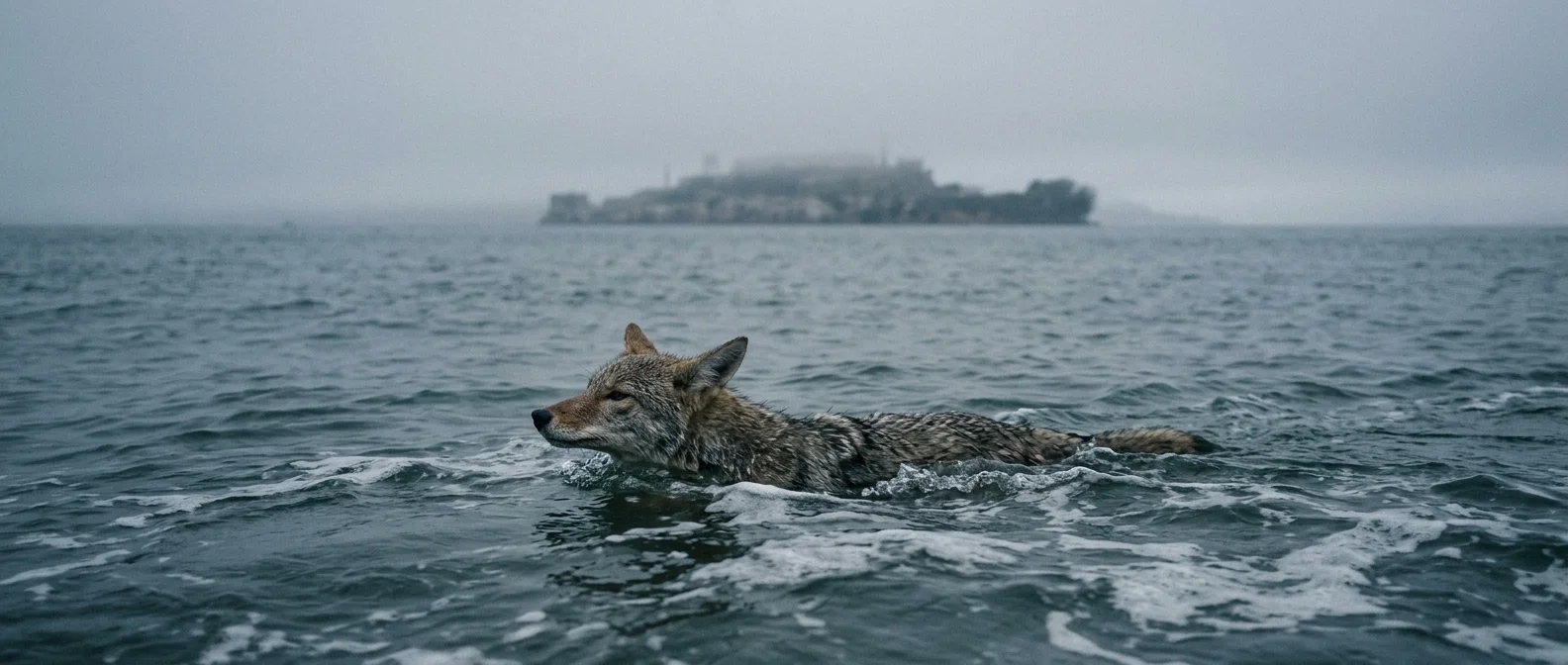
The sun was setting behind the Golden Gate Bridge when a visitor to Alcatraz Island spotted something unthinkable: a coyote swimming through the frigid, choppy waters of the bay, heading toward the rocky shore. No one had ever recorded such a thing — not even biologists who've studied these animals for decades.
📖 Read more: Animals See Colors We Can't Even Imagine
🏝️ The Swim That Made History
On January 11, 2026, a coyote (Canis latrans) was captured on video swimming toward the south side of Alcatraz Island in San Francisco Bay. The footage, later shared on social media, shows the animal battling waves before scrambling onto the rocks — visibly exhausted, shivering from cold and fatigue.
"Coyotes can often be spotted in our parks in San Francisco and Marin, but never before on Alcatraz," said Julian Espinoza, spokesperson for Golden Gate National Recreation Area. “It was the first time our biologists had observed anything like this.” The visitor who filmed the encounter shared the footage with Aidan Moore, an employee of Alcatraz City Cruises, who immediately alerted park rangers.
🌊 A Swim Worthy of an Inmate
Alcatraz sits more than a mile offshore. The island is surrounded by cold estuary waters with strong currents — precisely why it was chosen for the maximum-security prison that operated there until 1963. Some inmates drowned attempting to escape, while today's recreational swimmers use wetsuits, specialized training, and guides.
Stan Gehrt, wildlife researcher and head of the Urban Coyote Research Project, explained that coyotes can swim, but typically only a few hundred yards in calm lake waters. The waters around Alcatraz bear no resemblance to those conditions. "Once it got out of the water, it was clear it had been swimming for a very long time," Gehrt said. “Animals I've seen come out after swimming don't look that distressed or tired.”

🎥 The Video That Went Viral
The videos, posted to Facebook and quickly spreading across all platforms, show the coyote paddling toward Alcatraz's southern shore as the sun sets. It's unclear where it started — the footage begins with the animal already in the water. The Alcatraz City Cruises captain reported unusual currents that day, possibly due to runoff from recent storms. The coyote may have been swept away during a shorter swim.
📖 Read more: Ankylosaurus: The Living Fortress with a Club-Tail Weapon
🐺 Which Coyote Was This?
Christine Wilkinson, a conservation researcher from UC Santa Cruz and the California Academy of Sciences, believes the coyote came from a pack near Coit Tower, on the shore south of Alcatraz. The area has minimal green space, making it difficult for young coyotes seeking their own territory.
Coyotes wanting to move south from Coit Tower face Interstate 280 — and the risk of being struck by vehicles. The ocean may have seemed like a safer option. Coyotes live in small family groups, and solitary individuals are mainly young animals aged 6 months to 2 years, searching for new packs or their own territory.
🗺️ From Desperation to New Home
Despite its apparent exhaustion, Wilkinson noted that coyotes are “incredibly resilient.” Alcatraz Island, though seemingly barren, offers rich food sources: seabird eggs, chicks, rats, and mice. For a hungry coyote seeking a fresh start, it seems almost ideal habitat.
The timing is also significant. Coyotes typically seek new territories in fall and early winter, but January dispersal isn't impossible. This period (January-March) is also mating season, which further increases movement patterns.
💡 Did You Know...
Coyotes had already swum to Angel Island, a closer island in the bay, where they've lived permanently since 2017. However, Angel Island sits much closer to shore, making the swim to Alcatraz significantly more difficult and dangerous.
🏙️ How Coyotes Conquered Cities
Coyotes once lived exclusively in the prairies and deserts of central and western North America. Everything changed in the 19th century when humans created open habitats through logging and agricultural development, while simultaneously eliminating their natural competitors — wolves and mountain lions. The opportunity was massive, and coyotes seized it completely.
Today, coyotes thrive in major cities from Los Angeles to New York. In San Francisco, they prefer brushy areas, parks, and golf courses. Their flexible diet — from rodents and rabbits to insects, fruit, garbage, and even pet food — makes them perfect urban animals. Between 1977 and 2015, 367 coyote attacks on humans were recorded in the US and Canada, but only two were fatal. Their population is considered increasing according to the IUCN.

📖 Read more: Antarctica Loses Ice Mass Equivalent to Two Countries
🔬 Remarkable Features of Canis latrans
Size
32-37 inches body length + 16-inch tail, weight 20-50 pounds — about the size of a medium dog.
Speed
Reach 40 mph, alternating between pack hunts and solo pursuits when chasing deer.
Reproduction
63-day gestation, average 6 pups per litter. Young open their eyes after 10 days.
Communication
Howls, barks, and yips — each sound carries different messages to the pack.
A fascinating detail: there are 19 different coyote subspecies. Coyotes can also crossbreed with both dogs (coydogs) and wolves (coywolves), though this rarely happens in the wild. The eastern coyote is sometimes called a “coywolf” because its ancestors crossbred with wolves during their expansion across North America — many generations ago.
⚖️ Coyote vs Wolf
A coyote's skull rarely exceeds 8 inches, while a wolf's exceeds 9 inches. Coyotes weigh 20-50 pounds, while a gray wolf reaches 80-145 pounds. Despite their smaller size, coyotes have proven far more adaptable — spreading to every type of environment, from deserts to skyscrapers.
🌍 An Animal That Beats Every Challenge
Stan Gehrt has recorded coyotes traveling over 150 miles during natural dispersal, even crossing the Ohio River. "This speaks to the animal's ability to overcome different challenges and exploit every opportunity," he commented. Humans kill over 400,000 coyotes annually — 80,000 from federal programs alone — yet their population continues to grow.
The story of the coyote at Alcatraz isn't just a unique snapshot. It's a symbol of this species' incredible adaptability. In a rapidly changing world, coyotes don't retreat — they evolve. They find new ways to hunt, new places to live, and as this story proves, new ways to reach places no one expected. If a coyote can swim to Alcatraz — a journey even escaped prisoners didn't always manage — then perhaps no obstacle is too great for this resilient, cunning mammal.
Sources:
- Live Science — Coyote scrambles onto Alcatraz Island after perilous, never-before-seen swim
- National Geographic — Coyote Facts