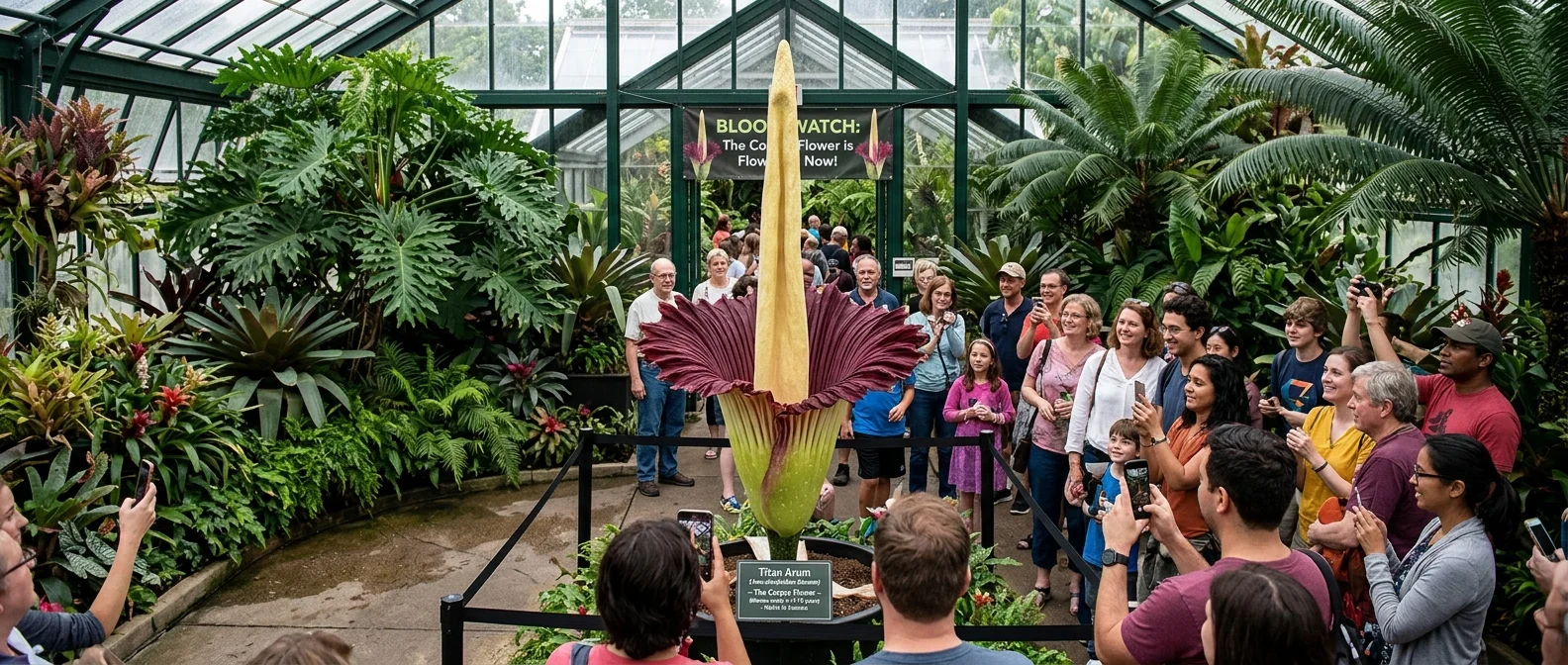
Imagine walking into a greenhouse and being hit with the overwhelming stench of rotting flesh — so intense it makes you gag. But there's no dead animal here. You're face-to-face with a flower. The Amorphophallus titanum, known as the “corpse flower,” might be the strangest plant on Earth: it blooms every 5-10 years, smells like death, and heats itself up like a warm-blooded animal.
🌿 What Exactly Is the Corpse Flower?
The Amorphophallus titanum isn't a single flower — it's a cluster of hundreds of tiny blooms hidden around a giant central spike called a spadix. This spadix can tower 12 feet high, making it the world's tallest unbranched inflorescence. At its base, a ruffled petal-like spathe unfurls in deep burgundy-red, creating a massive cup-shaped structure that could easily swallow a small child.
The plant is endemic only to the tropical rainforests of Sumatra, Indonesia — an island with rich but rapidly declining biodiversity. There, beneath the dense canopy, it spends most of its life in energy-storage mode. A massive underground corm, weighing over 150 pounds, silently feeds its leaves. No one knows when it will decide to bloom.
🔬 The Chemistry of Death: Why It Smells This Way
A team at Dartmouth College, led by G. Eric Schaller, professor of biological sciences, revealed for the first time the molecular mechanisms behind the stench. The study, published in PNAS Nexus in November 2024, analyzed tissue from “Morphy” — a 21-year-old corpse flower in Dartmouth's greenhouse.
RNA analysis revealed that during blooming, genes for sulfur transport and metabolism activate. The basic amino acid methionine, rich in sulfur, converts into volatile compounds that evaporate with heat — creating that unbearable “aroma” of rotting flesh. But the real surprise was discovering putrescine — a compound naturally found in animal carcasses as they begin to decompose. The research team detected high levels of putrescine in the spathe tissues, proving the plant chemically mimics death with stunning accuracy.

🔥 Thermogenesis: A Plant That Heats Itself
Thermogenesis — the ability to generate heat — is common in animals but extremely rare in plants. During blooming, the spadix heats up 20°F above ambient temperature. This serves a very specific purpose: heat vaporizes the foul-smelling compounds, dispersing the odor across dozens of yards.
In animals, uncoupling proteins disrupt chemical energy storage and release it as heat — exactly like mammals shivering in the cold. Schaller's team discovered that plant equivalents, called alternative oxidases, show increased gene expression precisely at bloom onset — particularly in the upper part of the spadix, the “spadix antenna” that functions like a heat-broadcasting odor transmitter.
🐛 Flies and Beetles: The Evolutionary Trap
Why would a flower want to smell like a corpse? The answer lies in its evolutionary pollination strategy. Its primary pollinators aren't bees or butterflies, but carrion flies and necrophagous beetles — insects that seek dead animals to lay their eggs. Attracted by the combination of sulfur compounds and putrescine, the insects enter the cup-shaped spathe, become temporarily trapped between male and female flowers, and unknowingly transfer pollen.
Olivia Murrell, a researcher at Northwestern University, describes: "You don't need to get close to the flower to smell it. The moment you enter the greenhouse, the odor hits you in the face. It's extremely powerful. The plant also heats up during blooming, which spreads the smell even further."
🌺 A Bloom Worth Decades of Waiting
The rarity makes each blooming a spectacular event. The plant can go 7 to 10 years without flowering — it needs this time to store enough energy in its corm. When it decides to bloom, the process happens overnight — the spadix shoots upward, the spathe unfurls, temperature rises, and the stench floods the area. All of this lasts just 24 to 48 hours before the flower wilts. Researchers still don't fully understand what triggers the process — Schaller now focuses on identifying these genetic switches.
Botanical gardens worldwide organize special events whenever a corpse flower blooms. Thousands of visitors literally line up to smell death. At Dartmouth, “Morphy” has become a local celebrity, with its blooms attracting journalists, students, and curious citizens.

🧬 Genetic Crisis: Clones and Inbreeding
The situation in institutions housing corpse flowers is troubling. A study by Northwestern University and the Chicago Botanic Garden (2025, Annals of Botany) examined nearly 1,200 plants in 111 institutions worldwide. Results revealed that 24% were clones and 27% were offspring of closely related individuals.
The cause? Female flowers open first and wilt permanently before pollen matures on the males. Each plant blooms unpredictably, and female flowers remain viable for only a few hours. In panic, caretakers use pollen from previous blooms of the same plant — creating inbreeding. One institution reported that all their offspring were born albino: without chlorophyll, they couldn't photosynthesize and died.
24% Clones
Nearly one in four plants in collections was a genetic copy
27% Inbreeding
Offspring of closely related individuals reduce genetic diversity
Poor Records
Data gets lost every time plants are transferred between institutions
🌍 Only 162 in Nature: A Species on the Brink
Beyond greenhouses, the situation in the wild is even worse. According to a publication in Biodiversity and Conservation, only 162 Amorphophallus titanum plants remain in Sumatra's tropical forests. Habitat loss from deforestation, climate change, and invasive species pressure the population. The plant belongs to “exceptional plants” — species whose seeds cannot be stored in seed banks because they lose viability after drying.
"The population needs diversity to survive," Murrell emphasizes. "If nothing changes, it could self-extinct through inbreeding. That's why it's critical to maintain consistent, standardized, and centralized data." Her team proposed five recommendations: document parents, standardize data, track genealogy, transfer records with plants, and establish a common recording language.
🎭 The Allure of Death
Something deeply human and primal draws us to this plant. Maybe it's the contradiction: something so visually striking that simultaneously emits the worst possible smell. Maybe it's the rarity — the idea that a plant “thinks” for a decade before deciding to show itself to the world, and only for 48 hours. Or maybe we're fascinated that nature, to ensure reproduction, invented something so radical: a flower that mimics death to bring life.
What's certain: with only 162 plants in the wild and declining genetic diversity, the corpse flower needs our help. Perhaps the next time we smell something unpleasant, we should remember that even stench can hide an evolutionary masterpiece.