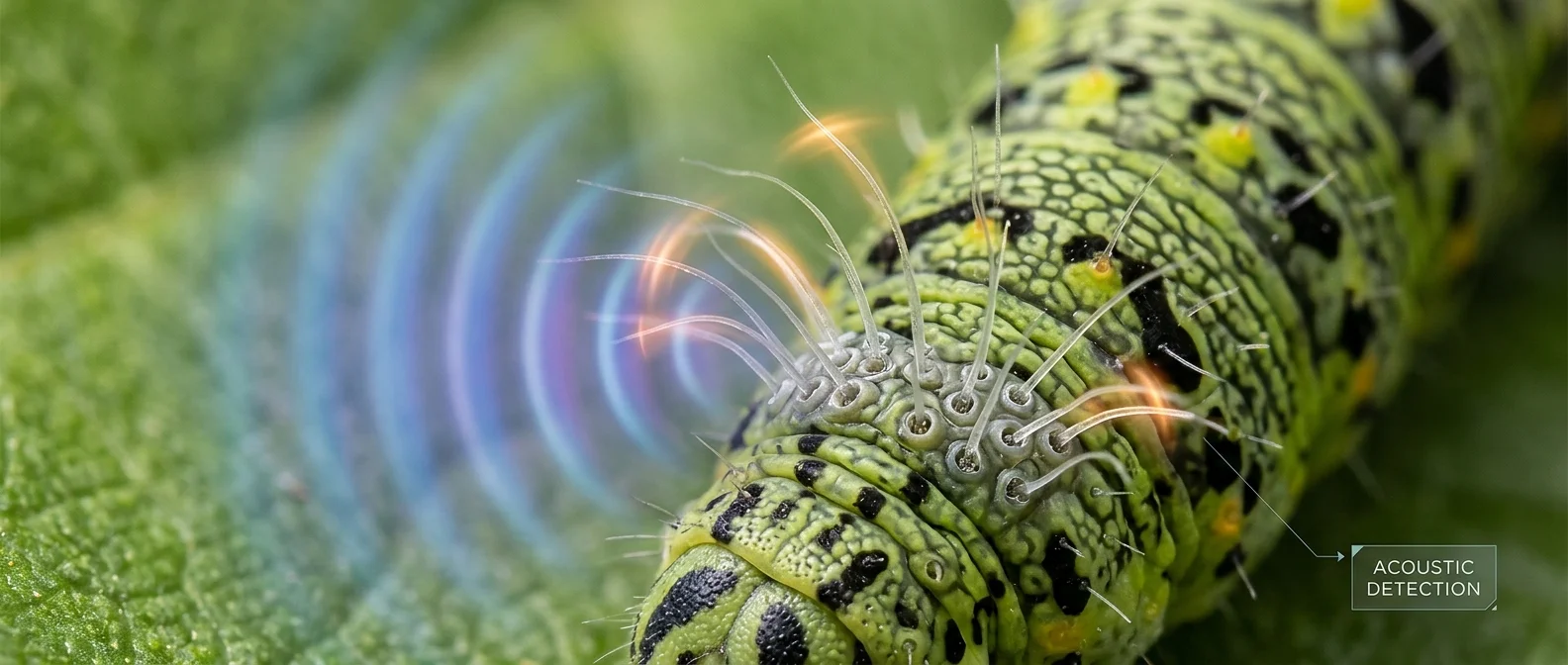
A caterpillar crawls slowly across a leaf, seemingly defenseless. It has no ears, no tympanic membranes, not even a head large enough to house such structures. Yet the moment a wasp approaches from three meters away, the caterpillar freezes. Why? Because it heard it. Without ears.
📖 Read more: 5,000-Year-Old Tree: Methuselah Still Stands Strong
🔬 Hairs That Function as Microphones
The answer lies in thousands of microscopic hairs — called setae — that cover the caterpillar's body. Each hair connects at its base to nerve endings extremely sensitive to air vibrations. When a sound wave hits the seta, it bends slightly — just enough to trigger a neural signal.
Think of setae as dozens of antennas tuned to different frequencies. Smaller hairs respond to high frequencies, while larger ones pick up low sounds. The system doesn't work exactly like an ear, but serves the same purpose: converting sound waves into information the nervous system can process.
🦋 From Caterpillar to Butterfly: Ears Appear Later
Here's where it gets truly fascinating. Caterpillars lack tympanal organs — these develop only after metamorphosis. Researchers at the University of Bristol, led by Katie Lucas, discovered in 2009 that the tropical butterfly Morpho peleides possesses a remarkably complex ear at the base of its wing.
This ear's tympanic membrane is oval, like stretched rubber, with an unusual dome at the center. Using laser scanning to map the membrane during operation, Lucas discovered something remarkable: low frequencies caused vibration only in the outer section, while high frequencies made the entire membrane beat. An ear that distinguishes high from low sounds — unprecedented in butterflies.
The practical significance? Low sounds correspond to bird wingbeats. High sounds to their songs. Morpho peleides can likely distinguish whether something is approaching or simply singing from afar.

🎵 Talking Caterpillars: Acoustic Territorial Communication
Jayne Yack, professor of neuroethology at Carleton University in Canada, spent decades studying sound in the caterpillar world. What she discovered overturns our conventional image of these creatures.
In a PNAS publication (2001), Yack and colleagues showed that certain Lepidopteran caterpillars (Drepana arcuata) use acoustic signals to defend their territories. These aren't buzzes or insignificant noises. The caterpillars drag their posterior anal shields across the leaf surface, creating vibrations that function as a message: “This leaf is occupied.”
A subsequent Nature Communications publication (2010) revealed that this acoustic behavior has evolutionary roots stretching back millions of years. Caterpillars' ritualistic sound signals likely evolved from simple defensive movements that gradually acquired communicative function.
🔊 How Do Caterpillars “Talk”?
Drepana arcuata produces four types of acoustic signals: scraping, mandible clicking, mandible drumming, and anal scraping. All generate substrate vibrations — sound waves that travel through the leaf, not through air.
📖 Read more: 52 Hertz Whale: The World's Loneliest Whale Calls
⚔️ Sound as a Survival Weapon
For a caterpillar, the ability to detect sound isn't luxury — it's a matter of life and death. Many predators betray their presence acoustically long before becoming visible.
Parasitic Wasps
A wasp's wing buzz falls in the 100–500 Hz range — precisely where caterpillar setae are most sensitive. The caterpillar freezes or drops from the leaf.
Birds in Flight
A bird's wingbeat produces low-frequency air vibrations. Studies show caterpillars react to these sounds even when they can't see the bird.
Spiders
Some spiders approach almost silently through web strands — but vibrations transmitted through the leaf can be detected by the caterpillar's setae.
Defense Response
Depending on species, the caterpillar may freeze, drop, thrash violently, or secrete chemicals in response to acoustic stimuli.
🧬 Setae vs. Tympana: Two Paths to the Same Goal
Insects evolved two basic hearing systems over millions of years of evolution. The first — and better known — is tympanal organs (tympana): externally vibrating membranes, similar to our ears. Cicadas, crickets, and many butterflies use them.
The second — what caterpillars use — is filiform sensilla: hairs that detect air particle movement in the near field. No membrane needed. No air chamber required. Just a hair, a nerve ending, and some air.
⚖️ Comparison of Insect Hearing Systems
Tympanal Organs (Tympana)
Thin membrane connected to neurons. Detect sound pressure at long distances. Found in crickets, cicadas, adult butterflies.
Filiform Sensilla (Setae)
Hairs that detect air movement. Function in near field. Effective at low and medium frequencies. Dominant system in caterpillars.

📖 Read more: 70-Ton Dinosaur: The Patagotitan Giant That Ruled Earth
🌿 Substrate Vibrations and Acoustic Terrorism
Beyond air, caterpillars “hear” through leaves. What for us is silence — a leaf swaying in the breeze — for a caterpillar is an earthquake of information. Vibrations traveling through plant substrate carry data about approaching predators, competitor presence, or even the plant's own condition.
Yack's team documented that Drepana caterpillars change behavior based on vibration rhythm and intensity. Slow, rhythmic vibrations meant territorial claims. Sudden, irregular vibrations meant danger. The caterpillar doesn't consciously interpret these signals — but its nervous system responds with impressive accuracy.
Some caterpillars go a step further: they scream. In a Scientific Reports study (2016), Yack with Bura and Kawahara analyzed acoustic defenses of Bombycoidea caterpillars — silkworms and hawkmoth larvae (Manduca sexta). They force air through specially modified spiracles, creating clicks or whistles reaching 80+ dB. For a creature a few centimeters long, this equals a human shout.
🧠 Neural Mechanisms: How Does a Creature Without a Brain Process Sound?
The question seems absurd, but it isn't. Caterpillars lack a centralized brain — they have a chain of ganglia distributed along the body. Each ganglion can locally process signals from nearby setae, without needing central command.
This explains why their response is so fast. The signal doesn't need to travel to a central brain and return. The local ganglion receives, evaluates, and reacts — within milliseconds. Decentralization isn't a disadvantage. It's an evolutionary advantage.
💡 Why Don't They Need “Real” Ears?
Evolution doesn't optimize — it pragmatizes. A caterpillar lives a few weeks, feeds in a fixed position, and doesn't need to locate sounds at great distances. Setae perfectly cover this need: detecting nearby dangers within the leaf's micro-environment. Fancy tympanal ears would be energy waste.
🌍 Evolutionary Implications: What It Tells Us About the Nature of Sound
The story of caterpillars hearing without ears isn't just a biological curiosity. It reveals something deeper: hearing doesn't require ears. Sound is vibration, and nature found dozens of ways to detect it.
Snakes “hear” through their skulls. Fish through their lateral lines. Spiders through their legs. And caterpillars through thousands of microscopic hairs. Each solution evolved independently, in different animal groups, to cover a basic need: knowing something is approaching before it reaches you.
Research in this field already inspires industrial design. Micro-vibration sensors based on filiform sensilla structure are being studied for applications from robotics to medical hearing aids. The caterpillar, ultimately, may not make noise — but science can learn much by listening to it.