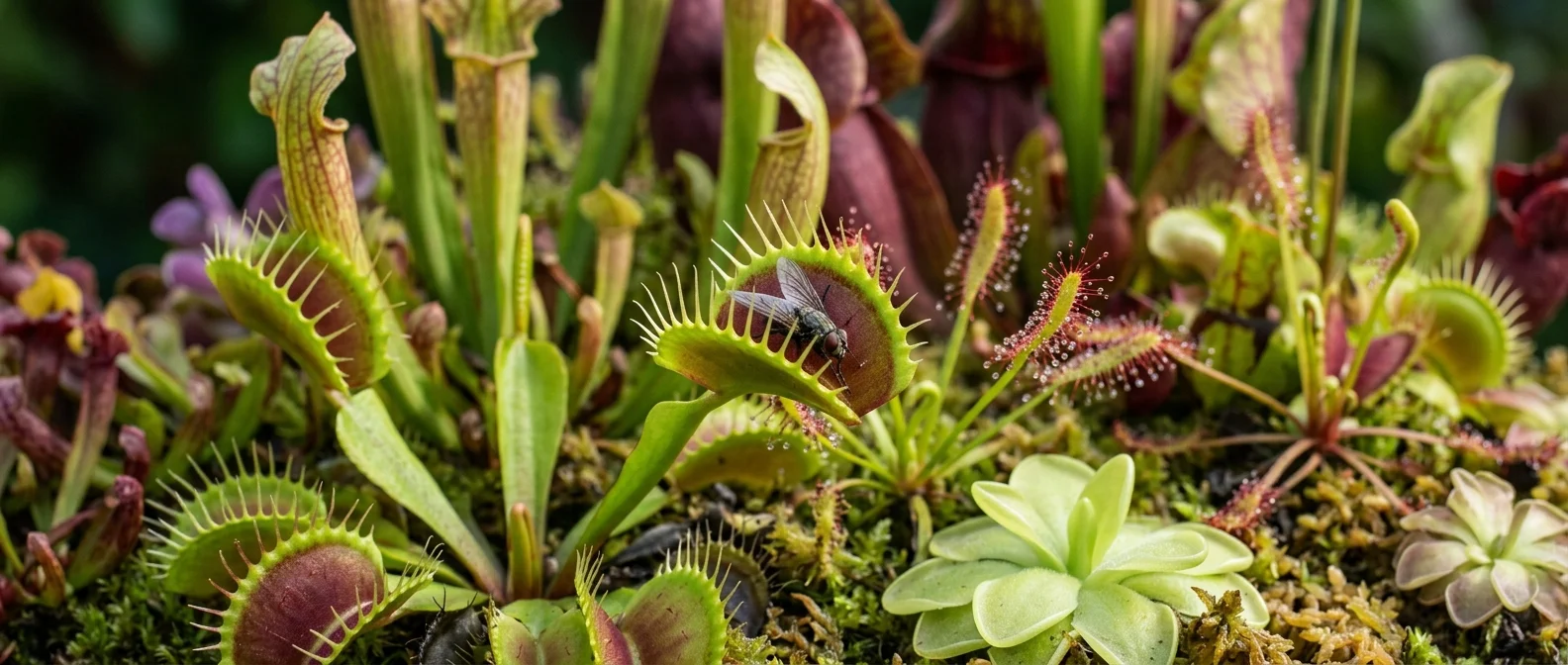
A fly lands innocently on a leaf with a green-red shimmer. It touches a microscopic hair — nothing happens. It touches a second one within 30 seconds — and both lobes snap shut in milliseconds, like jaws. Within hours, an insect begins digesting inside a plant. Carnivorous plants have reversed the rules of the food chain, and modern genomics reveals that the cost of this evolution was far greater than we suspected.
📖 Read more: The 10,000-Year Milk Mutation That Changed Human History
The Green World of Hunters
Over 800 species of carnivorous plants exist on the planet, distributed across at least 12 genetically distinct families — meaning carnivory evolved independently multiple times across different continents and climates. From the boggy soils of North Carolina, where the Venus flytrap (Dionaea muscipula) lives in a natural range of just 120 kilometers radius, to the tropical forests of Southeast Asia where giant Nepenthes drown even mice, these plants developed in soils extremely poor in nutrients — particularly nitrogen and phosphorus. The solution? Take nutrients directly from living sources.

The Electrical Response: A Plant That “Counts” Touches
The Dionaea trap is an engineering marvel: each lobe bears three extremely sensitive trigger hairs. When an insect touches them, each hair emits an electrical signal that spreads through the leaf. The plant doesn't react immediately — it waits for a second signal within 30 seconds, as if “counting” to confirm it's dealing with living prey and not a raindrop. "We discovered that the Venus flytrap counts electrical stimuli, remembers them for a certain time, and finally makes a decision based on the number," explained Rainer Hedrich of the University of Würzburg.
A 2020 study at UZH and ETH Zurich revealed a second, previously unknown strategy: a single slow touch can also trigger the trap. When movement over the hair is slow enough, ion channels in the cell membrane stay open long enough to produce two signals from a single touch. This mechanism likely evolved to catch slow prey — larvae and snails.
The “Click” Mechanism: Why It Closes So Fast
The trap lobes, when open, curve outward — like a stretched spring. The electrical signal causes a minimal change in curvature, enough for the structure to “flip” instantly — a snap-buckling mechanism similar to a contact lens turning inside out. The entire movement completes in 100 milliseconds — faster than a blink. Even more impressive, after the fifth electrical signal, digestive enzyme production begins, and after more signals, the plant opens special nutrient absorption channels from the prey. Step by step, like an algorithm.
Fewer Genes, More Specialization
In 2020, Hedrich and Jörg Schultz's team decoded the genomes of three carnivorous species: Dionaea muscipula, Drosera spatulata (sundew), and Aldrovanda vesiculosa (waterwheel plant). The big surprise was that these plants have unusually few genes: the sundew just 18,111, the Venus flytrap 21,135, and the waterwheel plant 25,123 — while most plants have between 30,000 and 40,000. Specialization in animal food was accompanied by massive gene loss in other functions.

📖 Read more: Why Giant Sequoias Survive Fire: 100-Million-Year Secret
Root Genes in Traps: An Evolutionary Trick
Perhaps the most stunning discovery: most genes functioning in traps exist in slightly modified form in normal plants too — but there they operate in the root. "In carnivorous plants, several genes are activated in the traps that in other plants function only in the root. In the traps, these genes only turn on when prey is secured," Hedrich explained. Evolution's logic is elegant: instead of inventing new genes, it used existing ones for nutrient absorption, simply transferring them from root to leaf. The “payment” was underdevelopment — or complete disappearance — of roots: in the waterwheel plant (Aldrovanda), roots don't exist at all.
Beyond the Venus Flytrap: Sticky, Tubular, and Drowning Traps
The Venus flytrap may win the publicity, but it's not unique. Drosera (sundew) covers its leaves with sticky tentacles that look like dewdrops — insects stick and the tentacles slowly curl around them. Pitcher plants (Nepenthes, Sarracenia) use tubular leaves filled with digestive fluid — a slippery rim ensures insects slide inside with no possibility of climbing out. Utricularia (bladderwort), the fastest hunter in the plant kingdom, sucks microscopic organisms into bladders in milliseconds — like an underwater vacuum cleaner.
The Ancient Duplication That Birthed Hunters
Genomic data revealed that carnivory began with an ancient whole-genome duplication in the common ancestor of the three species, millions of years ago. This genomic doubling of hundreds of additional genes provided evolution with a “playground” for experiments — some copies became carnivory genes, while the rest were gradually lost. Instead of needing thousands of new genes, carnivory relied on an elegant rearrangement of existing genetic material.
Plants That Are Changing Biology
Carnivorous plants aren't just curiosities — they've fascinated scientists for over 200 years, starting with Charles Darwin, who devoted an entire book to “insectivorous plants” in 1875. Today, studying the Venus flytrap's touch-counting mechanism opens doors to bioelectronics and bio-inspired robotics. How a plant without a brain “remembers,” counts, and decides challenges the boundaries between plant and animal intelligence — and proves that evolution can achieve impressive results with very few resources.
Sources:
- Palfalvi, G. et al. «Genomes of the Venus Flytrap and Close Relatives Unveil the Roots of Plant Carnivory.» Current Biology, 2020 — ScienceDaily / University of Würzburg
- Burri, J. T. et al. «A single touch can provide sufficient mechanical stimulation to trigger Venus flytrap closure.» PLOS Biology, 2020 — ScienceDaily / University of Zurich