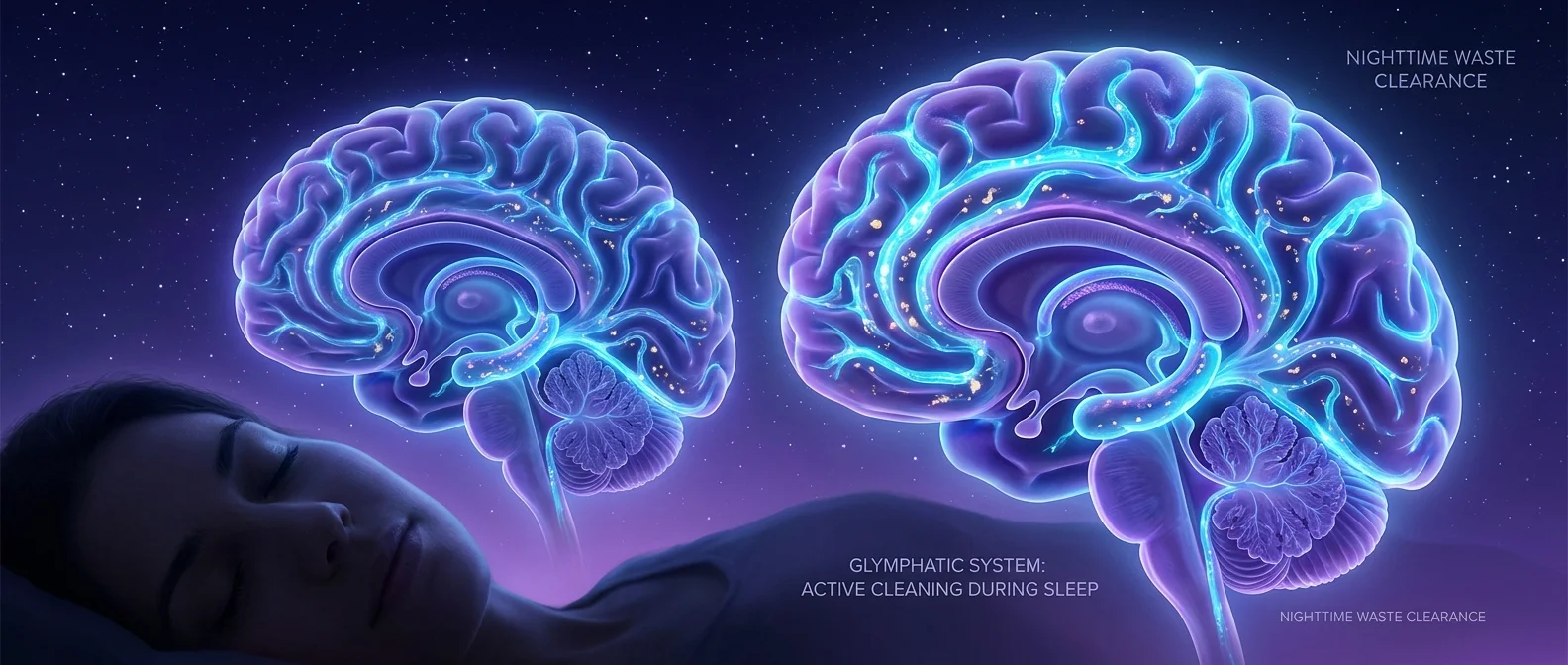
You know that feeling after a sleepless night — the fog, the sense that your brain is operating through molasses. For centuries, scientists wondered why sleep is so essential that every animal with a nervous system requires it. The answer came in 2012 from a lab in Rochester, New York, and it changed everything we knew about the relationship between sleep and the brain: the brain has its own waste disposal system, and it operates almost exclusively when you're asleep.
📖 Read more: 332m Dive Without Breathing: How Does the Body Survive?
A System Hidden in Plain Sight
For decades, the brain was considered an exception. Every other organ in the body — heart, liver, kidneys — has a lymphatic system, a network of thin channels that collects metabolic “garbage” and delivers it to the immune system for recycling. But the brain? Nothing apparent. Or so we thought until recently. Danish neuroscientist Maiken Nedergaard and her team at the University of Rochester revealed that the brain has a parallel system, based on astrocytes — brain cells that for decades were considered merely supportive but now prove to play a starring role.
This system was named the glymphatic system, a portmanteau of “glial cells” and “lymphatic.” It functions as a washing system: cerebrospinal fluid channels along arteries into brain tissue, sweeps up metabolic waste, and extracts it through veins. Think of it as a plumbing system that rinses the brain — literally. What's striking is the scale: roughly 3 pounds (about 1.4 liters) of cerebrospinal fluid is renewed every 24 hours.
Why Only During Sleep?
Here lies the most impressive finding of the research. Nedergaard used fluorescent tracers in mice and observed that cerebrospinal fluid flow through the glymphatic system increases by 60% during sleep compared to wakefulness. Not 10%, not 20% — 60%. The reason lies in astrocytes: during sleep, brain cells shrink by about 20%, creating larger intercellular space for fluid flow.
Imagine a room full of furniture. If you move half of it, suddenly there's space to sweep the floor. That's exactly what the brain does during sleep: it “packs away” cells to let the cleaning fluid through. Wakefulness, with continuous neural activity, doesn't allow space for this process. Basically, your brain must “shut down” to get cleaned. You can't think intensively and detoxify simultaneously — it's biologically impossible.

Beta-Amyloid: The Waste That Kills Neurons
Among the waste removed by the glymphatic system, one stands out and sits at the center of neuroscience: the beta-amyloid protein. This protein, normally present in small amounts, forms plaques between neurons when it accumulates and is considered a central factor in Alzheimer's disease. Experiments in mice show that sleep deprivation alone leads to dramatic increases in beta-amyloid levels — in just one night, with no other changes.
The connection is terrifyingly simple: sleep, the brain washes out amyloids. No sleep, amyloids accumulate. Chronic sleep deprivation means chronic accumulation. This doesn't prove that insomnia “causes” Alzheimer's, but the correlation is consistent and strong across multiple studies — every hour of lost sleep counts biologically. PET studies in humans confirmed that just one sleepless night measurably increases amyloid levels in the hippocampus — the region critical for memory and first affected in Alzheimer's.
Aquaporin-4: The Water Gateway
Astrocytes have specialized water channels on their surface — aquaporin-4s. These microscopic protein gates allow cerebrospinal fluid to enter brain tissue quickly and efficiently, functioning like microscopic mouths of an irrigation system. Without them, fluid cannot penetrate tissue and cleaning is impossible. In experiments with genetically modified mice completely lacking aquaporin-4, glymphatic function was drastically reduced — waste remained undisposed in the brain, gradually accumulating and causing inflammation and damage, like sewage water that can't find drainage.
Age dramatically affects these gates. In elderly mice, aquaporin-4s lose their proper orientation — instead of being on the outer side of the astrocyte, they “relocate” inward, reducing functionality. This may explain why elderly people have less effective brain detoxification — and why neurodegenerative diseases appear mainly after age 65. The hope is that future therapies will be able to restore proper aquaporin orientation and restart glymphatic function in aging brains.
📖 Read more: 385-Million-Year-Old Forest Discovered Hidden in Stone
Deep Sleep and Slow Waves
It's not enough to sleep — you must sleep correctly. And this is crucial. The glymphatic system activates primarily during deep sleep phase, also known as slow-wave sleep — the phase where we don't dream and the brain is in its most “quiet” and relaxed state, ideal for cleaning. In this phase, the brain produces synchronized low-frequency electrical waves that appear to function as a “pump,” rhythmically pushing fluid through tissue, like a pump beating in slow, steady rhythm.
Recent research shows that body position during sleep plays a role. Experiments on awake and sleeping mice found that lateral body position (sleeping on the side) favors glymphatic flow more than supine or prone positions. Researchers note that lateral position is also the most popular sleep position in humans and animals — did evolution lead us there? This remains a hypothesis, but the data provoke curiosity and discussion in the scientific community.

Alcohol, Anesthesia and Paradoxes
A striking result came with alcohol. Low doses of alcohol — equivalent to one glass of wine per day — increased glymphatic function in mice. High doses, conversely, collapsed it and caused inflammation in astrocytes. This aligns with epidemiological data showing lower dementia risk in moderate drinkers — though the recommendation to “drink a little for your brain” remains extremely controversial in the medical and research community, because alcohol has many other negative effects.
General anesthesia also activates glymphatic flow — logical, since anesthesia physiologically resembles deep sleep. However, it never replaces natural sleep, because it lacks the characteristic cyclical phase alternation, dream activity, memory consolidation, and emotional processing that accompany a complete night. Sleep isn't simply an “off” state — it's an active and multifaceted process serving multiple critical functions simultaneously, from memory to detoxification.
What This Means for Us
The discovery of the glymphatic system finally gave a biological explanation for why sleep isn't luxury but a survival necessity. Every night you sleep 7-8 hours, you give your brain time to wash out toxins that accumulated during the day. Every night you cut sleep short, those wastes stay behind. Think about the days you stayed up all night, that heavy feeling in your head — now you know what's happening: the brain literally hasn't been cleaned. The damage isn't just to performance, it's molecular and measurable.
The Future of Brain Detoxification
Scientists worldwide are examining whether they can enhance glymphatic flow pharmacologically — perhaps by opening more aquaporins, perhaps by increasing slow-wave frequency with transcranial stimulation. If something like this succeeds, it could radically change treatment of neurodegenerative diseases like Alzheimer's and Parkinson's. For now, the most effective strategy is the most obvious: sleep well, sleep enough, sleep every night without interruption. Your brain will thank you — even if you don't feel it immediately.
Sources:
- Xie, L. et al. “Sleep drives metabolite clearance from the adult brain.” Science, 342(6156), 373-377, 2013
- Nedergaard, M. “Garbage truck of the brain.” Science, 340(6140), 1529-1530, 2013