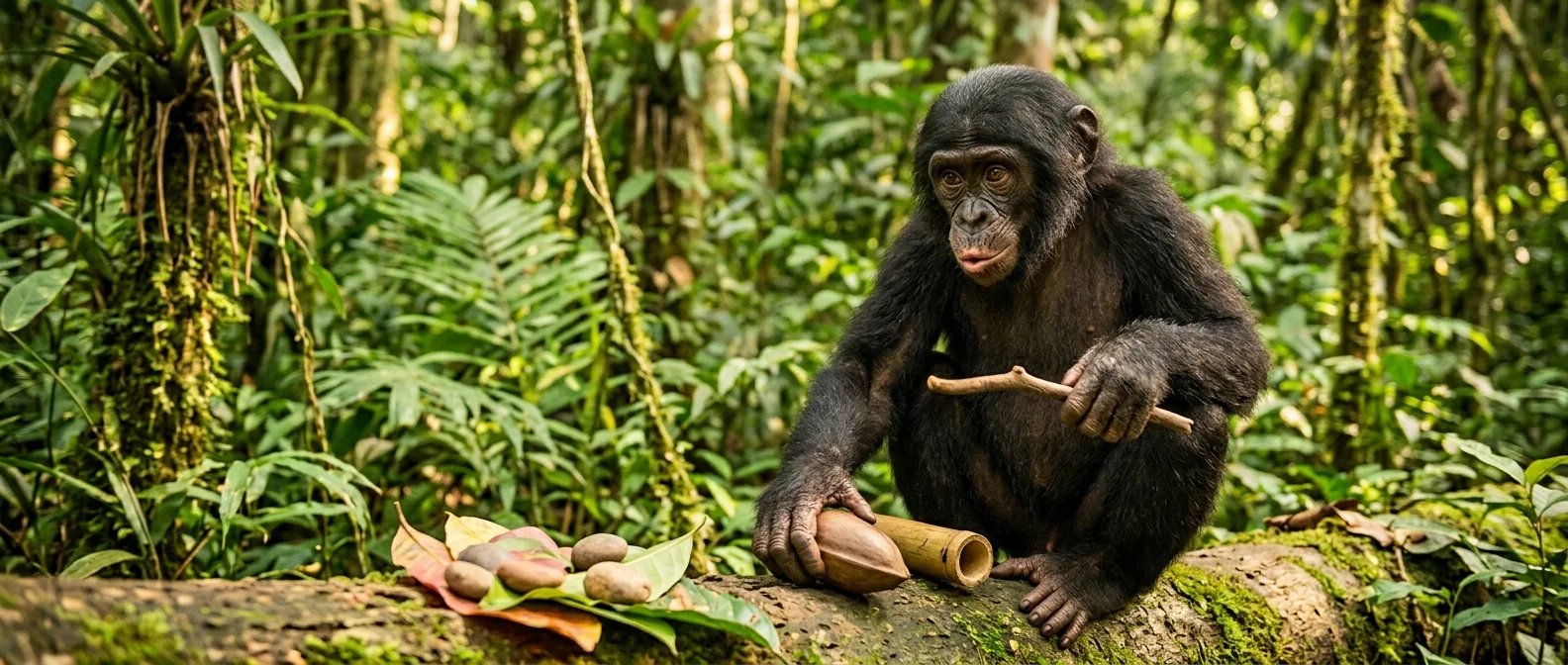
A researcher stands before two empty cups. Inside a sterile lab room, he does something strange: pretends to pour juice from an empty pitcher into one cup, then the other. No juice exists anywhere. Across from him, a bonobo named Kanzi watches — then consistently points to the correct cup. This bonobo just tracked imaginary juice. And knew where it went.
📖 Read more: Archaeopteryx: The First Bird That Ever Flew
🎭 What Does “Pretend Play” Actually Mean?
Children under 2 begin role-playing — serving tea in empty cups, feeding dolls imaginary food, pretending to talk on phones. These seemingly innocent activities hide something profound: they require creating mental representations of objects that don't exist. Imagination, in other words.
Until recently, science considered this ability exclusively human. Some anecdotal evidence existed — a three-year-old chimpanzee in Guinea was observed playing with a handmade leaf pillow, placing it on his head like a hat. A captive bonobo “picked” and “ate” blueberries from a photograph of real berries. But these were isolated observations, open to alternative explanations — perhaps the animals believed the imaginary objects were real.
🧪 The Experiment: Imaginary Juice in Real Science
In February 2026, a study published in Science changed everything. Researchers Christopher Krupenye, assistant professor of psychological and brain sciences at Johns Hopkins University, and Amalia Bastos, comparative psychology researcher at the University of St Andrews, designed an experiment inspired by children's tea parties.
First, Kanzi was trained to indicate which cup contained real juice. Two transparent cups before him: one full, one empty. He performed perfectly — 100% success across 18 trials. Then came the critical test.
A researcher placed two transparent empty cups on the table. He pretended to pour juice from an empty pitcher into each one. Then, he poured the “imaginary juice” from one cup back into the pitcher. Kanzi was asked: where's the juice? He identified the correct cup in 68% of trials. No one told him if he was right, no one rewarded him.

🍇 No Confusion: He Distinguished Real from Imaginary
A critical question remained: did Kanzi actually believe juice existed in the cups? To test this, researchers designed a second experiment. They placed a cup filled with real juice next to a cup “imaginarily filled.” If Kanzi believed both contained juice, he'd choose them equally.
He didn't. He selected real juice 77.8% of the time — proving he clearly distinguished reality from fantasy.
🔬 The Third Trial: Imaginary Grape
Co-researcher Amalia Bastos wanted even greater certainty. They repeated the procedure, this time with an imaginary grape instead of juice. Kanzi correctly located the imaginary grape's position in 68.9% of trials. "By the time we finished the third experiment, I was very confident that what we saw was what we saw," Bastos stated.
🧬 Who Was Kanzi?
Kanzi wasn't just any bonobo (Pan paniscus). Born in 1980, he died in March 2025 at age 44. He understood English — in a 1993 study, he executed brand-new commands like “put on the monster mask and scare Linda” with 75% success, even outperforming a 2.5-year-old child. He communicated through lexigram boards — visual symbols for names, objects, actions, and locations. He even had unique sounds for “yes” and “no.”
According to evolutionary anthropology professor Simon Townsend from the University of Zurich, Kanzi possessed the most advanced linguistic skills documented in a non-human primate. "He learned symbolic communication, which is a hallmark of another species' communication system," Townsend explained.
English Comprehension
Executed new English commands with 75% success — outperforming a 2.5-year-old child.
Lexigrams
Used visual symbol boards for names, actions, and locations in complex communication.
Pretend Play
First experimental proof that a great ape can track imaginary objects through space.
Close Relative
Bonobos share 98.7% of our DNA — our closest relatives alongside chimpanzees.

💡 Why This Changes Everything
"We were really in awe of this finding," Krupenye stated. "What we're seeing is that something that seems fundamentally human and appears early in our development is shared with our closest relatives."
This means the ability to imagine non-existent objects may have evolved before humans and bonobos split evolutionarily — over 6 million years ago. We didn't “invent” imagination. We likely inherited it from a common ancestor living in African forests, long before the first Homo sapiens walked the earth.
Laura Simone Lewis, evolutionary anthropologist and psychologist at the University of California, Santa Barbara, called the discovery “a huge development for the field” because it "provides direct evidence supporting anecdotal reports that great apes can use their imagination."
🔎 The Study's Limitations
The study isn't without constraints — something the researchers themselves acknowledge. Only one bonobo was tested. Harvard psychologist Paul Harris noted that "it would be a big leap to say this is comparable to what we see in 2-year-old children, where you typically observe regular production of pretense, like drinking from empty cups."
The critical distinction: Kanzi could understand pretense created by humans. He didn't prove he could spontaneously generate pretend scenarios himself — serving imaginary tea to friends or feeding imaginary fruit to other animals. This spontaneous production of fantasy scenarios typically appears in human children around age two. But understanding alone represents a significant discovery — it shows that mental representation of imaginary objects isn't exclusively our privilege.
🌍 What's Next: Imagination in Great Apes
Krupenye and Bastos now hope imagination studies in animals will expand to chimpanzees, gorillas, and orangutans. "If the anecdotal evidence is correct, it should be the case that other great apes share this same ability," Krupenye noted.
🧩 Imagination as an Evolutionary Tool
Why would the ability to track imaginary objects have evolutionary advantage? Consider an animal foraging in the forest. If it can remember where food “could” exist based on previous experience — even without seeing it — it has better survival odds. Imagination, in its most primitive form, is a way to predict without evidence. And that could have been crucial for our ancestors — human and non-human alike.
Kanzi died in March 2025, months before the study that made him the protagonist of a scientific revolution was published. He couldn't know what this meant for science. But at one point in the experiment, he sat before two cups with nothing inside them, watched an invisible liquid move — and understood where it went. We once thought only humans could do that.