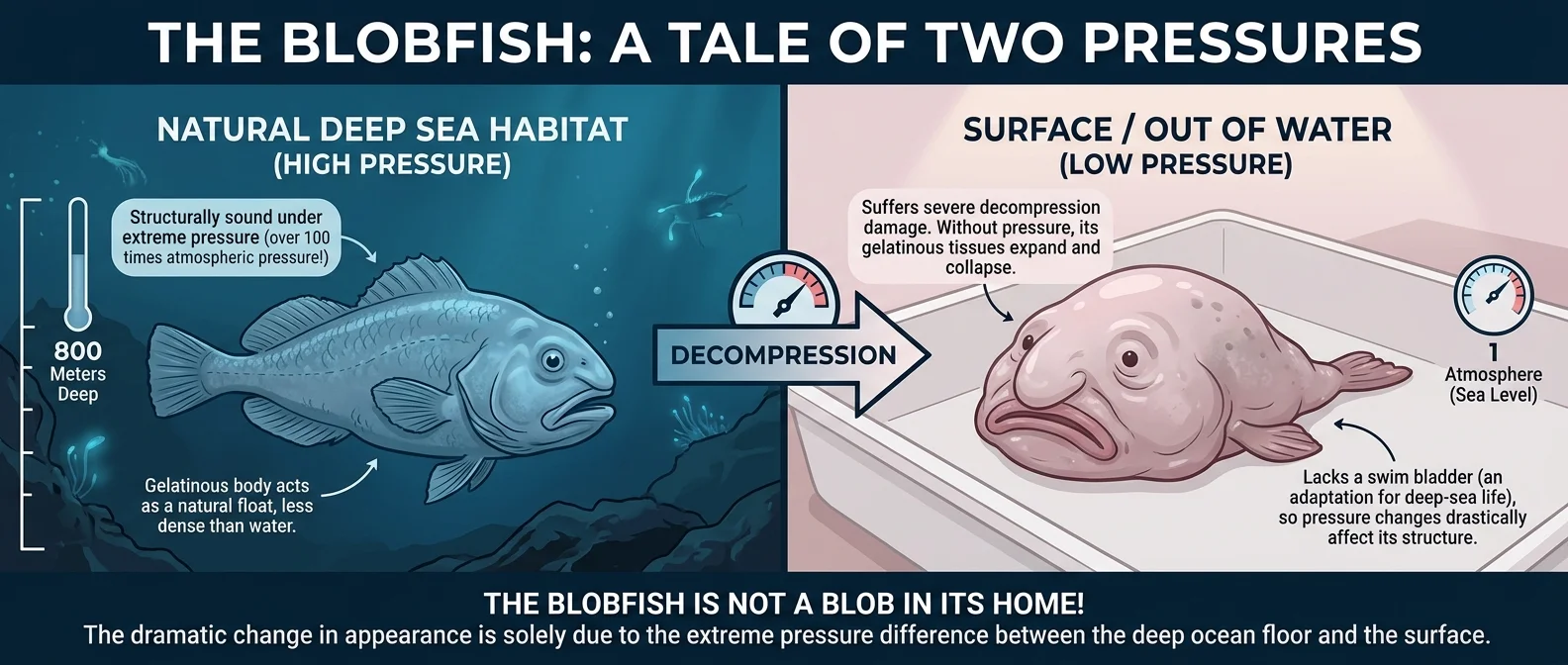
In 2013, a pink, shapeless creature with a droopy face was voted “the world's ugliest animal.” The photo went viral, spawning thousands of memes and laughs. But what if that famous image is completely misleading? What if the blobfish, in its natural habitat, looks like a perfectly normal fish?
🏆 The Vote That Created a Meme
In 2013, the British Ugly Animal Preservation Society organized an online poll to find the planet's ugliest animal — aiming to highlight endangered species that don't get attention due to their appearance. The winner was the blobfish (Psychrolutes marcidus) by a landslide. The image used — a pink, fleshy blob with sagging features — continues to circulate in memes, t-shirts, and coffee mugs. But that image doesn't show a blobfish. It shows a dead, decompressed specimen that has undergone catastrophic structural collapse.
🐡 What the Blobfish Actually Is
The blobfish belongs to the family Psychrolutidae (also known as “fatheads”), a group of deep-sea fish living at depths of 600 to 1,200 meters in the waters off southeastern Australia, Tasmania, and New Zealand. In its natural environment, the blobfish looks like a normal fish — with relatively standard features, proper proportions, and a small, rounded body.
Its key adaptation? The body consists of gelatinous tissue with a density slightly less than seawater. This means the blobfish doesn't need a swim bladder to hover above the seafloor — something that would be impossible at this depth, as the pressure would crush any air-filled cavity. Instead of actively swimming, it hovers passively near the bottom and eats whatever organic matter drifts by — crabs, sea urchins, mollusks.
Its skeleton is minimally calcified — the bones are soft and flexible, designed to withstand pressure rather than provide structural rigidity. Its muscles are sparse and weak compared to surface fish, but at its depth it doesn't need speed — food is abundant on the seafloor and there are no fast competitors. This “low-energy” strategy is common among many deep-sea species.

💀 Decompression — What Destroyed Its Reputation
Here lies the entire problem. When deep-sea fish are brought to the surface — usually as bycatch in bottom trawl nets — they undergo rapid decompression. The pressure drops from 60-120 atmospheres to 1 atmosphere within minutes.
For a fish made of gelatinous tissue, this means literal collapse. The tissue that was solid and functional at depth now loses the mechanical support that pressure provided. Result: a shapeless, pink blob — the famous photo. It's like criticizing a deep-sea submersible because it looks different after you've crushed it.
Key Understanding
Dr. Thomas Linley from Newcastle University explained about deep gelatinous fish: "Their gelatinous composition means they are perfectly adapted to living at extreme pressure. The hardest structures in their bodies are the bones of the inner ear (for balance) and their teeth. Without the extreme pressure and cold, they are extremely fragile and deteriorate quickly when brought to the surface."
🌊 The World of Gelatinous Fish
The blobfish isn't unique. It represents an entire category of deep-sea fish that have abandoned bones, scales, and swim bladders in favor of a gelatinous, low-density body. The most well-known belong to the family Liparidae (snailfish) — a group with over 400 species worldwide that dominates the deepest parts of the oceans.
Gelatin Instead of Bones
Without air cavities and with soft skeletons, gelatinous fish internally balance external pressure — a strategy that fails outside the deep sea.
Cold and Darkness
Temperature 2-4°C, zero light. Slow metabolism allows these fish to survive on minimal food — floating like ghosts above the seafloor.
3 New Species (2018)
The Newcastle University expedition to the Atacama Trench discovered three new snailfish at 7,500m — the pink, blue, and purple Atacama Snailfish.
Apex Predators
At the greatest depths, snailfish are apex predators — without competitors, they feed on abundant amphipods.
Bumpy Snailfish (2025)
MBARI discovered the pink, “bumpy-skinned” snailfish (Careproctus colliculi) at 3,268m in Monterey Canyon — a female just 9.2 cm long.
400+ Species
The Liparidae family includes over 400 species — from shallow tidal pools to the deepest ocean trenches.
Dr. Mackenzie Gerringer, a deep-sea physiology specialist at SUNY Geneseo, emphasizes: "The deep sea hosts incredible diversity of organisms and a truly beautiful range of adaptations. The discovery of three new snailfish species is a reminder of how much we still have to learn about life on Earth."

🔬 The Expedition That Revealed Their World
In 2018, a team of 40 scientists from 17 countries, led by Dr. Alan Jamieson and Dr. Thomas Linley of Newcastle University, conducted an expedition to the Atacama Trench — a 6,000 km long trench over 8,000m deep off the coasts of Peru and Chile.
Using two landers with HD cameras and traps, they recorded over 100 hours of video and 11,468 photographs at depths from 2,537 to 8,000 meters. Among the discoveries: three new snailfish that were actively feeding, moving quickly, and appeared “quite well fed” according to Dr. Linley.
In Natural Environment
Small, semi-transparent, scaleless. Active, mobile, feeding on amphipods. Apex predators at their depths. Normal fish shape.
After Decompression
Shapeless, fleshy mass. Gelatin collapses without pressure. “Deteriorate quickly” according to researchers. The image that became a meme.
The same expedition also captured rare footage of Munnopsid isopods — crustaceans the size of a human palm with extremely long legs that swim upside down backwards before “landing” on the seafloor and spreading their legs like spiders. A world operating by rules completely different from our own.
🛡️ Why Truth Matters
The blobfish story isn't just about one fish — it's about how we perceive nature. An entire species was demonized because we saw a photo of a dead, destroyed specimen and considered it “normal” appearance. We didn't think that bringing a creature from 800 meters depth to the surface is equivalent to taking a fish into the vacuum of space.
"There is something about snailfish that allows them to adapt to living very deep. Beyond the range of other fish, they are free from competitors and predators. Their gelatinous composition means perfect adaptation — but without pressure, they deteriorate."
— Dr. Thomas Linley, Newcastle University (2018)Today, the main threat to the blobfish isn't memes — it's bottom trawling. Massive nets scrape the seafloor at depths of 600-1,200m, dragging up blobfish as bycatch. The species doesn't reproduce quickly, and every fish brought to the surface dies. With the deep sea facing pressures from climate change, pollution, and mining, protecting these invisible ecosystems becomes increasingly urgent.
MBARI, in 38 years of operation, has discovered over 300 new species. In 2025, Steven Haddock's team used the ROV Doc Ricketts in California's Monterey Canyon and discovered three new snailfish — including Careproctus colliculi, a pink fish with bumps just 9.2 centimeters long. The identification required micro-CT scans, DNA sequencing, and morphological analysis — reminding us that even in “known” areas, the deep sea holds surprises.