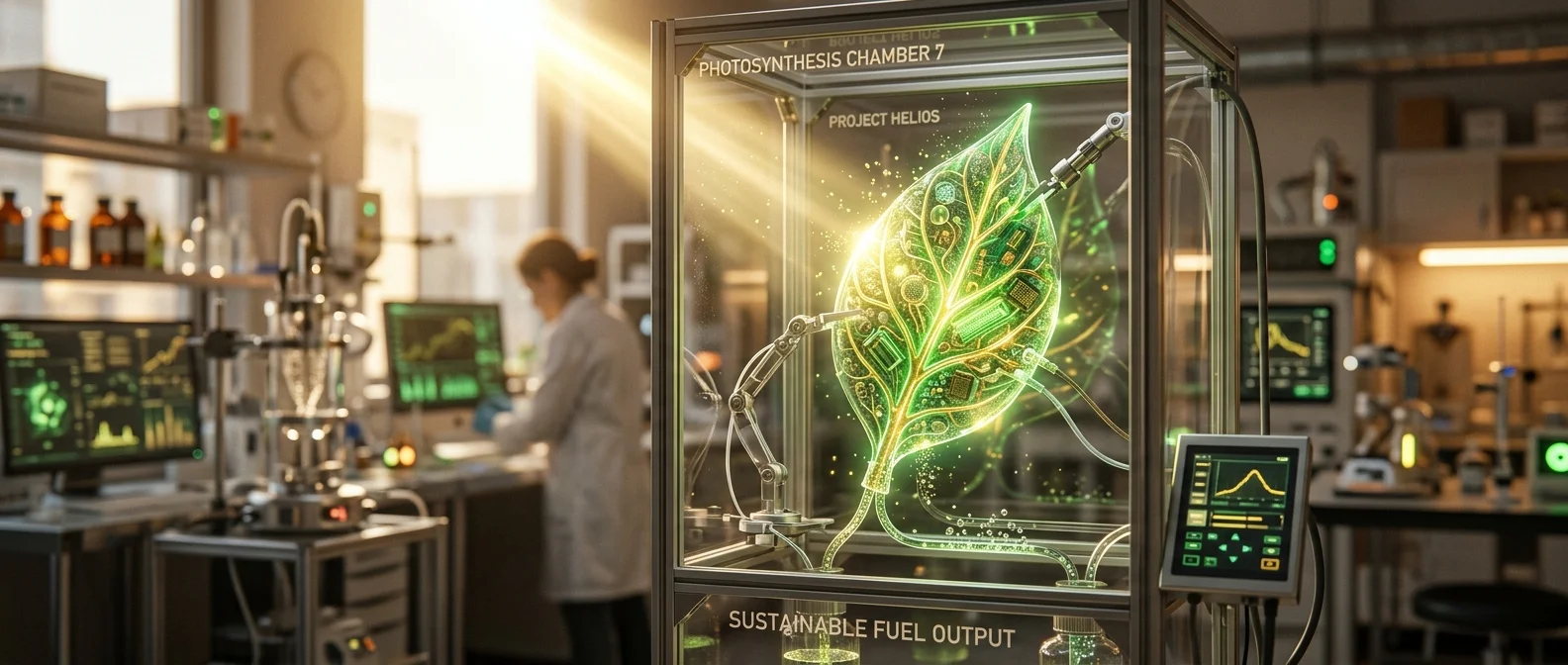
Every green leaf on every tree performs something no factory on Earth can efficiently replicate: converting sunlight, water, and CO₂ into chemical energy — silently, at room temperature, with zero toxic waste. What if we could artificially copy this process? Artificial photosynthesis is no longer science fiction — it's a rapidly advancing field promising clean fuels from sun and water.
📖 Read more: 10 Mind-Blowing Facts About Your Body You Never Knew
How Natural Photosynthesis Works
Before understanding the artificial, we should marvel at the natural. Photosynthesis evolved 2.4 billion years ago in cyanobacteria — and transformed the planet, filling the atmosphere with oxygen (Great Oxidation Event). In plants, the process splits into two phases: light reactions (in chloroplast thylakoids, where chlorophyll absorbs photons, splits water into H⁺ + O₂, and produces ATP + NADPH) and the Calvin cycle (in the stroma, where CO₂ is fixed and converted to glucose using ATP/NADPH). The efficiency? Just 1-2% of solar energy converts to chemical energy.
This 1-2% seems low — but it powers the entire biosphere: plants capture roughly 130 terawatts of energy annually, six times global human consumption (about 18 terawatts). The limitation isn't physics — it's biology: the enzyme RuBisCO (ribulose-1,5-bisphosphate carboxylase/oxygenase, Earth's most abundant protein at roughly 700 million tons) makes mistakes, binding O₂ instead of CO₂ (photorespiration), wasting about 25-30% of captured energy. Artificial photosynthesis aims to keep the physics but replace biology with more efficient chemistry.
Nocera's Artificial Leaf
In 2011, Daniel Nocera at MIT published in Science what many called an "artificial leaf": a thin silicon wafer coated with cobalt phosphate catalyst (CoPi) on one side and a nickel-molybdenum-zinc alloy on the other. Submerged in water under sunlight, the wafer splits water molecules: one side produces oxygen, the other hydrogen.
The revolution wasn't water splitting (electrolysis was first demonstrated by Nicholson and Carlisle in 1800) — it was simplicity and cost. The CoPi catalyst self-repairs: if damaged, it recreates itself during operation — exactly like photosystem II in plants replaces the D1 protein every 30 minutes. It works at neutral pH (clean or dirty water, even river water), without expensive platinum or iridium metals required by conventional electrolyzers. Nocera envisioned cheap units powering homes in developing countries: “Every house, its own gas station.”

📖 Read more: 12-Meter Crystal Cave: Life Thrives in Extreme Heat
Bionic Leaf 2.0: Bacteria + Solar Power
In 2016, Nocera (now at Harvard) collaborated with microbiologist Pamela Silver and published in Science the “bionic leaf 2.0.” Instead of simply producing hydrogen, they added the bacterium Ralstonia eutropha to the system. The solar catalyst splits water into hydrogen, and bacteria use this hydrogen with atmospheric CO₂ to synthesize isopropanol (liquid fuel) or bioplastics (PHB). The efficiency? 10% — ten times natural photosynthesis.
This conversion rate means theoretically, a 4 × 4 meter surface could produce enough fuel for a household in a developing country. The system operates autonomously: air + water + sunlight = liquid fuel. The first bionic leaf (1.0) used a nickel-molybdenum catalyst that produced reactive oxygen species (ROS) killing bacteria — 2.0 solved this with a cobalt-phosphorus alloy producing clean hydrogen without ROS. The team also experimented with modified bacteria producing lipids, drug precursors, even soil bio-stimulants — essentially converting sunlight into whatever the chemical industry needs.
Photoelectrochemical Cells: The Industrial Approach
Parallel to “leaves,” photoelectrochemical cells (PEC cells) are being developed. These use semiconductors (BiVO₄, Fe₂O₃, TiO₂) as photoanodes — absorbing light, creating electron-hole pairs, and oxidizing water. At the cathode, electrons reduce CO₂ to carbon monoxide (CO), methanol, or ethylene — basic chemical industry feedstocks.
The major problem remains stability: photoanodes corrode within hours or days in aqueous environments — unlike plants that repair their photosystems in real-time. Researchers at Caltech, JCAP (Joint Center for Artificial Photosynthesis), and Max Planck Institute are developing protective TiO₂ and NiFeOₓ nanocoatings extending lifetimes to hundreds of operating hours without significant performance loss.

📖 Read more: 18,000 Dinosaur Tracks on Bolivia's Vertical Rock Wall
CO₂ to Fuels: Closing the Carbon Loop
The most ambitious application isn't simply hydrogen production — it's converting atmospheric CO₂ into hydrocarbons. If we could use solar energy to convert atmospheric CO₂ into gasoline, diesel, or aviation kerosene (Sustainable Aviation Fuel — SAF), we'd close the carbon loop: fuels burn, release CO₂, and artificial photosynthesis recreates them. Net-zero carbon footprint. Aviation especially cannot easily electrify due to energy density — SAF from artificial photosynthesis may be the only viable solution for long-haul flights, a problem affecting 4.5 billion passengers annually.
Single-atom copper catalysts (Cu single-atom) on graphene substrates have shown over 70% selectivity to ethylene — a molecule forming the basis of polyethylene, polyester, and dozens of chemical products. The challenge is scale: these lab experiments produce micrograms — industry needs tons. The JCAP (Joint Center for Artificial Photosynthesis) program from the US DOE is investing over $122 million to address this scaling challenge — from lab to factory.
Synthetic Biology: Enhanced Photosynthetic Bacteria
An alternative approach uses synthetic biology to modify photosynthetic organisms. Cyanobacteria (Synechocystis, Synechococcus) have been genetically modified to secrete ethanol, butanol, or isoprene directly — without requiring biomass harvesting. Joule Unlimited (before closing) had demonstrated cyanobacteria producing 15,000 gallons of ethanol per acre — 10 times more than sugarcane.
Meanwhile, the RIPE (Realizing Increased Photosynthetic Efficiency) program genetically modifies crop plants (Glycine max, Oryza sativa) to reduce photorespiration. By adding a more efficient bacterial glycolate metabolism pathway to tobacco chloroplasts, the RIPE team significantly increased productivity by 40% in field trials — clearly proving natural photosynthesis can be dramatically improved.
📖 Read more: 2,000-Year-Old Seed Sprouts: Date Palm from Herod's Era
Quantum Phenomena and Photosynthesis
Berkeley researchers discovered that the photosynthetic energy transfer chain exploits quantum coherence: excitons (energy packets) simultaneously explore multiple pathways through protein antennas, “finding” the most efficient route in femtoseconds (thousandths of a billionth of a second). Energy transfer efficiency approaches 99%. The Engel and Fleming study in Nature (2007) was the first to show quantum coherence in a biological system at room temperature — shocking the physics world. If artificial nanomaterials copy this, solar catalysts will change radically.
When Will Fuels Change?
The biggest obstacle isn't chemistry — it's economics. Today, green hydrogen from electrolysis (PEM or alkaline) costs $4-6/kg, while gray hydrogen (from steam reforming natural gas) costs $1-2/kg. Artificial photosynthesis must bring costs below $2/kg to compete — a target the European Union sets for 2030 through its hydrogen strategy. Meanwhile, hydrogen storage requires high pressures (700 bar) or cryogenic temperatures (-253°C) — which is why direct production of liquid fuels (methanol, ethanol) is more attractive for immediate use.
If nature took 2.4 billion years to perfect photosynthesis, humanity has been trying for just 50 years. Progress is exponential: efficiency tripled in a decade, catalyst costs dropped 90%, and the first generation of pilot plants is already being tested in Germany, Japan, and the US. The leaf is the most successful energy machine in Earth's history — and we're finally learning how to copy it.
Sources:
- Nocera, D.G. et al. (2011). “In Situ Formation of an Oxygen-Evolving Catalyst in Neutral pH Conditions.” Science, 334(6056), 645-648. DOI: 10.1126/science.1209816
- Liu, C., Colón, B.C., Ziesack, M., Silver, P.A. & Nocera, D.G. (2016). "Water splitting-biosynthetic system with CO₂ reduction efficiencies exceeding photosynthesis." Science, 352(6290), 1210-1213. DOI: 10.1126/science.aaf5039