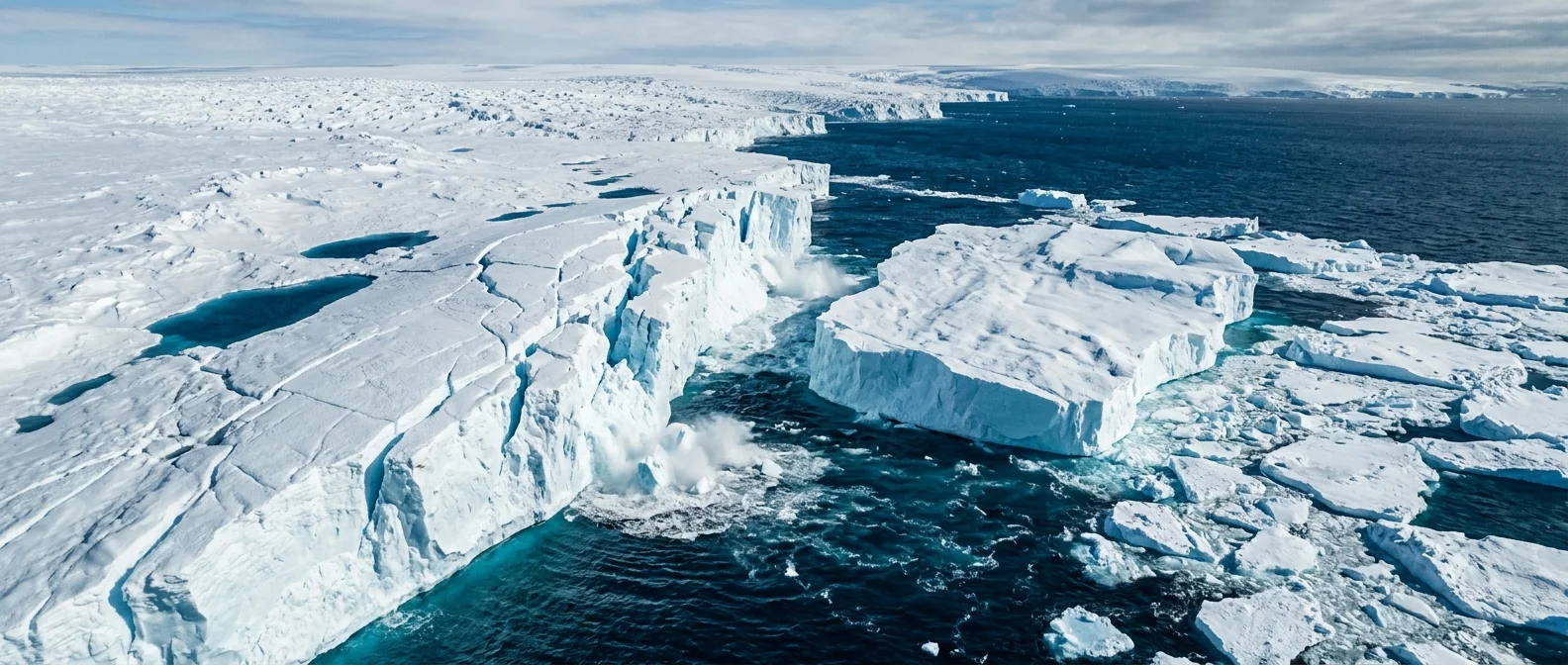
Picture an ice mass larger than France vanishing in just a few decades. This isn't science fiction — it's happening right now. Antarctica dumps roughly 150 billion tons of ice into the ocean every year, and the rate tripled after 2012. The Thwaites glacier — dubbed the "Doomsday Glacier" — could single-handedly raise global sea levels by over 60 centimeters if it collapses completely. This isn't just about penguins. It's about hundreds of millions of people living in coastal cities worldwide. Yet despite the gravity of this crisis, most people have no clue how fast Antarctica is changing — because it's far away, cold, and invisible. The truth is that Antarctica controls the climate of the entire planet — including your local weather.
📖 Read more: Polar Bears in Mud: The Harsh Reality of 2026
📖 Read more: Narwhal: Real-Life Unicorn Finally Reveals Its Secrets
Antarctica by the Numbers: How Much Ice Are We Talking?
Antarctica's ice sheet contains 26.5 million cubic kilometers of ice — enough to raise global sea levels by 58 meters if it melted completely. It's the planet's largest refrigerator, reflecting solar radiation back to space through the albedo effect. The ice covers 14 million square kilometers — larger than all of Europe. Until recently, scientists believed East Antarctica was stable. Now, satellite data shows even this massive ice sheet is losing mass — slowly but steadily. The Totten and Moscow University glaciers in East Antarctica show signs of instability, contradicting what scientists thought they knew. If East Antarctica starts losing mass at rates similar to West Antarctica, sea level rise projections will need radical upward revision.
Thwaites: The Doomsday Glacier
Thwaites is a West Antarctic glacier roughly the size of Great Britain. The problem isn't just that it's melting — it's that it sits on bedrock below sea level. Warm ocean water sneaks underneath the ice, melting it from below. This mechanism — marine ice sheet instability (MISI) — can trigger runaway collapse. A 2022 study in Nature Geoscience found that Thwaites' grounding line is retreating at 2 kilometers per year — double the rate from the 1990s. If it collapses, it will drag neighboring glaciers with it, raising sea levels by 3 meters total over centuries. The International Thwaites Glacier Collaboration, a $50 million US-UK partnership, has deployed underwater robots beneath the glacier to map its base — revealing unsettling discoveries. Researchers discovered massive cracks in the foundation, plus warm water penetrating areas they didn't expect. The possibility of sudden collapse is no longer theoretical. Thwaites may be the most dangerous glacier on Earth — and most people have never heard its name.

Why So Fast? The Warm Current Problem
The main culprit isn't warm air — it's warm ocean currents. Circumpolar Deep Water (CDW), at 1-2°C above freezing, reaches glacier bases. Every degree Celsius above 0°C melts massive amounts of ice when applied across hundreds of kilometers of ice front. Climate change strengthens westerly winds around Antarctica, pushing warmer water into shallow areas. It's a vicious cycle: more melting means less light reflection, which means more heat absorption, which means even faster melting. Scientists call it "positive ice-albedo feedback" — and it's one of the most dangerous mechanisms in climate science. Antarctica isn't melting because it's hot there — it's melting because it's hot everywhere else.
📖 Read more: Silent Death: Why Forests Are Dying Quietly in 2026
What Satellites Reveal: GRACE Exposes the Truth
GRACE (Gravity Recovery and Climate Experiment) satellites measure gravity changes that correspond to ice mass variations. Their data reveals that between 2002 and 2023, Antarctica lost over 2.7 trillion tons of ice. To put this in perspective: that's enough ocean water to cover all of France with a 5-meter layer. And the rate is accelerating: from 76 billion tons per year (2002-2011) to over 150 billion tons per year (2012-2023). Essentially, Antarctica loses ice at a rate that would fill Lake Erie every 3 years. The acceleration continues.
Who's at Risk: Coastal Cities in the Crosshairs
Every centimeter of sea level rise counts. Cities like Shanghai, Jakarta, Miami, Alexandria, and Kolkata sit at elevations below 2 meters. By 2100, even conservative scenarios predict 30-60 centimeters of rise. In worse scenarios, over 1 meter. This means permanent flooding, soil salinization, destroyed infrastructure, and hundreds of millions of climate refugees. Antarctica may seem distant, but every ton of ice it loses becomes water at someone's doorstep. A 2021 study calculated that just half a meter of sea level rise would displace over 340 million people globally. The numbers don't lie — current emission rates make this inevitable. Greece, with thousands of kilometers of coastline and dozens of low-lying islands, is among Europe's most vulnerable countries to sea level rise.

📖 Read more: 5,000-Year-Old Tree: Methuselah Still Standing
Ecosystems in Crisis: Penguins, Krill, Seals
Sea ice isn't just frozen water — it's an ecosystem. Beneath it, algae flourish, feeding krill (Euphausia superba), the foundation of the entire Antarctic food web. Less ice means less krill, which means fewer penguins, seals, and whales. Emperor penguin colonies have already been forced to relocate due to premature ice melting. A 2023 study in Communications Earth & Environment documented complete reproductive failure in four colonies — not a single chick survived.
Points of No Return: The Tipping Points
Climate scientists warn of "tipping points" — temperatures beyond which collapse becomes irreversible. For West Antarctica, this may occur with planetary warming of 1.5-2°C above pre-industrial levels — dangerously close to current conditions. West Antarctica may have already passed the point of no return — we don't know for certain yet, but every year of delay increases the risk. Once the MISI mechanism activates, even if we zero out emissions, collapse continues. It's like dominoes: you don't need to push every piece — just the first one. And the first one may already be falling. In 2023, Antarctic sea ice broke the record for minimum extent, with 2.6 million square kilometers less than average — as if an area larger than Greenland had vanished. This event shocked even the most experienced climatologists — no model had predicted such dramatic decline so early.
What Can Be Done — and What Can't
Some of the lost ice won't return for thousands of years. But the speed is up to us. Aggressive emission reductions can keep the rate of loss low, giving societies time to adapt. The international community must treat Antarctica as a global commons — not as a remote continent without inhabitants. Every plane that takes off, every factory that burns coal, every forest that gets cut sends a little more heat to the ice. And ice doesn't forget. It doesn't forgive. What we send into the atmosphere today will determine the planet's map in 100 years. The choices of the next few decades will be visible in geography for millennia. Cities will sink, islands will disappear, coastlines will change forever.
"Antarctica is the canary in the coal mine of our planet. If we don't listen, we'll pay in meters, not centimeters."
— Richard Alley, glaciologist, Penn State UniversitySources:
- Rignot, E. et al. — "Four decades of Antarctic Ice Sheet mass balance from 1979–2017", Proceedings of the National Academy of Sciences, 2019
- Fretwell, P. T. & Trathan, P. N. — "Emperor penguins and climate change", Communications Earth & Environment, 2023