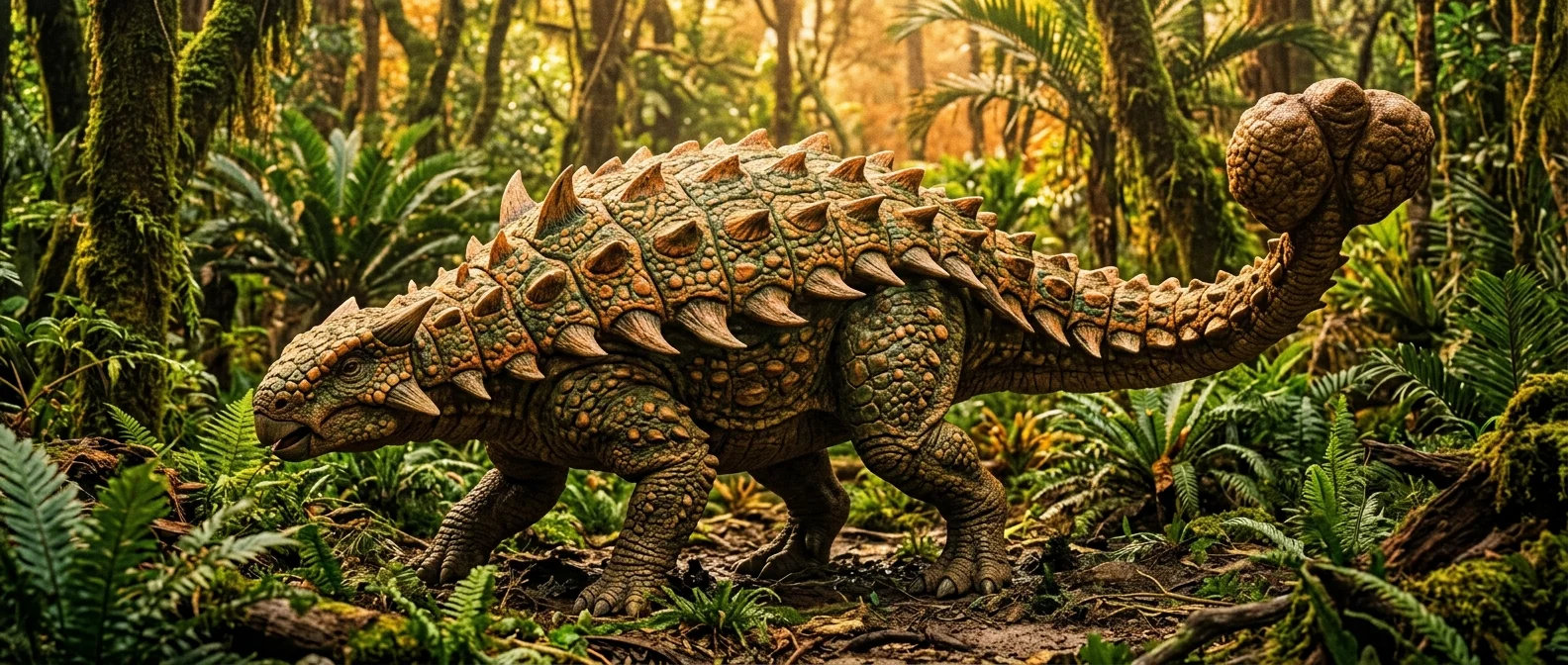
If an engineer designed the perfect armored dinosaur, they'd end up with something remarkably similar to Ankylosaurus. Armored from head to tail, low and wide like a tank, with a built-in weapon at the end of its tail. This was the ultimate defensive mechanism walking the Earth 68-66 million years ago — and its fossils prove it worked exceptionally well.
📖 Read more: Spinosaurus: Swimming Dinosaur Larger Than T. rex
The Armor: Osteoderms and Keratin
Ankylosaurus's back was almost completely covered with thick armor — bony plates known as osteoderms or scutes, similar to those found on modern crocodiles, armadillos, and certain lizards. “These are bones that form within the skin, just like in crocodiles,” explains Kenneth Carpenter, a specialist in armored dinosaurs at the Utah State University Eastern Prehistoric Museum. The osteoderms consisted of a thin outer layer of compact bone and a thick inner layer of spongy bone — a construction that combined hardness with lightness.
The plates, which varied in size, were arranged in regular horizontal rows along the neck, back, and pelvis. Between the large plates were smaller ones, creating an almost impenetrable mosaic. Above the osteoderms was keratin — the same protein that forms nails and hair in humans. The greatest concentration of armor was found on the neck — logical, since that was the most vulnerable target for T. rex. Additionally, two rows of spikes extended along the body, and large horns protruded backward and sideways from the head.
The Club: A Built-In Weapon
If the armor was the shield, the tail was the sword. Ankylosaurus's tail ended in a massive bony club — a knobbed mass of fused bones that could swing with devastating force. The vertebrae at the base were fused together forming a rigid rod, on which the knob swung. According to a 2015 study in the Journal of Anatomy, the rigid tail structure evolved first, before the club appeared — indicating that nature “built” the base first and then added the weapon.
And it was used. “In two fossilized specimens, the tail clubs show damage,” notes Carpenter. “It appears they definitely hit something hard.” A 2009 study in PLOS ONE concluded that the tail could easily break the bones of most predators. Ankylosaurus probably couldn't move its tail much up and down, but could swing it laterally with great force — karate chops to a predator's lower legs, capable of breaking shins and ankles.
📖 Read more: Halszkaraptor: The Duck-Dinosaur That Actually Swam
The tail wasn't necessarily used only for defense. A 2009 PLOS ONE study examined other hypotheses: perhaps it also functioned as a display tool during mating or as a means of territorial disputes between males. Imagine two Ankylosaurus dueling for dominance of territory — swinging their clubs at each other, in a spectacle that would be equally terrifying and comical.
Defensive Systems
- Osteoderms across entire body
- Horns on the head
- Eye protection plates
- Tail club (bone-breaking)
Biological Features
- 20-26 feet long
- 5.6 ft tall at hip
- Wide, flat body
- Quadrupedal, slow movement
The Brain Behind the Armor
Ankylosaurus wasn't just a “living tank” — it had sophisticated sensory systems. A 2011 study in the Journal of Anatomy revealed that ankylosaurs had complex nasal passages with pathways that formed loops inside the skull. These probably didn't improve smell so much — large olfactory bulbs handled that — but functioned as a temperature regulation system, cooling the brain during hot days. A presentation at the 2014 Society of Vertebrate Paleontology meeting confirmed this hypothesis.
Olfactory ability was crucial for a massive herbivore. Ankylosaurus needed about 130 pounds of plant matter daily — nearly as much as a modern elephant. Its triangular skull was wider than it was long, with a narrow beak at the tip for stripping leaves. The small leaf-shaped teeth weren't designed for chewing — instead, an enlarged abdominal area indicates it had a fermentation system in its digestive tract, similar to that of camels or cows, that broke down unchewed plants chemically.
📖 Read more: Largest Dinosaur That Ever Walked the Earth Revealed
Barnum Brown and the Mystery of Rarity
The first Ankylosaurus fossils were discovered in 1906 in Montana's Hell Creek Formation by Barnum Brown — the same paleontologist who discovered T. rex a few years earlier. In 1910, in Alberta, Canada, he found ribs, limb bones, armor, a complete skull — and the first known tail club. In 1947, Charles Sternberg discovered the largest Ankylosaurus skull. All three of Brown's finds are now housed at the American Museum of Natural History in New York.
But an intriguing question remains: why is it so rare? Only three significant specimens have been found to date, and no complete skeleton has ever been discovered. “This poses an interesting question,” says Carpenter. One possible explanation is that Ankylosaurus lived in upland areas, away from rivers and swamps — the environments that favor fossil formation. We still don't know exactly how the armor was positioned on the back, since osteoderms are always found detached from the main skeleton.
"In two fossilized specimens, the tail clubs show damage. It appears they definitely hit something hard."— Kenneth Carpenter, armored dinosaur specialist, USU Eastern Prehistoric Museum (LiveScience)
Zuul and the Ankylosaurus Family
Ankylosaurus wasn't alone. It belonged to the suborder Ankylosauria, an entire group of armored dinosaurs that spread from North America to Asia. One of the most impressive recent finds came in 2016 from Montana: Zuul crurivastator — “the shin destroyer” — a 75-million-year-old ankylosaur named after the monster from the Ghostbusters movie. At 20 feet long, with a 10-foot tail and rows of bony spikes, Zuul is one of the best-preserved ankylosaurs. There were also ankylosaurs without clubs — Nodosaurus, Panoplosaurus, and the British Polacanthus.
Ankylosaurus roamed the same habitats as the most terrifying predators that ever lived: Tyrannosaurus Rex and related dromaeosaurs. But it would be wrong to imagine it as an innocent victim. Many modern herbivorous animals — elephants, hippos, rhinos — are extremely aggressive and dangerous. We don't know if Ankylosaurus was calm or quarrelsome. But we know that if you challenged it, your last experience would be 8 tons of armored mass with a club — and that's probably enough.