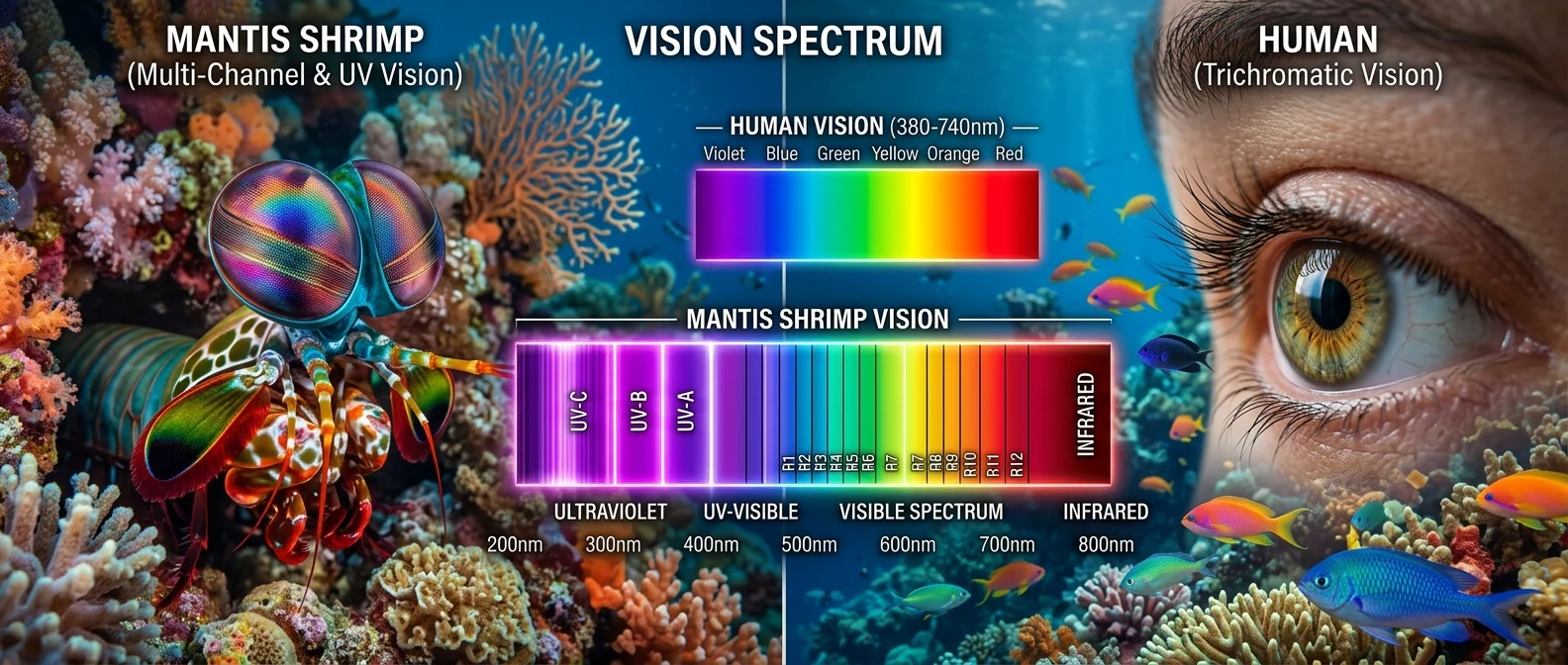
Imagine a color you've never seen — not a variation of red or blue, but something entirely new, as if you're missing a sense. This isn't a philosophical paradox — it's daily reality for millions of animals: birds that see ultraviolet light in every flower, mantis shrimp with 16 types of photoreceptors, snakes that “see” infrared heat, butterflies with pentachromatic vision. We humans with our 3 cone types “see” only a tiny window of the electromagnetic spectrum — and what we consider “reality” is simply the human version.
Three Cones, Three Worlds: Human Vision's Limitations
The human retina contains three cone types — cells that detect light: S-cones (blue, peak at 420nm), M-cones (green, 534nm), and L-cones (red, 564nm). Every color you “see” is your brain combining signals from these three sensors — trichromatic vision, giving us roughly 1 million distinguishable hues. This means we can't perceive individual wavelengths below 380nm (ultraviolet) or above 700nm (infrared). Our eye's lens absorbs UV — a “mechanical” protection that shields the retina from UV damage but blocks UV photons from reaching the cones. After lens removal surgeries (aphakia), some patients perceive UV as hazy violet — proof that the retina can, but the lens excludes. Painter Claude Monet after cataract removal reportedly painted flowers with UV hues others couldn't perceive.
Tetrachromatic Birds: A World in UV
Birds possess four cones instead of three — with an additional SWS1 cone sensitive to ultraviolet (300-380nm). Mathematically, four cones don't mean simply 33% more colors — they mean exponentially more combinations, because the color space becomes four-dimensional. Their structure includes oil droplets with carotenoid pigments that function as filters — each droplet allows only a narrow range of wavelengths to pass, dramatically improving color discrimination. Mary Caswell Stoddard's team at Princeton (2020) placed LED-feeders on wild hummingbirds in Colorado's Rocky Mountains with color combinations visible only to tetrachromats — and the birds recognized them immediately, choosing correctly in over 6,000 visits. For a bird, a “yellow” flower might appear UV+yellow — a non-spectral color with no equivalent in human experience, like “magenta” (red+blue without intermediates) is for us.

Mantis Shrimp: 16 Photoreceptors and Circular Polarization
The mantis shrimp (Odontodactylus scyllarus) holds the record: 16 photoreceptor types — 12 for color (300-700nm), 4 for polarized light. Tom Cronin and Justin Marshall revealed they don't use receptors for detailed color analysis (like we do). Instead, they recognize colors “holistically” — each receptor corresponds to a color channel, without comparing them. They're lightning-fast but crude — ideal for recognizing prey and rivals in milliseconds. Their compound eyes contain 10,000 ommatidia divided into 3 zones, with a central “midband” containing specialized color receptors. Each eye moves independently, providing 360° visual field. Uniquely in the animal kingdom, they perceive circular polarization of light — a property we detect only with 3D cinema glasses.
Peacock Spiders: Dancing in UV
Peacock spiders (Maratus) perform complex mating dances with abdominal vibrations, leg raising, and display of bright “wings” — a multisensory show combining optical and seismic signals. These colors aren't pigments — they're structural colors: nanostructures in the hairs create iridescent patterns through light interference, including UV. The nanostructures include photonic crystals — ordered arrangements that reflect specific wavelengths, like peacock feathers. Females evaluate UV brightness — males with brighter UV signals are chosen more frequently. The discovery that 2mm spiders have complex UV aesthetics shattered the assumption that color selection requires a “large brain.”

Infrared Vision: Snakes That “See” Heat
Pit vipers (Crotalus, Bothrops) and pythons possess cavities (pit organs) between eyes and nostrils that detect infrared radiation (7-15μm) — thermal emission from bodies. The sensor contains TRPA1 channels (temperature-sensitive ion channels) in a thin membrane just 15μm thick, suspended over an air chamber for thermal insulation — so sensitive they detect temperature differences of 0.003°C. Neural signals integrate into the brain's optic tectum, creating a “thermal image” overlaid on visual — an augmented reality system predating human FLIR technology by millions of years. A pit viper hunts mice in absolute darkness — “seeing” them through infrared like a night vision camera.
Ocean: Colors in the Depths
Deep-sea fish face a paradox: below 200m, only blue light (470nm) penetrates. Many species possess only rods (scotopic vision) — monochromatic vision adapted to darkness, with rhodopsin maximizing sensitivity to the few photons that reach them. Their eyes are enhanced: massive lenses, multiple rod layers (Bathylagus has rods in 30 layers), even reflective tapetum lucidum. But Aristostomias (dragonfish) produces red bioluminescence (700nm) — a wavelength invisible to its prey that perceive only blue — using it as an “infrared flashlight” invisible to every other creature. Red bioluminescence is rare: only 3 fish families produce it, using bacterial chlorophyll as a fluorescent molecule. The shrimp Parapandalus at 500m depth possesses 8 opsins — likely to detect subtle bioluminescence shades from predators, distinguishing “friendly” from “hostile” light. Recent research discovered fish (Rhynchohyalus) with mirrors instead of lenses in their eyes — a structure so specialized it resembles a human Cassegrain telescope.
Insects: UV Patterns on Every Flower
Bees and butterflies see UV, blue, and green — but not red (their L-receptor is absent or shifted to green). For a bee, a red poppy appears almost black — but UV patterns on the petals (nectar guides) shine like bright roads pointing to nectar location. These patterns are completely invisible to humans — you need a UV camera to see them, and when you see them for the first time, it forever changes how you look at a meadow. Heliconius butterflies have two UV-receptors (UV-A and UV-B) — a rare feature enabling pentachromatic vision, the most detailed known in terrestrial animals. The number of color combinations a pentachromatic butterfly can distinguish is theoretically 10+ million — versus humans' 1 million. Light hitting a butterfly wing creates structural UV patterns for species recognition — a “secret” signal invisible to bird predators.
What This Means for “Reality”
Human trichromatic vision evolved in primates 30 million years ago — likely for recognizing ripe red fruits among green leaves (Mollon's “fruit theory”). It was evolutionarily sufficient — but not the “correct” version. Most mammals are dichromats (2 cones) — dogs, cats, horses, and most rodents see the world in yellow-blue shades. Our trichromacy is the exception, not the rule. Conversely, stomatopods (mantis shrimp) developed polychromatic vision 400 million years ago — 370 million before we appeared. Every animal sees the world through its own Umwelt — the concept Jakob von Uexküll introduced in 1909: the sensory world evolution designed for each species. A hummingbird sees UV+green in every meadow. A bee sees bright roads on every petal. A snake “sees” thermal maps in every room. A mantis shrimp sees polarized light in every reflection. The truth is that no animal — not even us — sees the world “as it is.” We all see a version filtered through millions of years of natural selection — and the real color worlds surrounding us are even richer, brighter, stranger, and more magical than we imagined.
Sources:
- Stoddard, M.C., Eyster, H.N., et al. (2020). “Wild hummingbirds discriminate nonspectral colors.” Proceedings of the National Academy of Sciences, 117(26), 15112-15122. DOI: 10.1073/pnas.1919377117
- Marshall, N.J. & Oberwinkler, J. (1999). “The colourful world of the mantis shrimp.” Nature, 401, 873-874. DOI: 10.1038/44751