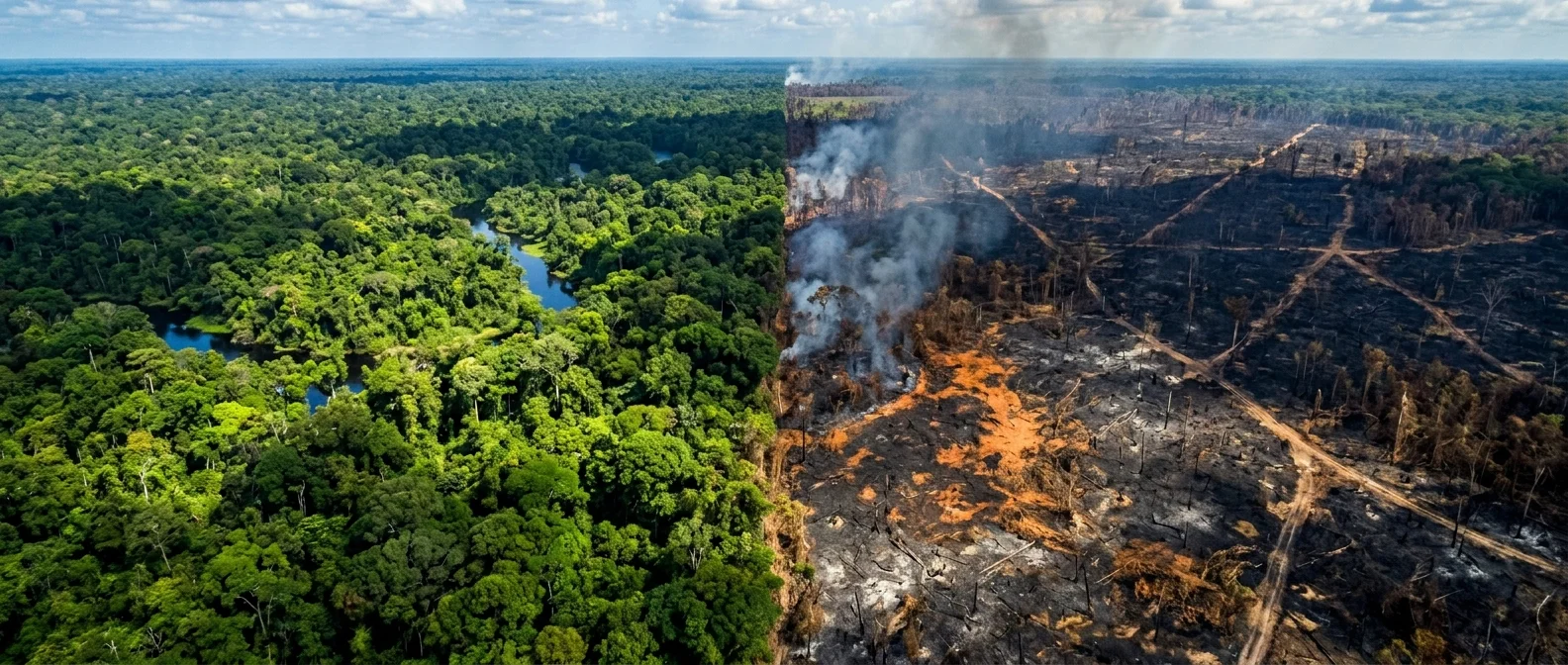
Every minute that passes, an area of tropical rainforest equivalent to two football fields disappears in the Amazon. This isn't a future prediction — it's happening right now. The world's largest tropical rainforest, which produces 6% of global oxygen and hosts 10% of known biodiversity, is approaching a point of no return. And the responsibility lies squarely with human decisions.
5.5 Million Square Kilometers of Life
The Amazon spans nine South American countries, with Brazil hosting approximately 60% of its total area. This is the world's largest continuous tropical forest — 5.5 million square kilometers, larger than all of Western Europe. To grasp the scale, you'd need over three weeks of continuous driving to cross it. The Amazon River, stretching over 6,400 kilometers, carries 20% of all freshwater flowing into the world's oceans. Within this vast forest live over 80,000 plant species, 2,500 fish species, 1,500 bird species, over 500 mammal species, and countless insects that science has yet to catalog. Each hectare can contain over 300 different tree species — more than exist in all of Europe. Every year, scientists systematically discover hundreds of new species in this complex and incredibly rich ecosystem.
Fires: Symptom of a Deeper Crisis
The summer 2019 Amazon fires shocked the entire planet — but they weren't natural. Over 80% were deliberately and criminally started to create pastureland, agricultural plots, and soy plantations. The “slash-and-burn” technique is cheap but devastating: it removes forest cover, destroys the underground mycorrhizal networks, and releases massive amounts of CO₂. In 2019 alone, annual deforestation in Brazil increased alarmingly by 34% compared to the previous year, exceeding 10,000 square kilometers of forest loss. Satellite imagery from INPE (Instituto Nacional de Pesquisas Espaciais) recorded over 80,000 fire hotspots within just a few months — more than any previous year of that decade. Each fire leaves behind dry, degraded land that struggles to regenerate. Amazon soil, despite supporting rich vegetation, is surprisingly poor in nutrients. Most nutrients are stored in the biomass of the trees themselves, not in the soil. When the trees disappear, the nutrients vanish with them.

The Point of No Return (Tipping Point)
Climatologist Carlos Nobre and distinguished ecologist Thomas Lovejoy warned in their joint publication in Science Advances that if deforestation exceeds 20-25% of original forest cover, the Amazon will pass a point of no return. Today we're already at an alarming 17%, dangerously close to the critical threshold. In this scenario, large portions of the southern and eastern Amazon would gradually transform into dry savanna — a drier ecosystem with sparse vegetation. The mechanism is self-feeding and dangerously self-reinforcing: fewer trees mean less transpiration, less rainfall, more drought, more fires, and even fewer trees. Once this chain reaction begins, it's practically impossible to reverse through human intervention. Such a scenario would release approximately 200 billion tons of CO₂ into the atmosphere — more than five years of global human emissions, dramatically accelerating planetary warming.
The “Lung” That Breathes for Everyone
The phrase “lungs of the Earth” is slightly misleading — the Amazon absorbs almost as much oxygen as it produces, due to natural decomposition and respiration of its organisms. But its true and greater value lies elsewhere: in carbon sequestration. Amazon trees store approximately 150 to 200 billion tons of carbon dioxide in their biomass and in the soil beneath them. A study published in Nature in 2021 by Gatti et al. revealed something deeply troubling: the eastern Amazon has already become a net source of CO₂ instead of a carbon sink. Measurements were taken with aircraft collecting air samples at various altitudes above the forest, clearly showing that specific regions emit more carbon than they absorb. This means deforestation and fires are reversing the forest's role in climate balance — from an ally against climate change to an accelerator of it.
Indigenous Guardians of the Forest
Approximately 400 different indigenous tribes live within the Amazon — some with absolutely no contact with the modern world. These indigenous populations aren't simply forest inhabitants — they're its most effective and dedicated guardians. Satellite data from NASA and INPE shows that areas under indigenous management have significantly lower deforestation rates than unprotected regions. The traditional knowledge of these communities about medicinal plants, natural cycles, and sustainable resource use is invaluable — many modern drugs, such as curare and quinine, originate from indigenous ethnobotany. However, they face constant pressure from illegal logging, gold mining that pollutes rivers with mercury, and expansion of soy farms. Murders of indigenous activists are recorded every year, reminding us that forest protection is also a human rights issue.

The Water Cycle Under Threat
The Amazon doesn't just affect rainfall locally. Water vapor it produces through transpiration travels southwest and feeds rainfall in Argentina, Paraguay, and even southeastern Brazil — regions absolutely critical for global food production. If the Amazon transforms into dry savanna, the dramatic reduction in rainfall will devastate soy production and cattle ranching that drove deforestation in the first place. This is a tragic paradox: the very economic activity destroying the forest depends entirely on the climate services it provides. Farmers burning forest for pastureland don't realize that without the Amazon's “flying rivers,” their own crops will be starved of rain.
What Can Be Done?
The situation is critical but not hopeless. Brazil has proven it can drastically reduce deforestation: between 2004 and 2012, logging rates dropped impressively by 80% thanks to stricter law enforcement and real-time satellite monitoring. International ambitious initiatives fund reforestation, while advanced remote sensing tools enable detection of illegal logging in real-time, and artificial intelligence programs automatically analyze satellite imagery. You can make a difference by supporting products certified as sustainable, reducing beef consumption linked to Amazon pastureland, and pushing for specific and measurable policy actions to protect the forest.
Reforestation: Hope or Utopia?
Amazon reforestation isn't as simple as planting trees. Tropical forests need many decades to regain their complex multi-layered structure — the multiple vegetation canopies, mycorrhizal networks, and interdependencies among thousands of species. However, initiatives like “Trillion Trees” and national reforestation programs in Brazil and Ecuador show it's feasible, provided it's accompanied by protection of existing forests. The international community must act now with determination — every year of delay brings the Amazon closer to irreversibility. The science is clear: the window for action is closing rapidly.
"If the Amazon dies, it won't die alone — it will take the entire planet's climate with it."
— Carlos Nobre, climatologist, University of São PauloSources:
- Lovejoy, T.E. & Nobre, C. — “Amazon Tipping Point,” Science Advances, 2018
- Gatti, L.V. et al. — “Amazonia as a carbon source linked to deforestation and climate change,” Nature, 2021