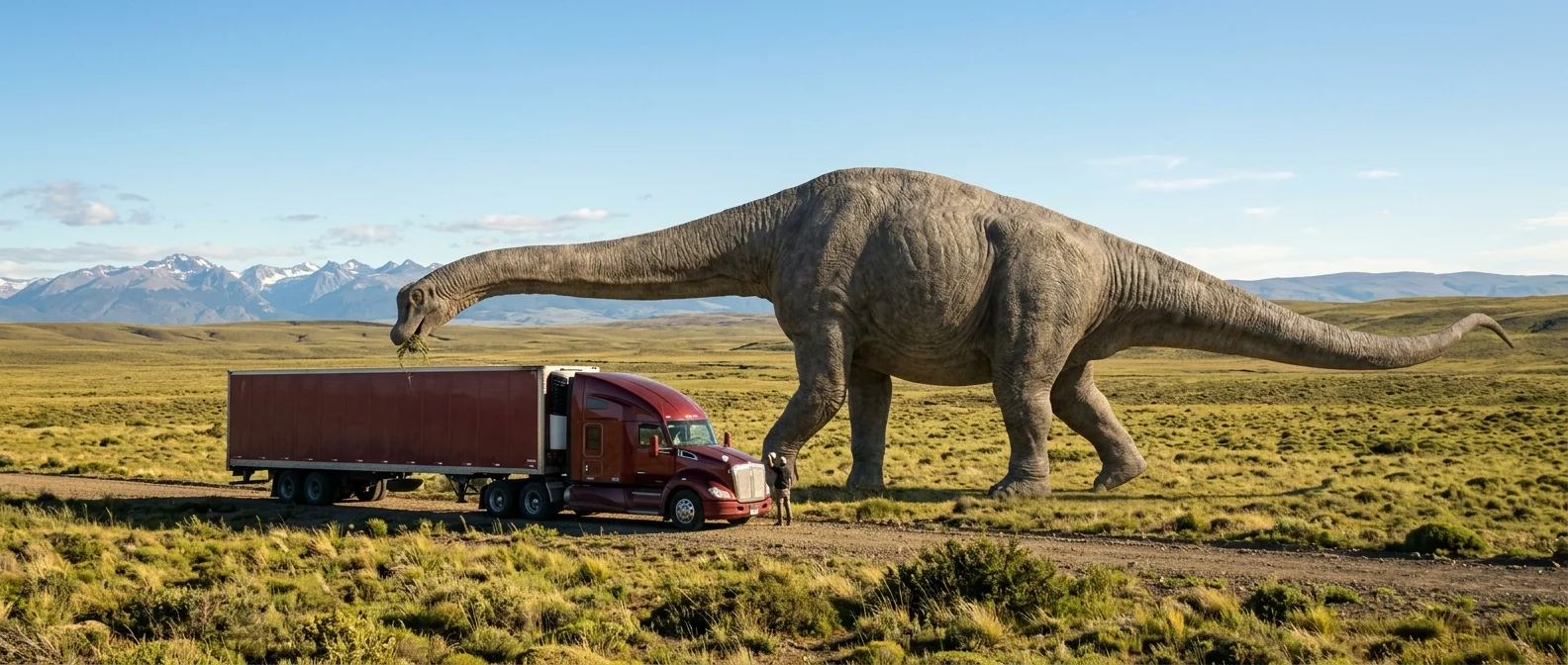
The Titan of Patagonia
In 2010, a ranch worker in Argentina's Patagonia spotted something protruding from the dirt. A massive bone — so large it seemed impossible that it belonged to a living creature. That discovery launched an excavation that would reveal Patagotitan mayorum, likely the largest land animal that ever walked the Earth. A 37-meter dinosaur weighing up to 70 tons. The titan of Patagonia.
The Bone at La Flecha Ranch
The story begins at La Flecha ranch in the heart of Patagonia. A worker doing his daily routine noticed a massive bone jutting from the ground. It wasn't a piece of rock or petrified wood — it was, unmistakably, bone. Scientists were called, and they quickly realized they were looking at something extraordinary: a femur measuring 2.38 meters long. For comparison, a human femur is about 48 centimeters. This was nearly five times larger.
The excavations that followed — in 2012, 2013, and 2015 — revealed hundreds of fossilized bones belonging to at least six different individuals. Six titans, buried in the same location across three separate floods. Imagine the scene: at three different moments, perhaps separated by millennia, massive sauropods died near a river, their bodies covered by sediment, and time turned them to stone.
How Big Was It Really?
Patagotitan was a titanosaur — a member of a sauropod subgroup that included the largest land animals of all time. According to London's Natural History Museum, it was “much longer, almost twice as tall and over three times heavier than Diplodocus.” The numbers are staggering: 37.5 meters long, weighing between 42,500 and 71,400 kilograms depending on the estimation method.
Why such a wide range of estimates? Because estimating mass in extinct animals isn't simple arithmetic. Paleontologists use different methods: some based on long bone diameter (volumetric method), others on skeletal volume and estimated soft tissue density. Each method yields different results. The most widely accepted estimate places Patagotitan around 57–70 tons.
🦕 Patagotitan
- Length: 123 feet
- Weight: ~57–70 tons
- Femur: 7.8 feet
- 6 individuals found
- Much more complete skeleton
🦴 Argentinosaurus
- Length: 121–131 feet
- Weight: ~70–100 tons
- Known from fragmentary bones
- Discovered 1987
- Very incomplete skeleton
The Battle of the Giants
Patagotitan isn't the only candidate for the title of “largest land animal.” Argentinosaurus, known since 1993, has weight estimates reaching 90–100 tons — but these are based on very fragmentary finds. Its original discovery in 1987 was a fossil so large that the rancher who found it thought it was a piece of petrified wood. It turned out to be a single vertebra.
Dreadnoughtus, also from Patagonian deposits, measured 26 meters and weighed about 59 tons. Paralititan, from Egypt, lived 94 million years ago in mangrove swamps and had a 1.69-meter femur — still smaller than Patagotitan's.
What makes Patagotitan special isn't just its size. It's the completeness of the finds. Unlike Argentinosaurus or Puertasaurus, known only from a few fragmentary bones, Patagotitan is represented by hundreds of bones from multiple individuals. As the Natural History Museum notes: "Patagotitan is much more complete and is the one whose size scientists can trust the most."
Life of a 70-Ton Herbivore
Patagotitan was herbivorous — sauropods weren't hunters. Its teeth were designed to strip plant material from branches, not for chewing. It swallowed large amounts of plant matter whole, and digestion occurred in its massive intestines — a fermentation process similar to modern ruminants, but on a much larger scale.
How could an animal this large move without collapsing under its own weight? The answer lies in its skeletal mechanics. Its legs were columnar, like pillars — similar in design to elephant legs but many times larger. Its vertebrae were internally hollow, with air sacs — a structure that reduced weight without sacrificing strength. This architecture resembles modern birds and provides yet another indication of the evolutionary dinosaur-bird connection.
Its neck, several meters long, functioned like a crane: it allowed the animal to reach vegetation at great height or horizontal distance without needing to move its entire body. This strategy reduced the energetic cost of feeding — crucial for an animal that needed massive amounts of food daily. A titanosaur of this size is estimated to have consumed hundreds of kilograms of plant matter each day — about as much as an entire herd of cattle would eat.
Three Floods, Six Titans
One of the most intriguing aspects of the excavation is that the six individuals died at three separate times. This means the area was consistently favored by Patagotitans — perhaps a water source, a grazing spot, or a migration route. Each time the river flooded, the bodies were covered by sediment, preserving them in exceptional condition.
It's worth noting that La Flecha ranch remains the only location in the world where Patagotitan fossils have been found — a fact that makes the site even more valuable to paleontologists. Until finds are discovered elsewhere, this ranch in the middle of Patagonia is the only window into the lives of these giants.
"Patagotitan is one of the largest known dinosaurs, making it also one of the largest land animals ever found."
— Natural History Museum, LondonThe Age of Patagotitan
Patagotitan lived 100–101 million years ago, during the Early Cretaceous period. At that time, Patagonia wasn't the dry, wind-swept steppe it is today. It was warm and humid, with dense vegetation of conifers, ferns, and early flowering plants. The forests were rich enough to support 70-ton animals — indicating remarkable bio-productivity in the Southern Hemisphere during that era.
Titanosaurs were the dominant group of large herbivores during this period. Their fossils have been found on every continent, including Antarctica. Their diversity was enormous: from the small Saltasaurus (just 7 tons, with armor-like osteoderms) to the gigantic Argentinosaurus. Patagotitan sits at the top of this scale — but with the security of reliable measurements.
In an era when new fossils are discovered every year in South America, North Africa, and even Brazil (where Austroposeidon magnificus was recognized only in 2016 from bones that had sat in a museum for 60 years), Patagotitan reminds us that the largest animals that ever walked the Earth didn't need an ocean to grow big. They just needed enough plants — and a little space.