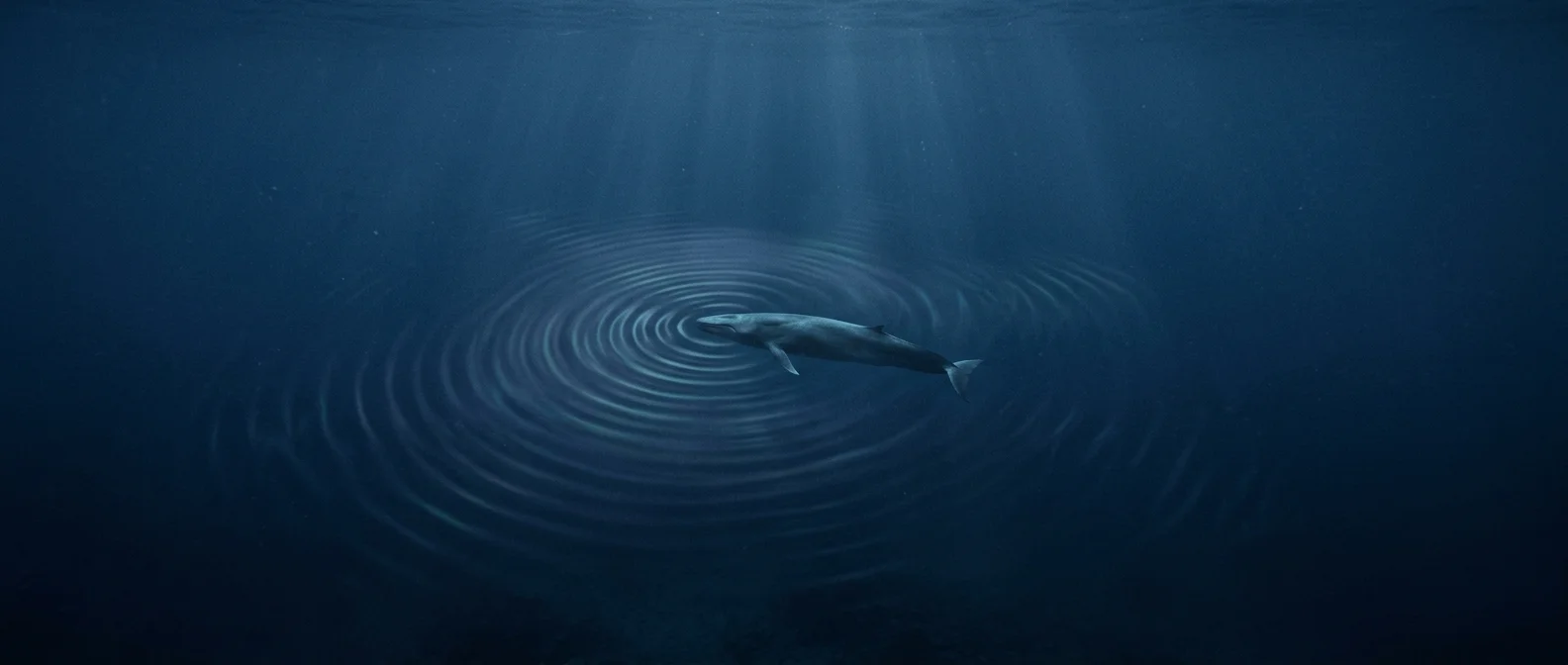
Somewhere in the North Pacific, a whale has been singing for decades at a frequency no other cetacean appears to hear. At 52 hertz — far higher than any known whale species — its voice travels thousands of miles through the ocean without ever receiving a response. Scientists call it “the world's loneliest whale.”
📖 Read more: Mariana Trench: What Lives at 36,000 Feet Deep?
🎵 How Whales Sing
The mysterious songs are primarily a male affair. Only males sing — humming about as loud as large cargo ships, around 180 decibels. Their songs travel over 1,000 kilometers beneath the surface, allowing them to communicate across distances no terrestrial animal could ever imagine.
Each species sings at specific frequencies. Blue whales (Balaenoptera musculus) emit calls in the 15-30 hertz range — at the very bottom of human hearing. Fin whales (Balaenoptera physalus) hover around 20 hertz. These extremely low frequencies resemble the sounds of the largest pipes in a cathedral organ.
🔊 The Discovery: A Sound That Didn't Fit Anywhere
The story began during the Cold War. The SOSUS (Sound Surveillance System) — a network of hydrophones on the ocean floor, built by the U.S. Navy to detect Soviet submarines — recorded something unexpected in 1989: a repeating call at 52 hertz.
Oceanographer William Watkins, from the Woods Hole Oceanographic Institution, recognized that the sound didn't match any known cetacean species. It was too high for blue whales, too high for fin whales, had a call pattern reminiscent of large baleen whales but at completely the wrong frequency. Watkins tracked the sound for over twelve years until his death in 2004. His publication in Deep Sea Research presented a whale that seemed to speak a language no one understood.

🐋 Why No One Answers
The whale's apparent “loneliness” isn't a matter of emotional interpretation — it's a matter of physics. Whales communicate in very narrow frequency ranges, almost like radio channels. A blue whale “listening” at 15-30 hertz likely cannot perceive a signal at 52 hertz — or if it does, doesn't recognize it as a call from its own kind.
It's like someone shouting in a room full of people, but at ultrasonic frequency. The sound exists. No one can just hear it. The 52 Hz whale travels migration patterns similar to those of blue whales — thousands of kilometers between feeding and breeding grounds — but always alone, never recorded alongside other cetaceans.
Notably, according to recordings, the whale doesn't remain silent. It calls consistently, follows seasonal calling patterns, and migrates along expected routes. In other words, it behaves exactly like a healthy whale — with the sole exception that no one responds to its songs.
🧬 What Is It Really?
No one has ever seen this whale. Its identity remains a mystery. The prevailing theories:
Hybrid
Possible cross between blue whale and fin whale — known hybrids exist and may produce unusual vocal structures.
Anatomical Variation
May have an abnormality in the larynx or vocal structures that shifts call frequency upward.
Unknown Species
There's the — unlikely but not excluded — possibility it belongs to a species or subspecies not yet catalogued.
📖 Read more: 10 Animals That Glow in the Dark: Bioluminescent Wonders
📉 The Frequency Is Changing — And It's Not Alone
An interesting detail: the 52 Hz whale's frequency isn't constant. Over the years, it has dropped slightly. This doesn't affect only this whale — according to a study by Emmanuelle Leroy (University of New South Wales) published in Journal of Geophysical Research: Oceans, Antarctic blue whales are dropping by 0.14 hertz per year. Fin whales and pygmy blue whales show similar trends (0.12-0.54 hertz annually).
Why? Researchers believe it's not related to noise pollution — the Southern Indian Ocean, where the study was conducted, has become quieter in recent years. Instead, the explanation appears anatomical: as whale populations increase following the end of commercial whaling (10,000-25,000 blue whales today, from a few thousand in the 1970s), they don't need to sing as loudly — and reducing intensity automatically lowers frequency.
The scientist herself explained: "Because whaling stopped, the population is increasing. They can reduce call intensity to maintain contact, because there are more whales. These calls are long-distance communication." However, there's an alternative: the ocean is becoming more acidic due to climate change, and this allows sound to travel farther.

🌊 What It Teaches Us About the Oceans
The 52 Hz whale isn't just a romantic story of loneliness. It's a window into how we study marine life. Hydrophones — underwater microphones — are revolutionizing cetology. A 2025 study in PLOS ONE, led by John Ryan of the Monterey Bay Aquarium Research Institute (MBARI), tracked songs of blue, fin, and humpback whales for six years off the U.S. West Coast.
The results were revealing: detection of humpback whale songs increased from 34% to 76% of days over six years — and this increase faithfully followed changes in food availability. When krill and anchovy increased, songs increased. Whale acoustic activity reflects the health of the entire marine food web.
🎧 Listening to the Ocean
Hydrophones don't just hear whales. They record ships, earthquakes, ice breaking, biological activity of fish. The ocean is a world of sound — and the voice of a whale at 52 hertz stands out in this symphony precisely because no one else sings in the same key.
🔮 The Search Continues
After Watkins' death, monitoring continued. The 52 Hz whale continues to be detected — at least seasonally — in the North Pacific. Documentaries, books, and musical pieces have been inspired by its story. In 2021, the film "The Loneliest Whale: The Search for 52″ chronicled a team of researchers' mission to finally find it visually. Millions of people identified with the idea of a creature that speaks but no one hears — the 52 Hz whale became a symbol of social isolation in the internet age.
🐳 Maybe It's Not So Alone?
Recent research challenges the “lonely whale” myth. Some acoustic biologists believe the 52 Hz call may actually be heard by other cetaceans — it's just not recognized as a mating invitation. Others note that the very concept of “loneliness” is anthropomorphic: we don't know if the whale suffers or simply lives a normal life with a different voice. After all, there are documented blue-fin whale hybrids found with Antarctic colonies, without apparent social isolation.
This doesn't diminish the story's significance. The real value lies elsewhere: it reminds us that the oceans host lives we haven't yet touched — voices that travel thousands of kilometers, at frequencies we're only beginning to understand. If a whale can sing for decades without anyone seeing it, what else hides beneath the waves?