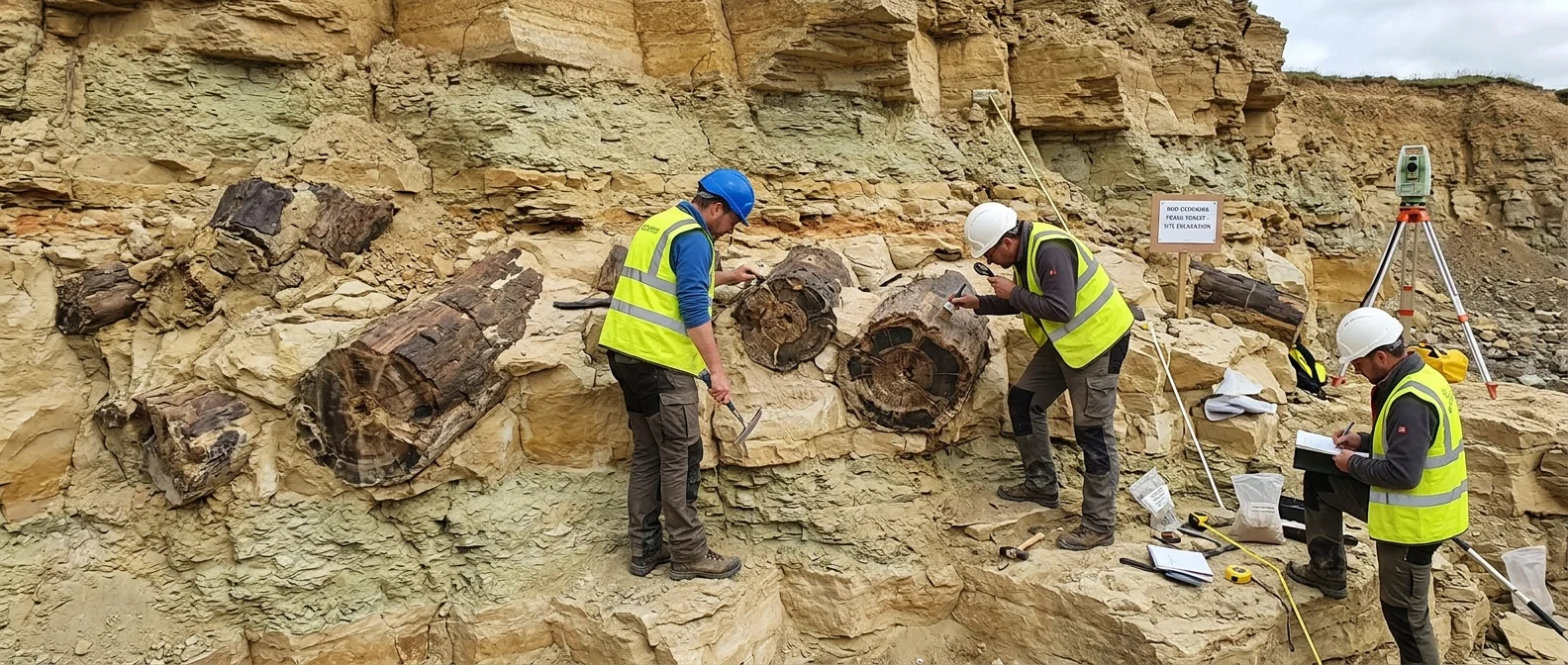
In an abandoned quarry near Cairo, New York, beneath layers of sedimentary rock, lay hidden a 385-million-year-old forest. Paleobotanists William Stein and Christopher Berry uncovered it gradually over decades — first root impressions, then trunks, finally an entire ecosystem. This wasn't just another fossil — it was the world's oldest known forest, from the era when plants had barely begun conquering land. A forest that literally changed Earth's atmospheric composition and triggered the planet's first ice age.
Discovery in Stone
The story begins in 2009, when William Stein (Binghamton University) examined limestone rocks in a quarry near Cairo, just 40 kilometers from historic Gilboa — the site that had yielded the first fossilized tree logs in 1870. The 2020 publication in Current Biology revealed that the Cairo site contained something far more significant: an entire root system imprinted in stone, spanning 3,000 square meters. For the first time, scientists could see not just trunks but how roots spread through ancient soil — revealing the spatial organization of an ancient forest ecosystem. The age: 385 million years, Middle Devonian period — 150 million years before the first dinosaurs, when the first tetrapods were just taking their initial steps out of water. The discovery fundamentally changed our understanding of when and how the first complex terrestrial ecosystems emerged.

The First Trees: What Were They?
The Cairo forest contained three types of trees — a diversity that surprised researchers. First: Archaeopteris, the first “modern” tree with broad fern-like leaves, woody trunk, and extensive root system — ancestor of today's conifers. Second: cladoxylopsids (Eospermatopteris), the “Gilboa trees” with 8-10 meter trunks lacking true leaves — only branched structures at the top, like giant asparagus. This bizarre shape resulted from not yet evolving real leaves — photosynthesis occurred in the branched tips. Third: a smaller lycopsid, without seeds, reproducing only through spores — a living link to mosses. This coexistence of three completely different evolutionary strategies in one forest represents the biggest surprise: diversity existed from the beginning, not as later evolution — overturning the previous hypothesis that early forests were monocultures of single species.
Earth 385 Million Years Ago
The Middle Devonian Earth was unrecognizable and utterly alien. The supercontinent Laurasia covered the northern hemisphere, while Gondwana dominated the south. The Cairo site lay near the equator in tropical climate. The atmosphere contained CO₂ 15 times higher than today, but without land plants (until recently), temperatures were extremely high — about 10-15°C warmer than today, with global average temperatures of 28°C. The first tetrapods (fish-amphibians) had just acquired legs — fossils like Tiktaalik (375 million years ago) show the transition from fins to limbs. Land was barren — without soil in today's sense: only fragmented rock without organic matter. No winged insects existed, the sound of land was only wind and the scratching of first plants on bare rock. The first forests didn't simply “conquer” land — they created it, transforming barren rock into living soil with organic matter, fungi, microorganisms, and the first terrestrial arthropods.
What the Roots Reveal
Cairo's greatest discovery was the Archaeopteris roots. Unlike cladoxylopsids (which had shallow, small roots), Archaeopteris displayed modern-type root systems: deep, extensive, laterally branched. These roots created the first true soil in planetary history (pedogenesis) — fragmenting rocks, binding water, hosting the first terrestrial mycorrhizal fungi — a relationship continuing today in 90% of plants. The impressions show roots 11 meters long — remarkable for trees of that archaic era, when plants had just evolved vascular systems. The root-fungus relationship was found in 407-million-year-old fossils (Rhynie Chert, Scotland) — proving plants didn't conquer land alone, but in symbiosis with fungi providing nutrients.

How Trees Changed the Planet
The spread of Devonian forests caused the first massive CO₂ drop in Earth's history. Trees sequestered carbon through photosynthesis, while their roots accelerated chemical weathering of silicate and carbonate rocks — a process consuming CO₂. The result: 90% atmospheric CO₂ reduction in roughly 50 million years — from 4,000 ppm to 400 ppm. This dramatic drop triggered the Late Devonian Ice Age — and contributed to the Frasnian-Famennian mass extinction (375 million years ago), eliminating 75% of marine species. Paradoxically, plants that created terrestrial ecosystems destroyed marine ones — a cosmic paradox showing how evolution in one ecosystem can devastate another — the same process that fed terrestrial life killed marine life.
Fossilized Forests Worldwide
Cairo isn't unique. The Gilboa logs (1870, 40 km away) were the first recognized fossilized trees. At Petrified Forest National Park (Arizona), 225-million-year-old trunks (Triassic) have transformed into quartz — visually spectacular. At Axel Heiberg (Canadian Arctic), a 45-million-year-old Metasequoia forest remains nearly carbonized — so well-preserved you can snap a branch. In Lesvos (Greece), the Petrified Forest — a UNESCO Monument — contains 20-million-year-old trunks (Miocene) in exceptional preservation, with visible growth rings revealing climatic fluctuations from 20 million years ago. Each fossilized forest represents a time capsule — a moment frozen in geological time revealing climate, ecology, biodiversity, and evolutionary transitions that shaped today's world.
Evolutionary Significance
The transition from water to land was one of evolution's greatest challenges. Plants had to develop: lignin (for structural support against gravity), vascular systems (xylem/phloem for water transport), waxy epidermis (against dehydration), stomata (gas regulation). Seed evolution — instead of spores — enabled reproduction without water, but this came later (Late Devonian). The Cairo trees still reproduced through spores — requiring moisture. Lignin was so novel that fungi couldn't decompose it effectively — fallen trees accumulated in thick organic layers, forming the first coal deposits of the Carboniferous — the same deposits that fueled the Industrial Revolution 300 million years later. Lignin remains today the most abundant organic compound after cellulose, and its decomposition remains a biotechnological challenge for biofuel production.
Future Research
CT scanning enables three-dimensional analysis of fossilized wood's internal structure without destroying samples. Stein plans digital reconstruction of the entire Cairo forest in 3D modeling. The probability of recovering ancient DNA from fossils this old is zero (DNA degrades in 500,000-1 million years), but protein fossils might persist. Climate models use paleobotanical data for predictions — if forests reduced CO₂ by 90% once, could reforestation help again? The answer is complex — the Devonian took 50 million years, while we have decades. In Greece, paleobotany is represented by the Natural History Museum of the Petrified Forest of Lesvos — a world-class center connecting geological heritage and evolutionary biology. The Cairo fossilized forest reminds us that life's history on Earth isn't simple progress — it's a series of revolutions, each permanently changing the planet. And the first, perhaps most important, began with a root digging into rock.
Sources:
- Stein, W.E., Berry, C.M., Hernick, L.V., et al. (2012). "Surprisingly complex community discovered in the mid-Devonian fossil forest at Gilboa." Nature, 483, 78-81.
- Stein, W.E., Berry, C.M., Morris, J.L., et al. (2020). "Mid-Devonian Archaeopteris Roots Signal Revolutionary Change in Earliest Fossil Forests." Current Biology, 30(3), 421-431.