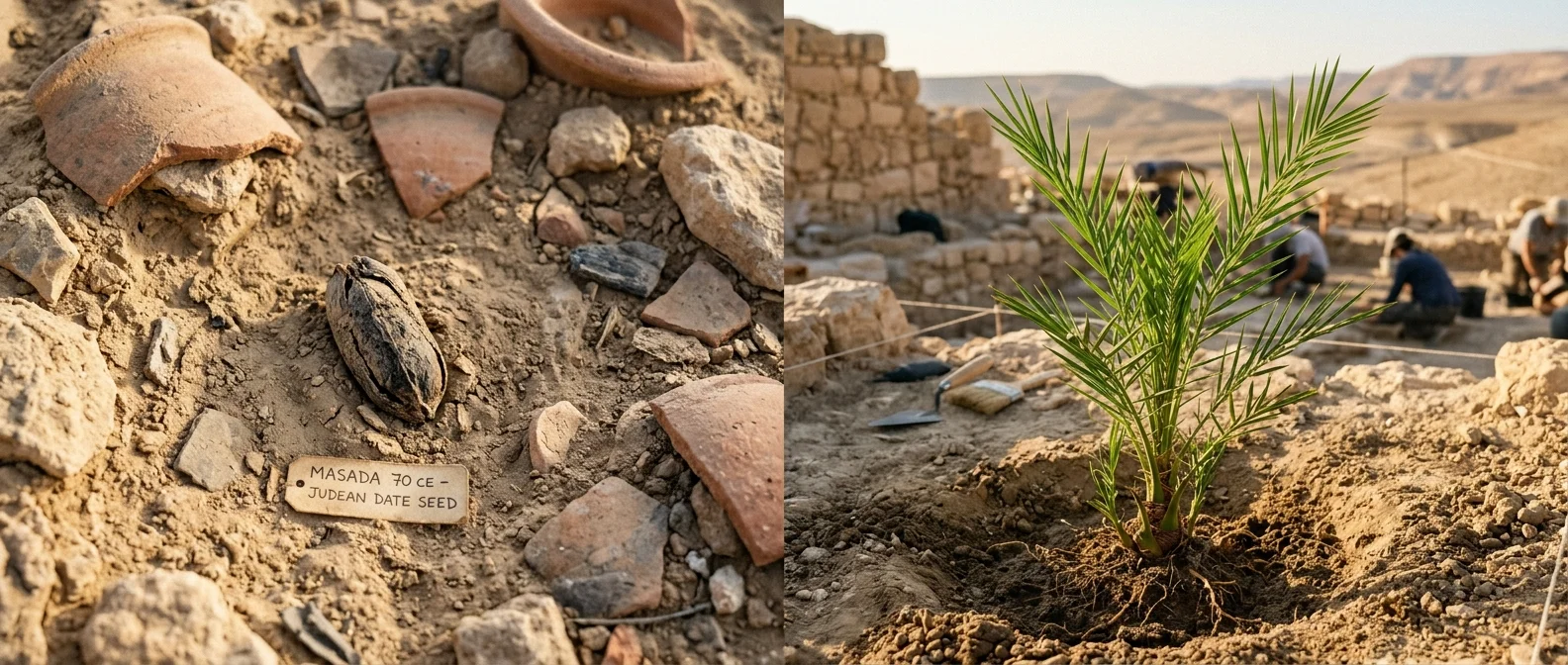
In an archaeological pit beneath Masada — Herod's legendary fortress in the Judean desert — date palm seeds waited buried for 2,000 years. In 2005, a team of researchers decided to plant them. Nobody expected what followed that morning: one seed sprouted, birthing the oldest known organism ever revived from seed. This achievement wasn't just scientific — it carried symbolic weight for Israel, where the date palm serves as a national symbol appearing on coins and stamps.
Methuselah: Birth of a Legend
Dr. Sarah Sallon at Jerusalem's Hadassah Medical Center and botanist Elaine Solowey at Kibbutz Ketura published in Science (2008) the successful germination of a ~2,000-year-old Phoenix dactylifera seed. They named it Methuselah — after the biblical patriarch who lived 969 years. The seed was discovered during Yigael Yadin's excavations (1963-1965) and carbon-dated between 155 BCE and 64 CE — spanning the Maccabean period through Herod's reign. Germination began after soaking in gibberellic acid (GA₃) and hormone-rich water. Within just 26 days, a tiny green shoot emerged — the first Judean date palm to sprout after two millennia of extinction. The initial leaves were white — chlorophyll not yet activated — but gradually turned green. Today, Methuselah towers over 10 feet and produces pollen annually.
The Judean Date Palm: An Extinct Species
Ancient Judea's Phoenix dactylifera was renowned throughout antiquity. Pliny the Elder (Naturalis Historia) described Jericho dates as the world's finest — large, sweet, with distinctive texture. They appeared on Roman “Judaea Capta” coins after the Temple's destruction (70 CE). The variety vanished during the Crusades — overexploitation, warfare, and climate change eliminated the plantations. By the 19th century, no trees of this variety existed anywhere globally. Mosaics from Madaba (Jordan, 6th century CE) depict date palms with massive fruit clusters resembling modern varieties but with larger individual dates — confirming Pliny's descriptions. Josephus mentions palm groves at Masada, Jericho, and Ein Gedi extending into “forests” of thousands of trees.

Genetic Analysis: What DNA Revealed
Genomic analysis (Sallon et al., Science Advances, 2020) revealed that ancient Judean date palms were genetic hybrids — between eastern varieties (Mesopotamia/Persia) and western ones (North Africa). The ratio: ~60% eastern genome, ~40% western. This means ancient Judea sat at the crossroads of genetic exchange between East-West date trade routes. Genes related to fruit size, drought resistance, and sweetness were present — explaining the reputation of Judean dates. Epigenetic analysis proved intriguing: ancient plants showed adaptation markers to warmer climates — alleles absent from modern Iraqi desert and Saudi Arabian varieties. The team successfully germinated 6 additional seeds, naming them Adam, Jonah, Boaz, Judith, Hannah, and Uriel — biblical names honoring their birthplace.
Mechanisms of Seed Longevity
How did seeds survive 2,000 years? The explanation involves multiple mechanisms. The arid Judean desert climate (annual rainfall 50mm) maintained moisture below 5% — critical because moisture activates decomposition enzymes. Phoenix seed coats contain lignin and sclerenchyma cells preventing mechanical damage and microbial invasion. Specialized LEA proteins (Late Embryogenesis Abundant) stabilize membranes in a “glassy state” — a form of biological hibernation — halting all metabolic activity. Natural radiation (cosmic rays + soil radon) causes ~1-10 mutations per generation even in dormant seeds, but DNA repair enzyme systems activate immediately upon germination. Masada seeds were found 10-13 feet deep beneath stone and soil layers, protected from UV radiation and temperature fluctuations — Masada's soil maintains relatively stable 68-77°F year-round.

Longevity Records: Other Ancient Seeds
Methuselah isn't alone. In 2012, a Russian team (Yashina et al., PNAS) revived Silene stenophylla from 32,000-year-old seeds — found in arctic squirrel burrows in Siberian permafrost — the absolute world record. The technique involved placental tissue culture since the embryo was damaged. Lotus (Nelumbo nucifera) aged 1,300 years germinated in China (Shen-Miller et al., 1995). Barley from Egyptian tombs (1,000 years) sprouted in 19th-century Britain — though authenticity remains disputed. At Norway's Svalbard Arctic seed vault, 1.1 million samples are stored at -0.4°F — but even there, seeds gradually lose viability after decades to centuries. Of Sallon's 34 seeds, only 7 germinated (20%) — the rest suffered irreversible DNA damage from cumulative oxidation and cosmic radiation. A 20% germination rate is remarkable for 2,000-year-old seeds, considering modern seeds lose viability after 10-50 years under normal conditions.
Plant De-Extinction: Can We Revive Lost Species?
Plant “de-extinction” success is more realistic than animal revival — no cloning required, just viable seeds and proper germination conditions. Sallon's team aims to create an ancient date plantation in the Negev. Methuselah, being male, produces pollen — but requires female plants for fruit. Hannah (female) was fertilized with Methuselah's pollen in 2020, producing the first fruits in spring 2021 — dates genetically identical to those eaten by ancient Judeans. The taste was described as drier, less sweet, with subtle honey notes — different from modern Medjool and Deglet Noor varieties. Molecular analysis revealed higher concentrations of antioxidant phenolic compounds and flavonoids compared to modern varieties — genes likely lost during selection for size and sweetness in contemporary cultivation.
Biotechnological Applications
Ancient seed studies offer more than archaeological interest. Longevity mechanisms — LEA proteins, antioxidant enzymes, membrane stabilization — interest food preservation biotechnology and pharmacology. The Crop Trust examines applications for improving modern crop drought resistance. Ancient resistance genes can be introduced into modern varieties through crossbreeding or CRISPR-Cas9 gene editing technology. The “library” of ancient seeds in museums and archaeological repositories across at least 15 countries globally gains new value — each seed potentially harbors genes lost during agricultural modernization over recent centuries. The “genetic erosion” of modern crops (few varieties dominate globally) makes ancient seeds valuable for recovering lost genetic diversity. Egyptian researchers already examine seeds from pharaonic tombs for similar revival experiments.
Significance for Biodiversity Conservation
Methuselah's story reminds us that biodiversity isn't always permanently lost. Seed banks — Svalbard, Millennium Seed Bank (Kew Gardens, 2.4 billion seeds), USDA Fort Collins — preserve genetic material from 300,000+ species. But climate change threatens even these: in 2017, meltwater from permafrost breached Svalbard's entrance tunnel (successfully contained before reaching seeds). Seed renewal every 10-25 years remains critical for maintaining viability. Methuselah, now reaching 10 feet at Kibbutz Ketura in the Arava desert, proves nature has survival methods we don't fully understand — and that a handful of forgotten seeds may hold keys to future food security. Each seed germinating after millennia is a “living fossil” connecting us to a vanished world — and offering genetic tools for a world that urgently needs them.
Sources:
- Sallon, S. et al. “Germination, genetics, and growth of an ancient date seed.” Science, 320(5882), 1464, 2008.
- Sallon, S. et al. "Origins and insights into the historic Judean date palm based on genetic analysis of germinated ancient seeds." Science Advances, 6(6), eaax0384, 2020.