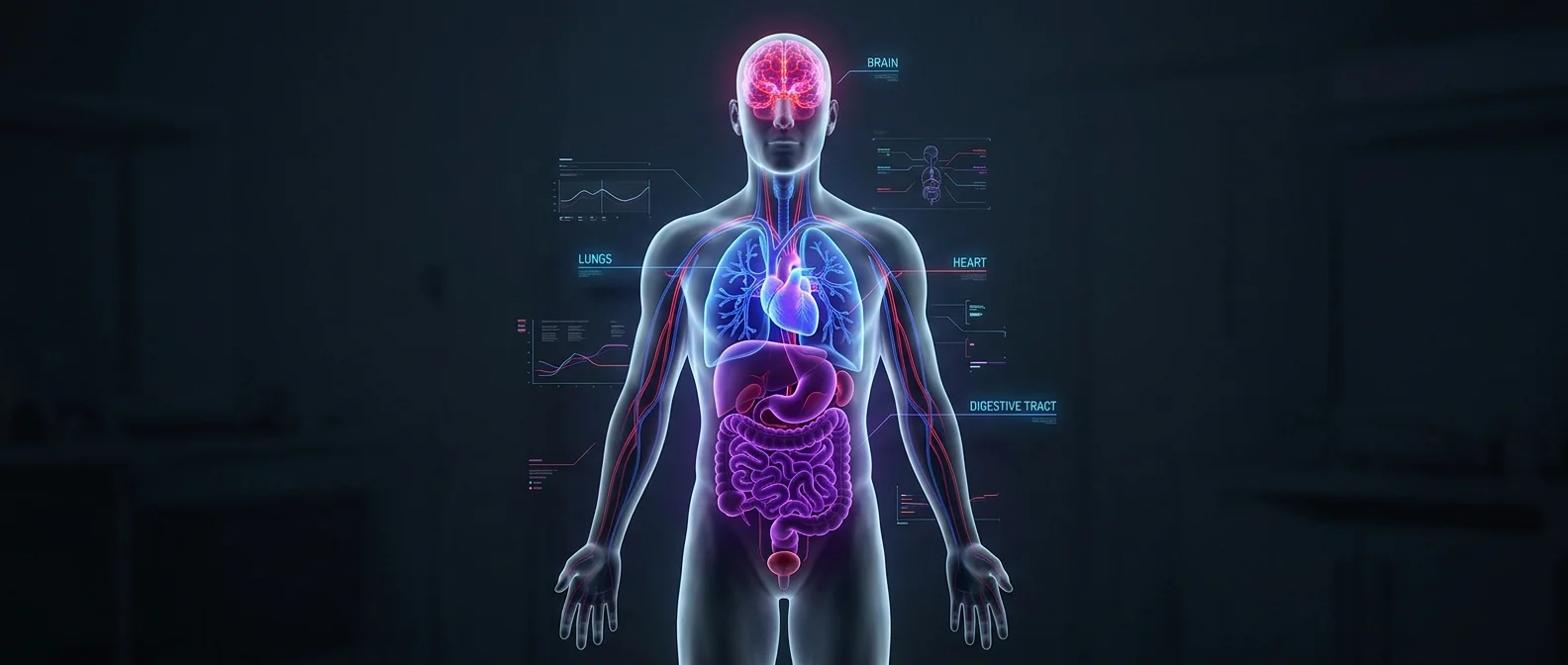
Think you know your body? Think again. Right now, as you read this sentence, your bone marrow is producing 3.8 million red blood cells per second. Your brain is firing electrical impulses at 270 miles per hour. And if you unwound the DNA from just one of your cells, it would stretch 6.5 feet. The human body is the most complex machine we know in the universe — and most of its secrets remain utterly mysterious.
37.2 Trillion Cells: A Universe Inside You
The landmark Bianconi et al. study (Annals of Human Biology, 2013) calculated that an adult human contains 37.2 trillion cells — more than the stars in our galaxy. Every second, approximately 3.8 million red blood cells are born in your bone marrow while an equal number die in your spleen. The renewal rate is staggering: intestinal lining replaces itself every 3-5 days, skin every 2-3 weeks, red blood cells every 120 days. Within 7-10 years, nearly every atom in your body has been replaced — you are literally a completely different person at the cellular level than you were a decade ago. The exceptions are neurons in the cerebral cortex, lens cells in your eyes, and certain heart muscle cells — these companions stay with you from birth to death. Cellular complexity is breathtaking: at least 200 different cell types exist, from massive egg cells (120 μm) to microscopic platelets (2-3 μm). Intestinal cells replace so rapidly that your gut's inner surface completely renews 60 times per year.

More Bacteria Than Cells?
The myth of “10 bacteria for every human cell” was debunked by Sender, Fuchs & Milo (Cell, 2016). The real ratio: approximately 1:1 — 38 trillion bacteria versus 30 trillion human cells. Your microbiome weighs 3-4 pounds — more than your brain. The gut-brain axis reveals that intestinal bacteria produce 90% of your body's serotonin — the happiness neurotransmitter. After each bowel movement, the bacteria-to-cell ratio shifts dramatically since most bacteria reside in your intestines. The 1,000+ bacterial species in your body are uniquely yours — no two humans share identical microbiomes, not even identical twins. At birth, your digestive tract is nearly sterile — colonization begins immediately through breast milk, maternal skin contact, and environmental exposure. Studies show gut bacteria influence mood, weight, even decision-making through production of neurotransmitters like GABA, dopamine, and norepinephrine. The Human Microbiome Project (NIH) has cataloged over 10,000 microbial species in the human body.
The Brain: 86 Billion Neurons
Brazilian neuroscientist Suzana Herculano-Houzel literally dissolved brains in a blender and counted: 86 billion neurons (not 100 billion as previously believed) and an equal number of glial cells. Each neuron forms 1,000-10,000 synapses — totaling 100-500 trillion connections. Electrical signals travel at 270 mph in myelinated axons — faster than a race car. Your brain comprises 2% of body weight but consumes 20% of your energy — 400 calories daily. During sleep, your brain doesn't rest — it organizes memories, clears toxins through the glymphatic system, and processes emotional experiences from the day. Remarkably, your brain generates enough electrical energy to power an LED bulb — about 12-25 watts while awake. Brain plasticity means that learning something new creates new synapses within seconds — the structure literally changes with every thought.
Heart: 100,000 Beats Per Day
Your heart beats 100,000 times daily — 2.5 billion times in an 80-year lifespan. It pumps 2,000 gallons of blood daily through a network of vessels. Cardiac muscle (myocardium) is the only muscle that never tires — thanks to mitochondria comprising 35% of heart muscle cell volume (only 5% in skeletal muscle). Your heart has its own electrical system — the sinoatrial (SA) node — and can beat even outside the body if supplied with oxygen. In embryonic development, the heart begins beating at 22 days after conception — before the brain is fully formed. Your blood completes full circulation in just 60 seconds — fast enough for white blood cells to continuously patrol every corner of your body. In a lifetime, your heart pumps enough blood to fill three supertankers — approximately 50 million gallons.

60,000 Miles of Blood Vessels
If laid end-to-end, an adult's blood vessels would span 60,000 miles — 2.5 times around Earth's circumference. 95% of this length consists of capillaries — so thin (5-10 μm) that red blood cells (7.5 μm) pass single-file, deforming as they squeeze through. A single red blood cell travels 250 miles during its 120-day lifespan before being recycled in the spleen. Every minute, your entire blood volume (5 liters) circulates completely — your heart, at 120 mmHg pressure, pushes blood 30 feet per beat. Capillaries are so dense that no cell in your body is more than 3-4 cells away from a capillary — ensuring continuous oxygen delivery. The aorta, with a 1-inch diameter, carries blood at 3 feet per second — while in capillaries, flow slows to fractions of an inch per second for gas exchange.
Bones: 270 at Birth, 206 in Adulthood
Newborns have 270 bones — many fuse during development (the skull starts as 6 separate bones, becomes one). In adulthood: 206. The strongest bone: the femur — withstands 3,700 pounds of force, stronger than concrete by weight-to-strength ratio. Bones continuously remodel: osteoclasts break down and osteoblasts build up — complete recycling every 10 years. The hyoid bone (in your neck) is the only bone that doesn't connect to any other — it floats, supporting your tongue. Bone marrow produces 200 billion red blood cells daily — an automated cell factory. At birth, bones are almost entirely cartilage — ossification begins in the womb and completes after puberty. Peak bone density occurs around age 30 — afterward, gradual loss of 1% annually begins. Bones also produce hormones: osteocalcin regulates glucose, energy, and fertility.
DNA: To the Sun and Back
Each cell contains 6.5 feet of DNA — compressed via histones into a nucleus 6 μm in diameter. Multiply by 37.2 trillion cells: 46 billion miles — enough for 600 round trips to the Sun. Only 1.5% of DNA codes for proteins — the genes (20,000-25,000). Of the remainder, 8% is viral in origin — ancient retroviruses incorporated into our genome millions of years ago (ERV). Telomeres — chromosome “caps” — shorten with each cell division, functioning as biological aging clocks. Telomerase, an enzyme that lengthens telomeres, activates only in stem cells — and cancer cells. Genetically, two random humans share 99.9% of their DNA — the 0.1% difference (3 million base pairs) explains all physiological, morphological, and predisposition diversity. We also share 60% DNA with bananas, 85% with mice, and 98.7% with chimpanzees — proving common evolutionary ancestry.
Senses: Far More Than 5
The “5 senses” concept (Aristotle) is completely outdated. Modern neuroscience recognizes at least 21 distinct senses: proprioception (body position in space), nociception (pain — 3 types), thermoception, balance (vestibular system) — separate from hearing, hunger sensation (appetite hormones ghrelin/leptin), chronoception (internal clock, suprachiasmatic nucleus). Your nose can distinguish 1 trillion odors (Bushdid et al., Science, 2014) — not 10,000 as previously thought. The tongue “taste map” (sweet front, bitter back) is a myth — all areas detect all tastes with only slight sensitivity differences. The fifth taste, umami (glutamate), was recognized only in 2002. Touch isn't one sense but four: pressure (Merkel discs), vibration (Pacinian corpuscles), light touch (Meissner corpuscles), and skin stretch (Ruffini endings). Proprioception lets you touch your nose with eyes closed — without it, every movement would require visual guidance. Pain receptors (nociceptors) total 3-4 million in skin — pain sensation itself can be dramatically altered through placebo, transcendent experience, or chronic sensitization.
Sources:
- Sender, R., Fuchs, S., & Milo, R. (2016). “Revised Estimates for the Number of Human and Bacteria Cells in the Body.” Cell, 164(3), 337-340.
- Bianconi, E., Piovesan, A., Facchin, F., et al. (2013). “An estimation of the number of cells in the human body.” Annals of Human Biology, 40(6), 463-471.