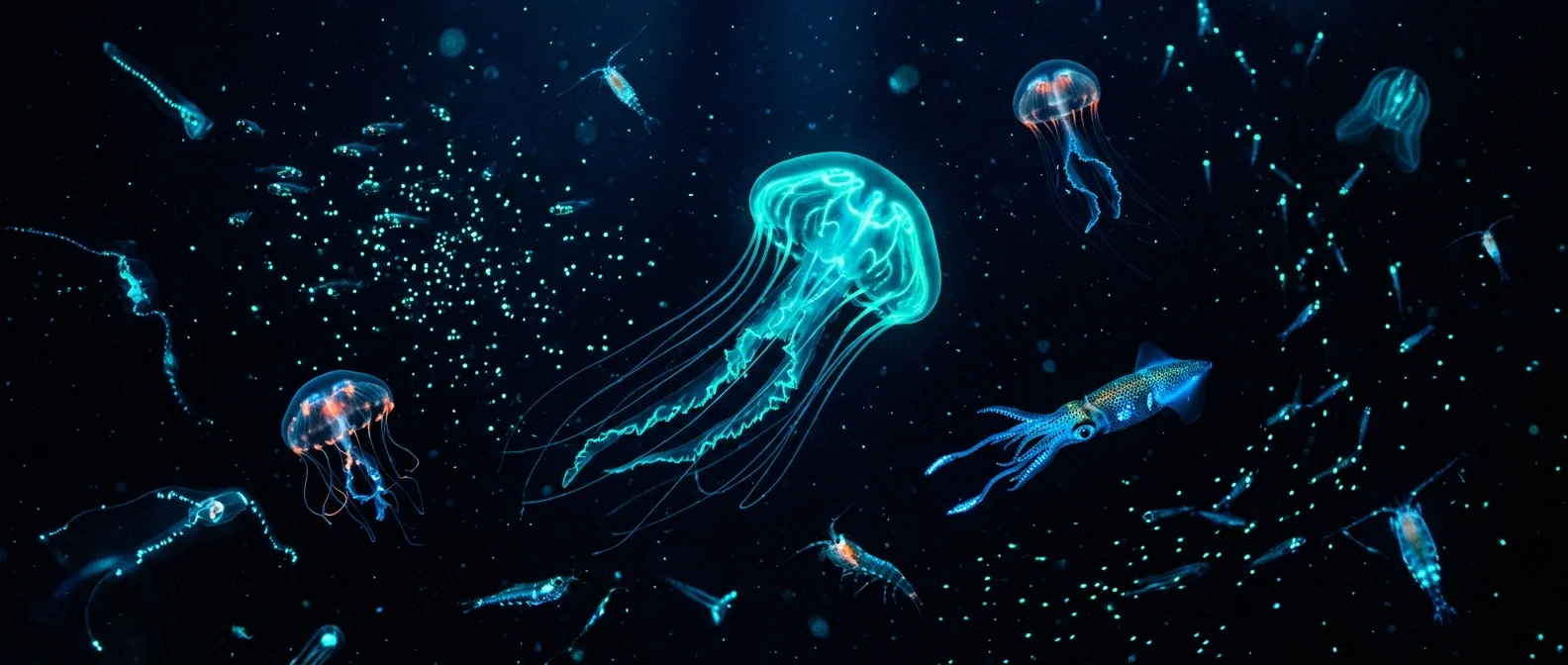
Turn off every human light on the planet — every lamp, every screen, every fire — and the ocean will keep glowing. Below 200 meters, where sunlight never reaches, more than three-quarters of all macroscopic organisms produce their own light. Bioluminescence isn't a rare phenomenon. It's the rule. And perhaps the most common form of communication on planet Earth.
🔬 What Is Bioluminescence — The Chemistry Behind the Glow
Bioluminescence means light produced through a chemical reaction inside a living organism. The reaction requires a molecule — luciferin — that reacts with oxygen and produces light. There are many types of luciferin, different for each species. Many organisms also produce luciferase, a catalyst enzyme that speeds up the process. Some animals go one step further: they package luciferin with oxygen in “photoproteins” — pre-packaged light bombs, ready to activate the moment calcium ions appear.
Bioluminescence didn't evolve just once. According to the Smithsonian Ocean Portal, it has appeared independently at least 40 different times in the tree of life. In ray-finned fish alone, it evolved 27 separate times. Evolution, in other words, arrived at the same “tool” again and again — a phenomenon known as convergent evolution.
The color? Mostly blue-green. These short wavelengths travel farthest in water. Longer wavelengths — red, orange — are quickly absorbed. This is why many deep-sea animals are red: in the dark depths, red is invisible. Exception? The dragonfish (Malacosteus), which evolved both red bioluminescence and the ability to see red light.
⚗️ The Recipe for Light
Luciferin + Oxygen → Light (+ oxyluciferin)
Each type of luciferin produces different colors. Coelenterazine — the most widespread type — is used by jellyfish, ctenophores, decapods, and fish. Luciferase accelerates the reaction. Photoproteins (e.g., aequorin) store the components in a “package” — activated only in the presence of Ca²⁺.
🐙 10 Creatures That Light Up the Abyss
The following list isn't a ranking. Each creature represents a different strategy — a different “why” behind the glow.
1. Deep-Sea Anglerfish (Lophiiformes)
Dangles a glowing lure — a bioluminescent projection above its head — to attract prey directly into its mouth. The light is produced by symbiotic bacteria.
2. Dinoflagellates
Single-celled algae that glow blue when mechanically disturbed. Responsible for glowing beaches. A biological clock regulates the glow: only at night.
3. Mauve Stinger (Pelagia noctiluca)
Glows violet-green. Luminous reaction upon contact — likely a defensive mechanism against predators. Common in the Mediterranean.
4. Cookie-Cutter Shark (Isistius brasiliensis)
Glowing belly that mimics the silhouette of a small fish. Larger prey (whales, squid) approach — and the shark removes a circular piece of flesh.

5. Lanternfish (Myctophidae)
The most abundant family of deep-sea fish. Photophores along the belly create counterillumination — they eliminate their shadow by illuminating their silhouette.
6. Vampire Squid (Vampyroteuthis infernalis)
Ejects bioluminescent mucus instead of ink. In darkness, a cloud of ink isn't visible — but a cloud of light disorients the predator.
7. Green Bomber (Swima bombiviridis)
Deep-water polychaete worm. Detaches bioluminescent “bombs” from its body — green spheres that distract attention, discovered only in 2009.
8. Hawaiian Bobtail Squid (Euprymna scolopes)
Doesn't produce light on its own. Hosts bioluminescent bacteria (Vibrio fischeri) in a special light organ — colonized within hours of birth.
9. Dragonfish (Malacosteus niger)
Unique: emits red bioluminescent light. Most deep-sea animals can't see red — Malacosteus hunts unseen, like wearing night vision goggles.
10. Fireworms (Syllidae)
Live on the seafloor, but during full moon they rise to the surface. Females glow while swimming in circles, attracting males — a luminous mating dance.
🛡️ Three Reasons for Light — Food, Mating, Protection
Bioluminescence serves three basic functions in the ocean, according to Smithsonian data.
Food: The classic technique — glowing bait that attracts prey. The deep-sea anglerfish is the iconic example. But the cookie-cutter shark does something more devious: it uses its glowing belly to mimic a small fish and lure larger prey close.
Reproduction: Male ostracods (microscopic crustaceans) of the Caribbean use bioluminescent signals on their lips to attract females. Fireworms (Syllidae) glow during their reproductive phase at the surface. Flashlight fish and ponyfish use luminescence for sex recognition.

Protection: Here bioluminescence gets creative. A bright flash can startle a predator. The vampire squid ejects luminous mucus instead of ink. The squid Octopoteuthis deletron detaches its own bioluminescent tentacles — they stick to the predator, confusing it while the squid disappears. And counterillumination — the technique used by lanternfish, lighting their bellies to match the dim light from above — eliminates their shadow. Invisible from below.
🌊 The Milky Sea — Bioluminescence Visible from Space
Sailor testimonies report journeys of hours through seas that glow like snow — mainly in the Indian Ocean. The phenomenon is called “milky sea” and is caused by massive concentrations of bioluminescent bacteria. In 2005, satellite images captured such a “milky sea” larger than 15,000 square kilometers — visible from space.
In shallow waters, dinoflagellates create the famous “glowing beaches” — those nights when every wave breaks in blue neon. It's not magic. It's single-celled organisms reacting to mechanical disturbance. However, when these dinoflagellates are toxic, they create harmful algal blooms (HABs) — red tides — that can poison filter-feeding shellfish, fish, marine mammals, and even humans.
🧪 Why It Matters — Science, Discoveries, Future
Bioluminescence isn't just spectacle. It's a tool. Researcher Edie Widder used a bioluminescent lure — a fake squid with flashing light — to record the giant squid (Architeuthis) on video in its natural environment for the first time in 2012. The logic: the flash works like an “alarm” — it means something bigger is hunting nearby. And it worked.
Green fluorescent protein (GFP), originally isolated from the jellyfish Aequorea victoria, is widely used as a biological marker — it allowed scientists to monitor cellular processes in real time. Nobel Prize in Chemistry 2008.
Biotechnology borrows more and more tools from bioluminescent animals. Luciferase is used in real-time virus detection, drug testing, genetic research. Companies are experimenting with bioluminescent plants as a potential low-energy lighting alternative. And every year, new species are discovered — the green bomber worm was found only in 2009, at depths considered “already mapped.”
In the Mediterranean, bioluminescence isn't an abstract concept. Pelagia noctiluca — the mauve stinger that glows — appears regularly in Greek waters, especially in recent years with rising temperatures. Bright, impressive — and unfortunately, painful if touched. The dinoflagellates that illuminate nighttime waves are also found on Greek beaches, though more rarely. A walk on a dark beach without moonlight, with dark water, might suddenly reveal a blue spark with every step.
The deep isn't dark. It's full of signals — we just don't see them. Every flash says something: “eat me,” “mate with me,” “stay away.” More than 75% of large deep-water organisms glow. Bioluminescence isn't the exception in the ocean. It's how the ocean talks to itself.