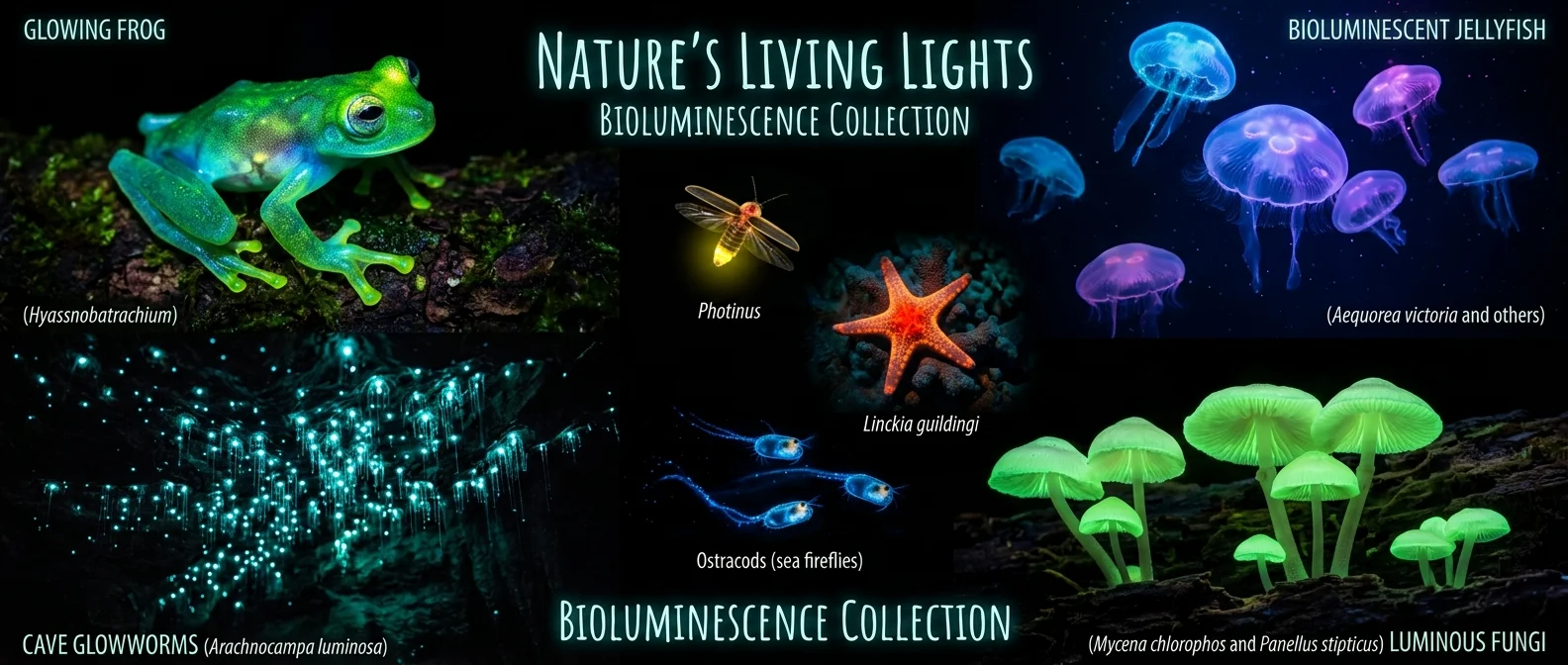
Somewhere in the Gulf of Mexico, a vampire squid shoots glowing slime at a predator's face. In New Zealand, thousands of worms transform a cave ceiling into an artificial sky. And on some Caribbean beach, waves light up blue every time they break. Bioluminescence — the ability of living organisms to produce light — isn't a rare phenomenon. It's one of nature's most widespread survival tools.
🔬 The Chemistry Behind the Glow
Before meeting our 10 animals, we need to understand how bioluminescence works at the chemical level. The process relies on two molecules: luciferin (the substrate that produces light) and luciferase (the enzyme that catalyzes the reaction). When luciferin oxidizes in the presence of luciferase and oxygen, the result is light — with almost no heat. That's why it's called "cold light": less than 20% of the energy converts to thermal radiation.
Some organisms produce luciferin themselves. Others acquire it through food or symbiotic bacteria. Color depends on molecular structure: blue-green in the ocean, yellow-green on land. A 2024 Smithsonian study revealed that bioluminescence evolved at least 94 times independently in the animal kingdom — with the oldest example dating back 540 million years in octocorals.
🔥 Fireflies — The Language of Light
If there's one animal we instinctively connect with bioluminescence, it's fireflies (family Lampyridae). Over 2,000 species live on every continent except Antarctica. Their light isn't decorative — it's language. Each species has a unique flash pattern: different rhythm, duration, and color. Males fly while flashing, and females, from the ground, respond only to the correct signal.
Their chemistry is impressively efficient: nearly 100% of energy converts to light, something no light bulb has achieved. But there's a dark side. Females of the genus Photuris mimic other species' signals to attract males — and eat them. They literally use light as a death trap.
🎣 Anglerfish — The Trap at 1,000 Meters
In ocean depths where sunlight never reaches, the anglerfish (order Lophiiformes) has developed one of the most terrifying hunting tools. From the top of its head grows a thin filament ending in a glowing sphere — the esca. The glow comes from symbiotic bacteria living inside the esca.
Smaller fish, curious about this unique point of light in the darkness, approach. Then the massive, dark jaws behind the glow are revealed. The anglerfish doesn't hunt — it waits. Another deep-sea fish, the loosejaw dragonfish, uses a different strategy: it emits red light, a color invisible to most marine creatures. It sees without being seen.

🧪 Crystal Jellyfish — The Molecule That Won a Nobel
The Aequorea victoria, a transparent Pacific jellyfish, doesn't stand out easily in a photograph. Yet inside it hides a molecule that changed biology: green fluorescent protein (GFP). The jellyfish uses a photoprotein — aequorin — that reacts with calcium ions and produces blue light. This blue light is then absorbed by GFP and re-emitted as green.
Why should we care? Because in 2008, Osamu Shimomura, Martin Chalfie, and Roger Tsien won the Nobel Prize in Chemistry for discovering and developing GFP as a biological marker. Today, GFP is used in laboratories worldwide: scientists attach it to genes to track where and when they're expressed inside living cells. A jellyfish gave biomedicine one of its most powerful tools.
🦑 Squids with Secret Lights
Two squid species stand out for how they use bioluminescence — but for completely different reasons.
The vampire squid (Vampyroteuthis infernalis) lives at depths of 600-1,200 meters, in the oxygen minimum zone. It doesn't resemble any relative. When threatened, instead of ink — which wouldn't show in darkness — it shoots sticky bioluminescent slime. The predator gets confused by the glowing spots, and the squid vanishes.
On the other hand, the bobtail squid (Euprymna scolopes) uses bioluminescence for camouflage. In its light organs, it hosts Vibrio fischeri bacteria, which produce light equal to moonlight. Swimming at night, the squid adjusts its belly's glow to eliminate its shadow — invisible to predators below. This squid-bacteria relationship is one of biology's most studied examples of symbiosis.

🌊 Dinoflagellates and Railroad Worms
Some night in Puerto Rico, you wave your hands in the sea and the water lights up electric blue. This isn't special effects — it's dinoflagellates, microscopic single-celled organisms that flash when disturbed. Bioluminescent dinoflagellates create the famous phosphorescent bays — ecosystems so rare they're strictly protected. Their luciferase chemically resembles plant chlorophyll, evidence of evolutionary kinship spanning eons.
In a completely different environment, in South America's tropics, the railroad worm (Phrixothrix) — actually a beetle larva — does something unique. It glows in two colors simultaneously: red on the head, green along the body. The two glows come from different luciferases, making it a true “railroad lantern.”
🦈 Sharks, Brittle Stars, and Cave Glowworms
The cookie-cutter shark (Isistius brasiliensis) grows only half a meter, but attacks whales, dolphins, even submarine tires. It uses counterillumination: its belly glows green, eliminating its silhouette. A dark section near the head resembles a small fish — enough to attract larger prey close to its razor teeth.
Brittle Stars
Detach glowing arms to distract predators — and regenerate them
Cave Glowworms
Arachnocampa larvae hang glowing threads from cave ceilings in New Zealand
Hatchetfish
Adjust belly glow according to light from above — perfect counterillumination
Sea Cucumbers
Transfer glowing segments onto nearby fish so they become targets instead
Brittle stars stand out for an incredible defensive tactic: they detach their glowing arms, leaving them to glow while crawling away in darkness. The predator follows the glow — and loses the real prey. In New Zealand, glowworms (Arachnocampa luminosa) create something unforgettable: they hang sticky glowing threads from cave ceilings, creating a luminous false sky that traps insects.
🧬 540 Million Years of Evolution in Light
Until recently, scientists thought the oldest animal bioluminescence dated back 267 million years in microscopic crustaceans (ostracods). The study by Andrea Quattrini and Danielle DeLeo (Smithsonian Institution, 2024), published in Proceedings of the Royal Society B, overturned this timeline. Analysis of 185 octocoral species revealed that bioluminescence appeared in these corals 540 million years ago — 273 million years earlier than we believed.
Why so many independent evolutions? The answer lies in survival pressure. In environments without light — the deep ocean, caves, tropical forests at night — the ability to create light becomes a competitive advantage. For hunting, camouflage, finding mates, communication. Three-quarters of deep ocean animals produce their own light. It's not the exception. In darkness, bioluminescence is the rule.
💡 From Antiquity to the Laboratory
GFP from the jellyfish Aequorea victoria is now used as a “reporter gene” in thousands of experiments worldwide. Bioluminescent trees could one day light streets without electricity, while bioluminescent crops could signal when they need water. Nature discovered light long before we invented electricity.