📖 Read more: Mesopotamian Gods: Enlil, Marduk, and Ishtar
🏛️ Architecture of the Divine
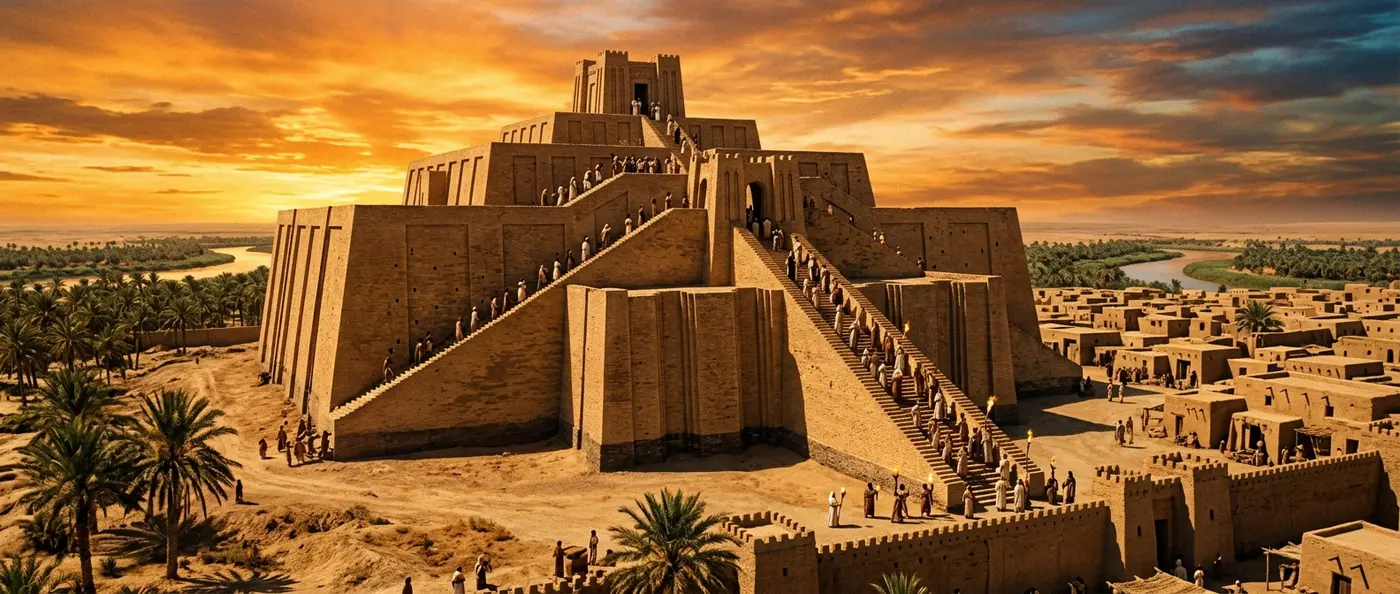
Ziggurats represented the pinnacle of Mesopotamian architectural thinking. These massive terraced structures weren't random—every level, every step, every angle carried symbolic weight. In Babylon, the greatest ziggurat dedicated to the god Marduk soared to heights exceeding 300 feet, according to ancient sources.
Building them demanded millions of baked clay bricks. Stone was rare in Mesopotamia, so architects developed advanced techniques to ensure these giants stayed upright. They used bitumen tar as mortar and embedded reed mats between brick layers for reinforcement.
Each ziggurat had seven levels, symbolizing the seven heavens of Mesopotamian cosmology. The levels were painted different colors—black, white, red, blue, orange, silver, and gold—creating a spectacular sight visible from miles away.
🔱 Etemenanki: The Tower of Babel?
Babylon's most famous ziggurat was Etemenanki, meaning "foundation of heaven and earth" in Akkadian. Many scholars believe this was the building that inspired the biblical Tower of Babel story. The connection isn't coincidental—Babylon was indeed a multilingual metropolis where merchants and visitors from across the known world converged.
According to Herodotus, who visited Babylon in the 5th century BC, Etemenanki had eight levels (instead of the usual seven) with a golden statue of Marduk crowning the top temple. The Greek historian describes how only one priestess was allowed to enter the uppermost shrine, where tradition held that the god descended to meet mortals.
The building had a square base roughly 300 feet on each side. A magnificent triple staircase led to the first level, while from there paths and stairs spiraled upward to the summit. The ascent was designed to be gradual and ceremonial, giving worshippers the sense they were slowly approaching the divine.
⚔️ History Through the Ages
Mesopotamian ziggurats have a history spanning over 3,000 years. The first prototypes appeared around 3000 BC in Sumeria, but Babylon evolved them into monuments of imperial power. Every great king wanted to leave his mark by renovating or expanding ziggurats.
Hammurabi (1792-1750 BC), the famous lawgiver, was among the first to invest significant resources in erecting ziggurats in Babylon. Centuries later, Nebuchadnezzar II (605-562 BC) undertook the ambitious project of completely reconstructing Etemenanki, making it the tallest building of his era.
Decline came with Persian conquest. Xerxes partially destroyed Etemenanki in 484 BC as retaliation for a rebellion. When Alexander the Great captured Babylon in 331 BC, he found the ziggurat in ruins. He planned to rebuild it but died before starting the project.
Royal Prestige
Every Babylonian king considered maintaining and expanding ziggurats a sacred duty. Neglect was seen as impiety that would provoke divine wrath.
Construction Techniques
Babylonians developed innovations like using asphalt as binding material and incorporating drainage systems to protect against rain.
Cultural Influence
Ziggurats influenced the architecture of many neighboring civilizations. Similar structures have been found from Iran to Syria.
🏺 Religious and Social Significance
Ziggurats weren't just impressive buildings—they were the center of religious, economic, and social life. At their base operated warehouses, workshops, and administrative offices. The priests who managed ziggurats were simultaneously astronomers, mathematicians, and bankers.
From ziggurat tops, priest-astronomers observed the stars and recorded their movements. These observations led to the development of the first 12-month calendar and the establishment of the seven-day week. This knowledge was used to schedule agricultural work and religious festivals.
Ceremonies at ziggurats were spectacular. During the New Year festival (Akitu), the king climbed the ziggurat steps to renew his divine authorization. Thousands of faithful gathered at the base to watch the ceremony, while musicians and dancers created an atmosphere of ecstasy.
💡 The Secret of Colors
Each ziggurat level was painted a different color corresponding to a planet: black for Saturn, white for the Moon, red for Mars, blue for Mercury, orange for Jupiter, silver for Venus, and gold for the Sun. This color coding reflected Babylonian astronomical knowledge.
🔬 Modern Archaeological Discoveries
Excavations in Babylon that began in the 19th century revealed Etemenanki's foundations. In 1913, German archaeologist Robert Koldewey discovered the ziggurat's square base, confirming ancient descriptions. Today, only the foundations survive—a massive water-filled pit marks the site of the once-magnificent monument.
Recent research using satellite imagery and ground-penetrating radar revealed that the Etemenanki complex was even larger than previously believed. Around the central ziggurat stood dozens of smaller temples, shrines, and administrative buildings forming an entire sacred city within the city.
In 2019, Iraqi archaeologists discovered clay cylinders with inscriptions detailing the reconstruction of a ziggurat in the ancient city of Kish. The inscriptions mention that the project took 12 years and 30,000 workers to complete, giving us insight into the scale of these undertakings.
🗺️ Ziggurats Across Mesopotamia
While Babylon's Etemenanki was the most famous, dozens of ziggurats rose throughout Mesopotamia. The ziggurat of Ur, dedicated to the moon god Nanna, survives in better condition and gives a vivid picture of these structures' original form. In Assyria, Nineveh's ziggurat rivaled Babylon's in size.
Every Mesopotamian city competed to build the tallest ziggurat. This arms race in stone drove engineers to invent better mortar, stronger foundations, and more daring heights—innovations that outlasted the empires that built them.
📊 The Greatest Ziggurats
💎 Legacy and Influence
Ziggurat influence extends far beyond Mesopotamia. Egypt's pyramids, though different in purpose, share the same ambition to reach the heavens. Maya and Aztec pyramids in Central America show striking similarities to ziggurats, though they developed independently thousands of years later.
In modern times, ziggurat architecture continues to inspire. Skyscrapers with stepped forms, like Chicago's Willis Tower, draw inspiration from these ancient monuments. The idea of a building connecting earth to sky remains powerful in the collective imagination.
Ziggurats also teach us about architecture's power to express cultural values. In an age without skyscrapers, these structures were the ultimate expression of human ambition and faith. They symbolized humanity's desire to transcend earthly limits and touch the divine.
Today, as archaeologists continue discovering new evidence about ziggurats, our understanding of these monuments deepens. Each new discovery adds a piece to the puzzle of Mesopotamian history and helps us appreciate the magnitude of achievements by a civilization that flourished 4,000 years ago.
Babylon's ziggurats may have collapsed, but their legacy lives on. They remind us that human creativity and spiritual seeking are timeless. The stairways to the gods may now be ruins, but the vision that created them continues to inspire us.