📖 Read more: Altai Turkic Monuments: New 2026 Discovery Expands Map
🦉 The Discovery That Stunned Mexico
An anonymous tip about illegal excavations led Mexican authorities to one of the decade's most significant archaeological finds. In January 2025, investigators arrived at San Pablo Huitzo in Oaxaca expecting to bust looters. Instead, they uncovered a pristine tomb that had escaped grave robbers for fourteen centuries.
President Claudia Sheinbaum Pardo called it "the most important archaeological discovery of the decade in Mexico" during a January 23 press conference. The tomb dates to around 600 CE, when the Zapotec civilization — known as the "Cloud People" — ruled vast territories across southern Mexico.
What makes this discovery extraordinary isn't just its age. The murals, sculptures, and inscriptions inside remain in stunning condition, preserving Zapotec beliefs about death and the afterlife in unprecedented detail. Mexico's National Institute of Anthropology and History (INAH) immediately assembled a multidisciplinary team to study and protect the site.
💡 Why "Cloud People"?
The Zapotecs called themselves "Be'ena'a" — the Cloud People. They believed their ancestors descended from clouds and were born from trees, rocks, and jaguars. This name reflects their deep spiritual connection to sky and nature, elements that permeate their art and architecture.
🗿 The Owl Guardian's Secret
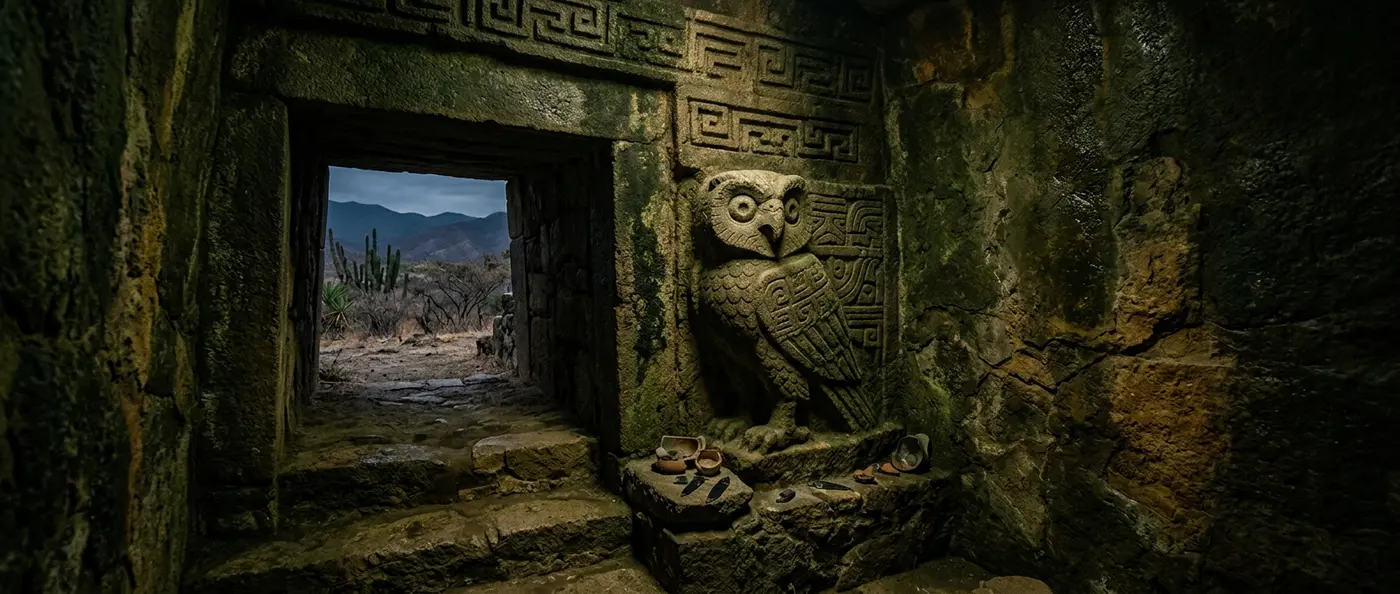
The tomb's entrance features a colossal owl sculpture with wide-open eyes. Its beak opens to reveal the painted face of a Zapotec ruler — not carved, but depicted in vivid colors within the bird's mouth. The positioning carries deeper meaning. In Zapotec culture, owls symbolized death and power, but this specific arrangement tells a deeper story.
The ruler's face positioned inside the owl's beak suggests the bird is "holding" the dead, functioning as a psychopomp — a spiritual guide escorting souls to the underworld. This symbolic representation is unique in Mesoamerica and shows previously unknown aspects of Zapotec cosmology.
The owl wasn't just guarding the tomb. It was actively participating in the deceased's journey to the afterlife, protecting against malevolent spirits and ensuring safe passage to the next world. The intricate detailing of feathers and the bird's intense expression demonstrate the sophisticated artistry of Zapotec sculptors.
🏛️ Architecture and Art Inside the Tomb
Past the owl guardian, archaeologists discovered an imposing threshold separating two burial chambers. The lintel consists of stone slabs carved with "calendar names" — a naming system where deities and important figures received specific symbols related to their birth dates.
Flanking the doorway are carved figures of a man and woman. Experts believe these represent either the ancestors buried within or the spiritual guardians of the tomb. The precision and detail of these carvings reveal the advanced artistic capabilities of Zapotec craftsmen.
Polychrome Murals
The burial chamber walls preserve vibrant murals in white, green, red, and blue. They depict funeral processions with people carrying bags of copal — tree resin burned as incense during ceremonies.
Calendar System
Inscriptions with "calendar names" reveal the complex Zapotec chronology. Each person received a name based on their birth date, combining numbers with sacred symbols in an intricate system of identification.
Architectural Precision
The tomb's construction shows advanced engineering knowledge. Stone slabs fit perfectly without mortar, while drainage systems protected the interior from moisture damage over centuries.
🔱 Zapotec Views on Death and Afterlife
The tomb shows how Zapotecs understood death and the afterlife. Unlike other Mesoamerican civilizations that viewed death as an ending, Zapotecs saw it as a transition to another level of existence.
Culture Minister Claudia Curiel de Icaza described it as "an exceptional discovery due to its level of preservation and what it reveals about Zapotec culture: their social organization, burial ceremonies, and cosmovision, preserved in the architecture and murals."
📖 Read more: Hazelnut Shells Rewrite Cornwall's Prehistoric Timeline
The murals depicting funeral processions with copal incense suggest death was a community event. The entire community participated in the deceased's journey to the underworld, offering aromatics and prayers to facilitate their passage.
⚔️ The Zapotec Empire and Its Legacy
The Zapotec civilization emerged around 700 BCE and collapsed with Spanish conquest in 1521. However, hundreds of thousands of Zapotec speakers still live in Mexico today, keeping their cultural heritage alive.
Recent lidar technology revealed the full extent of Guiengola, a 15th-century fortified Zapotec city. According to Pedro Guillermo Ramón Celis from McGill University in Canada, the city covers 890 acres with over 1,100 buildings, 2.5 miles of walls, and organized urban layout with temples and public spaces.
In 1497, the Aztecs attacked Guiengola but were defeated by the Zapotecs. Archaeologists found thousands of round pebbles near the walls, likely used as sling projectiles during the battle. This victory proved Zapotec military strength even against the powerful Aztec empire.
🏺 Archaeological Significance of the Discovery
The Huitzo tomb joins a dozen other ancient Zapotec tombs discovered in Oaxaca over the past decade. Unfortunately, many had been looted before archaeologists could study them. This makes the intact Huitzo tomb even more valuable.
INAH's multidisciplinary team now works to conserve and protect the tomb. Further research will focus on ceramic findings, iconography, and the few human bones recovered. Each element is studied carefully to reveal more information about life and death in ancient Zapotec society.
🏛️ Comparison with Other Mesoamerican Tombs
President Sheinbaum characterized the tomb as "a source of pride for Mexicans, proof of Mexico's greatness." The discovery reminds us of the wealth and complexity of pre-Columbian civilizations that flourished in Mesoamerica long before European arrival.
🔬 The Future of Research
Lidar technology that revealed Guiengola has transformed archaeological research in Mexico. With the ability to map entire ancient cities beneath vegetation, scientists can now better understand the organization and extent of ancient civilizations.
For the Huitzo tomb, next steps include detailed mural analysis with new imaging techniques, DNA analysis of bones to determine the buried person's identity, and comparative study with other Zapotec tombs to understand developments in burial practices.
The owl tomb holds more clues about one of ancient America's longest-lived civilizations. The Zapotecs, the "Cloud People," continue teaching us about their wisdom and artistry, 1,400 years after creating this stunning monument.