📖 Read more: Code of Hammurabi: The First Written Laws in History
📜 The Mesopotamian Writing Revolution
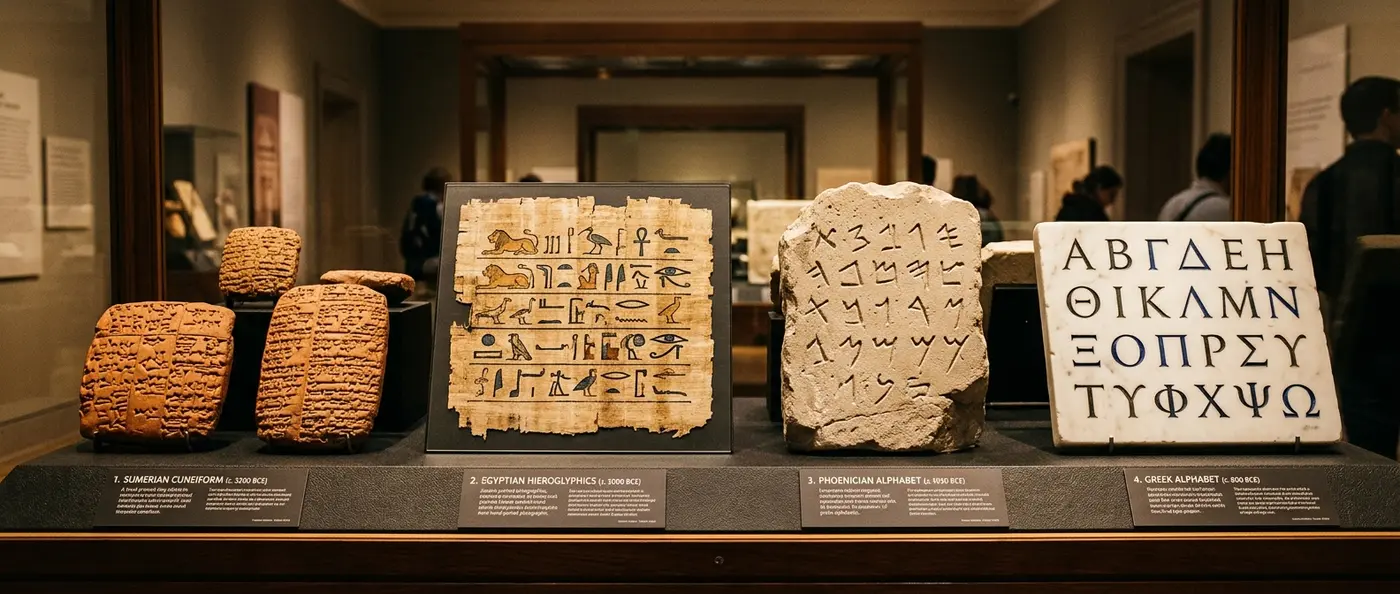
Writing began in Sumer around 3200 BC, when humans first pressed symbols into clay tablets. This early form of writing, known as cuneiform, wasn't just a recording system — it launched a revolution in how humans store and transmit knowledge.
Cuneiform got its name from the wedge-shaped marks that resembled little triangles. Scribes used reed styluses with triangular tips to press into wet clay, creating thousands of different combinations. Initially, each symbol represented an entire word or concept — a system that required memorizing hundreds, if not thousands, of different characters.
Over centuries, cuneiform evolved from a logographic system (where each symbol represents a word) to a syllabic system. This change cut the required symbols from thousands to roughly 600 syllabic signs that scribes could combine to write any word in their language.
🏺 The Discovery That Changes History
In 2004, at the ancient city of Umm el-Marra in northern Syria, archaeologist Elaine Sullivan found four small clay cylinders that initially seemed worthless. While excavating an Early Bronze Age tomb, she found four small clay cylinders, no bigger than a child's finger. She almost threw them away, thinking they were just clumps of dirt.
When she cleaned them, mysterious symbols emerged on their surfaces. Glenn Schwartz, head of the Johns Hopkins University excavation, immediately recognized these weren't cuneiform symbols. They were something entirely different — and far more revolutionary.
Radiocarbon dating revealed the cylinders date to around 2400 BC, making them 500 years older than previously known alphabetic texts. Ted Lewis, a specialist in Semitic languages, managed to identify the word "silanu" on one cylinder — likely a personal name. The cylinders had holes, suggesting they were tied with string to other objects, functioning as gift tags or content identifiers.
🔤 From Pictures to Sounds: The Evolution of Writing Systems
Ignace Gelb, a distinguished Assyriologist, identified four stages in writing evolution. The first stage was pictographic writing, where symbols directly represented objects or ideas. A drawing of the sun meant "sun," a drawing of a mountain meant "mountain."
The second stage was logographic systems, where each symbol represented an entire word. Chinese writing is the most familiar surviving example of this type. The third stage was syllabic systems, where each symbol represented a syllable — a combination of consonant and vowel.
The fourth and final stage was the invention of the alphabet, where each symbol represents an individual sound. This innovation, traditionally attributed to the Phoenicians around 1050 BC, created writing systems with just 20-30 characters that could express any word in a language.
Pictographic Writing
Early systems used simple pictures to represent objects and concepts. A circle with rays meant "sun," three wavy lines meant "water."
Logographic Writing
Each symbol represented an entire word. Chinese writing with its thousands of characters is the best modern example.
Syllabic Writing
Symbols representing syllables like "ma," "ti," "ko." Mycenaean Linear B and Japanese kana are examples.
🌍 Parallel Developments: China and the West
While Mesopotamia and the Mediterranean evolved toward the alphabet, China followed an entirely different path. Chinese writing, which appeared around 1250 BC during the Shang dynasty, remained logographic. Each character represents a word or morpheme, and the system includes thousands of different characters.
Chinese avoided the alphabet for practical reasons. The Chinese language, with its simple syllabic structure and large number of homophonic words, is better served by a logographic system. An alphabetic system would create massive confusion, as many different words would be written identically.
Japanese writing represents a unique synthesis: it borrowed Chinese characters (kanji) but also developed two syllabic systems (hiragana and katakana) to express grammatical elements and foreign words. Korean writing (hangul), created in the 15th century, is perhaps the most scientifically designed writing system, combining alphabetic and syllabic principles.
💡 Why So Many Different Writing Systems?
Each writing system evolved to serve the particular needs of the language and culture that created it. The alphabet was ideal for Indo-European languages with their complex syllabic structures, while logographic systems suited languages with simple syllabic structure and many homophonic words better.
🏛️ The Greek Innovation
The Greeks, around the 8th century BC, made the final innovation in alphabet history. They borrowed the Phoenician writing system, which contained only consonants, and added symbols for vowels. For the first time in history, every sound in a language could be represented with a separate symbol.
The Greek addition of vowels changed everything. As Eric Havelock wrote, the Greeks created "a table of linguistic sound elements not only manageable because of economy, but for the first time in the history of homo sapiens, also accurate." The Greek alphabet allowed precise recording of spoken language, opening new paths for literature, philosophy, and science.
From the Greek alphabet came Latin, Cyrillic, and many other alphabetic systems used worldwide today. Its simplicity and flexibility made it the dominant writing system of the West and, ultimately, the most widespread writing system globally.
📚 The Power of Written Language
Writing did more than record information — it rewired human thinking. For the first time, humans could store information outside the human brain, transmit messages across great distances, and preserve knowledge for future generations.
Writing enabled the development of complex legal systems, the maintenance of historical records, the evolution of literature and science. Complex legal systems, historical records, literature, and science all depend on writing. From the first accounting records in Sumer to today's digital texts, writing remains the foundation of human knowledge and communication.
📊 The Spread of Writing Systems
🔍 New Discoveries, New Perspectives
The Umm el-Marra discovery isn't the only one revising writing history. Recent excavations worldwide reveal that writing development was more complex and varied than we believed. In Egypt, the discovery of 13,000 ostraca (pottery shards with inscriptions) at Athribis revealed an entire archive of astrological texts, tax receipts, and school exercises spanning over 1,000 years.
Writing had spread beyond palace scribes and temple priests. At Athribis, they found student exercises with repeated lines — apparently punishments for unruly students. They found lists of months, numbers, arithmetic problems. Writing had become part of daily life, from school to marketplace.
New finds keep overturning assumptions about when and how writing spread. Writing history isn't a straight line of progress from simple to complex, but a complex network of innovations, borrowings, and adaptations. And as Syria's clay cylinders show, even after centuries of research, ancient history still has surprises to reveal.