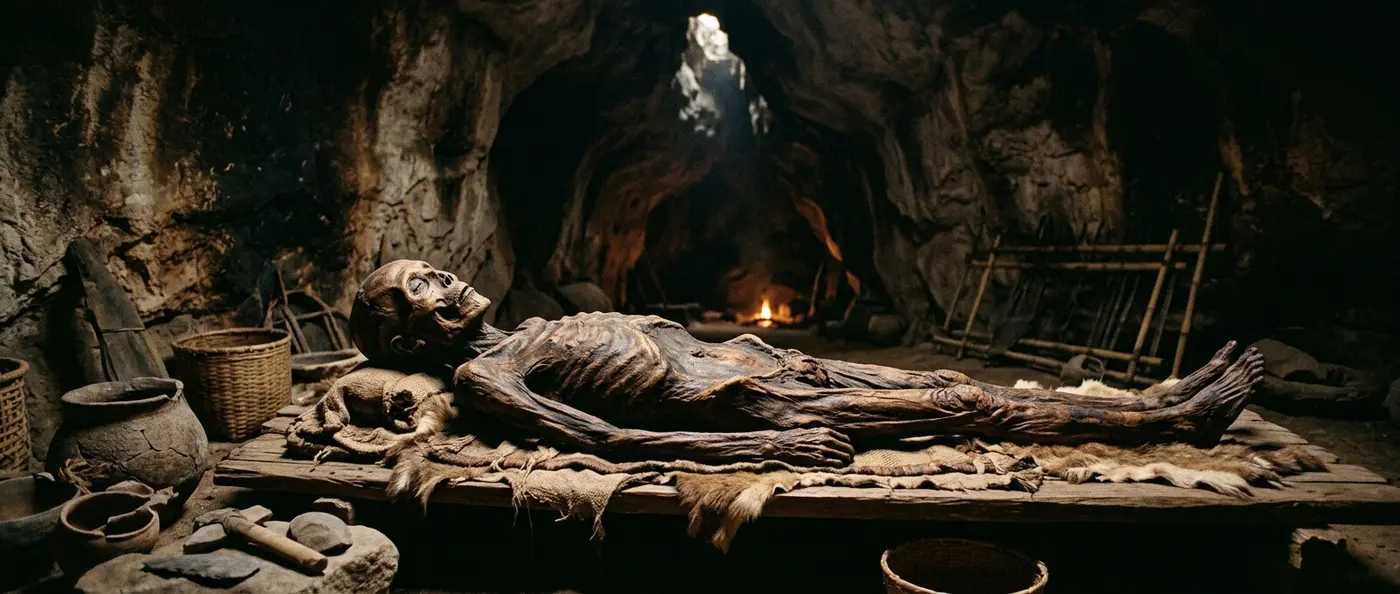
Forget Egypt. Forget the golden sarcophagi and linen wrappings. Forget the Chinchorro mummies of Chile and the frozen bodies of the Andes. A 2025 study published in PNAS overturns the established timeline of mummification. The world's oldest mummies weren't crafted in Egypt or South America — they were smoke-dried in Southeast Asia and southern China 10,000 years ago, using the same technique ancient hunters used to preserve meat. These Stone Age people figured out how to cheat death by turning their loved ones into human jerky.
📖 Read more: Tang Dynasty: China's Golden Age of Poetry and Power
🔬 The Discovery: Skeletons Twisted Into Impossible Positions
Researchers examined dozens of ancient burials across China, the Philippines, Laos, Thailand, Malaysia, and Indonesia, dating between 4,000 and 12,000 years old. One detail proved crucial: the skeletons were found in "hyperflexed" positions — twisted into unnaturally tight fetal poses that human joints can't achieve naturally. This artificial positioning means the bodies were bound tightly immediately after death, before rigor mortis set in, allowing limbs to be forced beyond their normal range of motion. A similar find in Portugal in 2022 had already been interpreted as possible mummification based on this same hyperflexed positioning.
Researchers found burn marks on many skeletons — but zero evidence of fire inside the burial sites. This ruled out cremation or accidental burning. Instead, it pointed to deliberate ritual processing involving fire and smoke before burial. A purposeful mummification practice using dry smoking. One of the most striking finds was the bones of a middle-aged man in China's Guangxi province, mummified over 9,000 years ago.
10,000
Years ago — earliest known mummification
6
Countries with smoke-dried mummy finds
42,000
Possible origin of practice in years
Dani & Pumo
Tribes still practicing today
🔥 The Technique: X-Rays Reveal Ancient Smoking
To confirm the bones had been exposed to heat, researchers deployed two cutting-edge non-destructive analysis techniques: X-ray diffraction, which examines internal crystalline microstructure without damaging materials, and infrared spectroscopy, which detects chemical changes at the molecular level. The results were clear. Many skeletons showed clear signs of low-intensity heating and discoloration from soot deposits — but no evidence of direct combustion like you'd see in cremation or funeral pyres. This meant bodies were placed over slow, controlled fires for extended periods, in a process similar to smoking meat but applied to human corpses.
The study concluded that a specialized burial practice — mummification through smoking — was widely applied in pre-agricultural communities across southern China and Southeast Asia. Bodies were bound tightly after death with vines or plant fibers, positioned over low-temperature fires, and smoked for extended periods — days or even weeks — until they hardened and turned completely black. The smoke dehydrated soft tissues while its chemical compounds — phenols and aldehydes — acted as natural antimicrobials, preventing bacterial decomposition and extending preservation.
In the hot, humid climate of Southeast Asia, decomposition begins rapidly — within hours of death, bacteria start breaking down tissues. Researcher Hsiao-chun Hung explained that "smoking was the most effective way to preserve bodies in this tropical climate, where temperature and humidity dramatically accelerate decay." Unlike Egyptian mummies sealed in sarcophagi and tombs, these weren't placed in closed containers after smoking — preservation lasted several decades to a few hundred years, long enough for two or three generations to keep their ancestors "present" among them, seated on stools or placed in positions of honor inside homes.
🌏 Living Tradition: The Dani and Pumo of Papua
Smoke-dried mummification isn't just ancient history — it's still alive in remote communities. In 2019, researchers traveled to Papua, an Indonesian province in western New Guinea, where the Dani and Pumo peoples continue mummifying their dead ancestors using the exact same method employed thousands of years ago. Bodies are bound tightly in fetal position immediately after death, placed over low fires on specially constructed platforms, and systematically smoked until they turn completely black and hard as wood. The process can take weeks.
These modern observations helped researchers understand the ancient practice. The relationship between tight binding, hyperflexed positioning, soot on bones, and low-temperature heating finally made sense — every element they found on ancient bones corresponded to a step in the living tradition. Dani mummies are kept in separate huts in the village, and residents "visit" them regularly, speak to them, and consider them active community members. Death, for these peoples, doesn't mean separation — it means transformation.
Hung noted: "What's clear is that the practice extended the visible presence of the dead, allowing ancestors to remain among the living in a tangible way — a deeply moving reflection of eternal human love, memory, and devotion." How exactly ancient hunter-gatherers discovered that smoke could preserve a human body remains unknown, she added — perhaps discovered accidentally near campfires, perhaps as a byproduct of some mourning ritual, or deliberately transferred from the technique of smoking animal meat to human bodies.
Only Bones Remain
Unlike Egyptian mummies, no skin, tissue, or hair survives in these ancient burials. However, researchers consider the finds "mummies" because they underwent deliberate mummification through smoking — the intent to preserve is clear, even though preservation doesn't last millennia like in the dry Egyptian desert.
"Two-Layer" Migration Model
The findings support the "two-layer" migration theory: ancient hunter-gatherers migrated to SE Asia 65,000 years ago as the first wave, while Neolithic farmers came as a second wave just 4,000 years ago, bringing completely different burial traditions. Today's Dani and Pumo peoples may be descendants of those first emigrants.
42,000 Years of History?
If hyperflexed burials throughout SE Asia represent smoke-dried mummies — which the study considers highly likely — the practice may have begun simultaneously with Homo sapiens' initial expansion from Africa 42,000 years ago, showing "deep and enduring biological and cultural continuity."
⚖️ Comparison with Other Mummification
Before this study, the oldest known mummies were those of the Chinchorro community in Chile, dating around 5050 BCE — nearly 3,000 years younger than Asia's smoke-dried mummies. Egyptians began mummification even later, around 3000 BCE. The most sophisticated Egyptian techniques — removal of internal organs, treatment with resin and natron, wrapping in linen bandages — developed gradually over millennia of experimentation. In contrast, the smoking technique was simpler to execute but extremely effective in the hot, humid tropical climate of Southeast Asia, where natural decomposition would begin within hours of death.
The word "mummy" comes from the Arabic "mūmiyah" meaning "bitumen," reflecting the medieval belief that Egyptian mummies were made with tar. During the Middle Ages, powder from ground mummies was sold in pharmacies as medicine — a trade that continued in Europe until the 18th century. Eventually, they forgot the "value" was in the bitumen and began making fake "mummy" from corpses of criminals or suicides. The discovery of smoke-dried mummies changes our understanding of this widespread human practice, showing that the desire to defeat death — at least visually — is far older than the Pharaohs.
SE Asia & China ~8000 BCE — Smoking over fires
Chinchorro, Chile ~5050 BCE — Organ removal, reconstruction
Ancient Egypt ~3000 BCE — Embalming, resin, linen
Inca, South America ~1400 CE — Natural drying in cold climate
Dani & Pumo, Papua Today — Living smoking tradition
This discovery changes the history of humanity's relationship with death. 10,000 years ago, hunter-gatherers without writing, without cities, without metals, had already developed a complex ritual practice to keep their dead "alive" within the community. Biological anthropologist Ivy Hui-Yuan Yeh from Nanyang University commented that the findings "are consistent with patterns of early human migration, distribution, and interaction in Asia." If the practice extends that far back in time — up to 42,000 years with the first expansion of Homo sapiens from Africa — then mummification wasn't an invention of "civilized" societies but an instinct deeply rooted in the human psyche. The need to not let our dead disappear — to keep them present, visible, part of us — appears to be as ancient as Homo sapiens itself.
ancient mummies mummification Southeast Asia ancient China smoke-dried bodies Dani tribe Papua hyperflexed skeletons ancient civilizations prehistoric burial