📖 Read more: Indus Valley: Lost Cities Reveal 4,500-Year-Old Secrets
📜 The Script That Refuses to Speak
The Indus Valley civilization flourished between 2600 and 1900 BCE across a vast territory covering modern-day Pakistan, western India, eastern Iran, and parts of Afghanistan. Its inhabitants created impressive cities like Harappa and Mohenjo-daro, developed advanced drainage and trade systems — and left behind thousands of inscriptions in a script no one can read.
Michael Philip Oakes, a computational linguistics researcher at the University of Wolverhampton, counts thousands of objects bearing this script that have survived. The problem? The inscriptions are extremely short — averaging just five symbols each. Without longer texts or bilingual inscriptions, scholars face an nearly impossible task.
🗿 Seals, Tablets, and Mysteries
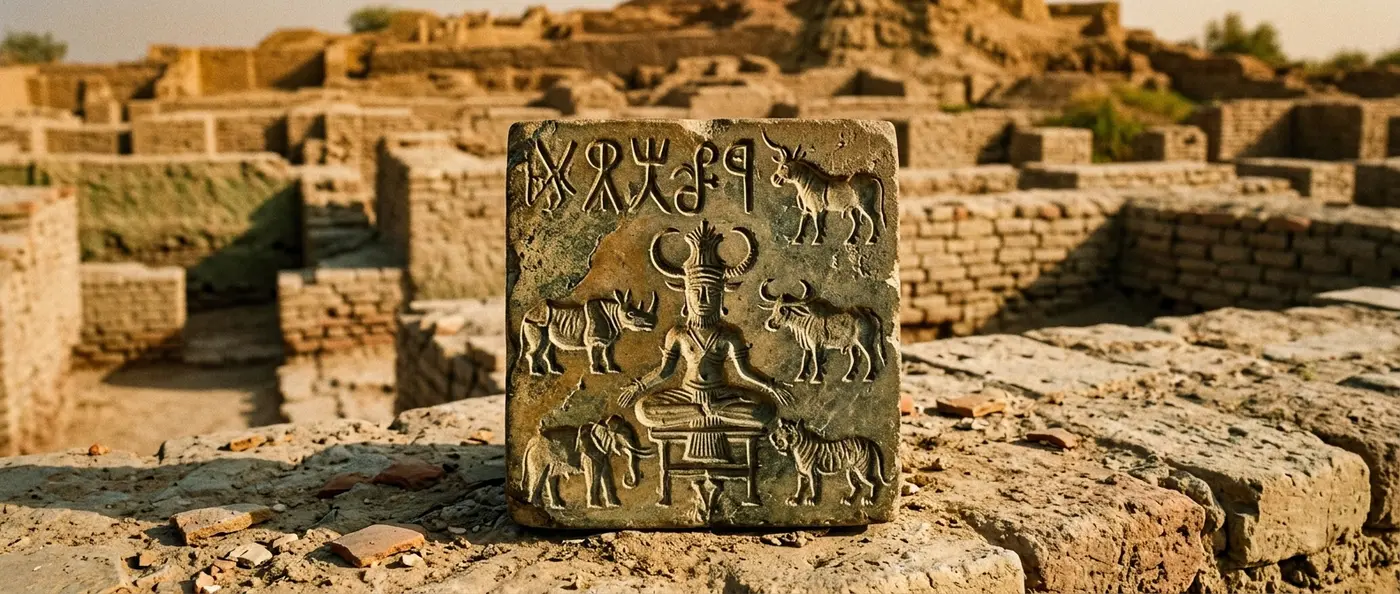
Indus script appears primarily on square steatite seals, where symbols are carved in reverse so they appear correctly when pressed into clay. Each seal typically depicts an animal — bulls, elephants, rhinoceros — with a short inscription at the top. But what do these inscriptions say? Are they names? Titles? Prayers?
The symbols vary dramatically. Some resemble a diamond with a square at its corner, others look like the letter U with three "fingers" at each end, and still others appear as ovals containing asterisk-like shapes. Beyond seals, the script appears on faience tablets, clay and copper plates, as well as tools, weapons, and decorative objects.
One of the most impressive finds comes from the ancient city of Dholavira — a "signboard" roughly 10 feet long with a 10-character inscription. It's the largest known inscription from the civilization, but even this remains silent about its meaning.
⚗️ From Sumerians to Dravidians
For more than a century, researchers have proposed dozens of theories about the language behind the script. Initially, some suggested connections to Sumerian, Hurrian, Elamite, even ancient Slavic or Egyptian writing. None of these theories managed to produce convincing results.
In the late 1960s, two independent research teams — one Soviet led by Yury Valentinovich Knorozov and one Finnish led by Asko Parpola — used computers for the first time to analyze symbol sequences. Both concluded that the script represents a Dravidian language, a family of languages still spoken in southern India.
Other scholars, including renowned archaeologist S.R. Rao, argued that the script encodes an Indo-Aryan language. This theory, however, conflicts with the prevailing view that Indo-Aryan languages arrived in the subcontinent via Central Asia between 2000 and 1500 BCE — centuries after the Indus civilization's disappearance.
Multilingual Theory
Some researchers propose that the script doesn't represent any specific language but functioned as a pictographic system understandable by multilingual populations — something like modern emojis.
📖 Read more: Nazca Lines: Ancient Designs Only Visible from Above
Numerical System
Vertical lines next to symbols likely represent numbers. The civilization's weight system used ratios of 1, 2, 4, 8, 16, 32, and 64 — perhaps the key to understanding numerical inscriptions.
Identity Emblems
Another theory suggests the symbols functioned more as emblems declaring a person's or entity's identity, rather than as actual written language.
🤖 Artificial Intelligence Enters the Game
With the advent of artificial intelligence, new hopes emerge for deciphering the Indus script. Rajesh Rao, a computer science professor at the University of Washington, has used AI since the 2000s to analyze the script's statistical patterns. His team concluded that the script has statistical characteristics suggesting it does encode a language — not just symbols.
However, Rao himself remains cautious about complete decipherment with existing texts. "The odds aren't very high," he states, noting that partial decipherment might be feasible. "Maybe we can reconstruct their numerical system."
Steve Bonta, an independent researcher with a PhD in linguistics, is more optimistic. He believes the script has already been partially deciphered since the '90s, when he showed that certain symbols indicate property notations expressed in various weights. The problem is that the scientific community hasn't widely accepted these interpretations.
💡 Why Don't We Have Our Own Rosetta Stone?
The Rosetta Stone enabled the decipherment of Egyptian hieroglyphs because it contained the same text in three scripts: hieroglyphic, demotic, and ancient Greek. Unfortunately, no bilingual inscription with Indus script has been found to date. Without such a "key," decipherment remains extremely difficult.
🏺 The Dancing Girl and Other Mysteries
While the script remains silent, other objects from the Indus civilization speak volumes about their artistic and technological evolution. The famous bronze figurine of the "Dancing Girl" from Mohenjo-daro, just 4.1 inches tall, shows a young woman with her hand on her hip and head tilted slightly back. She wears only a necklace and stacks of bracelets on each arm.
British archaeologist Mortimer Wheeler described the figurine in 1973: "She's about fifteen years old I should think, not more, but she stands there with bangles all the way up her arm and nothing else on. A girl perfectly, for the moment, perfectly confident of herself and the world. There's nothing like her, I think, in the world."
The figurine was created using the lost-wax casting technique, where hot wax is poured into a mold to create a model. The wax then melts, forming a cavity for the metal. This sophisticated technique demonstrates the civilization's high level of metallurgical knowledge.
📖 Read more: Australia's Aborigines: 65,000 Years of Unbroken Culture
🔍 The Future of Decipherment
Expert opinions on whether the Indus script will ever be deciphered remain divided. Peter Revesz from the University of Nebraska believes that "the Indus Valley script will certainly be solved one way or another, and AI can help, but it needs to be guided by good research design." His team has used data mining and statistical analysis to identify which symbols likely have similar meanings.
Bonta, on the other hand, emphasizes that AI is "an extension of human intelligence and intuition, albeit an extremely powerful one." Technology can help create catalogs of possible symbol values, but ultimately human researchers must take the lead.
The greatest hope may lie underground. Many Indus Valley civilization sites remain largely unexplored. Future excavations might reveal longer texts or — the holy grail of epigraphy — a bilingual inscription containing Indus script alongside a known language.
📊 Comparison with Other Ancient Scripts
🌏 A Civilization Waiting to Speak
Four thousand years later, the Indus Valley script guards its secrets. Each seal, each tablet, each inscription holds secrets about a civilization that once dominated an area larger than contemporary Egypt and Mesopotamia combined. Their cities had advanced drainage systems, standardized weights and measures, and extensive trade networks reaching Mesopotamia.
Without understanding their writing, archaeologists can only speculate about how they lived, what they believed, how they governed themselves. Were they peaceful traders or warriors? How did they organize their society? What gods did they worship?
New excavations continue across Pakistan and India. Perhaps one day, whether through artificial intelligence or a chance discovery in the soil of Pakistan or India, the silent symbols will finally speak. And then, an entire lost world will come alive before our eyes.