🛡️ The Warrior Legacy That Built a Reputation
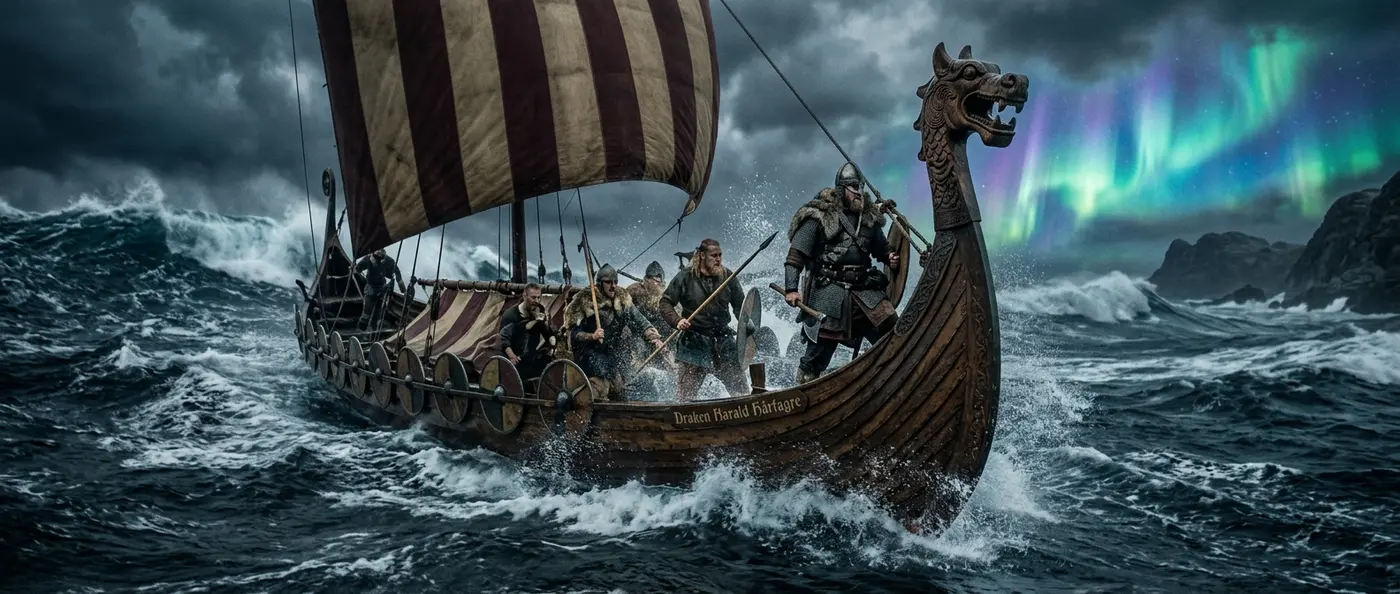
The Viking reputation for violence wasn't manufactured. Starting in 793 AD with the raid on Lindisfarne monastery in northeastern England, Scandinavian warriors terrorized Europe for three centuries. Their era ended at Stamford Bridge in 1066. Their tactics were brutally simple: lightning raids using shallow-draft longships that could navigate both open seas and river systems.
Ragnar Lothbrok stands as the archetype of Viking leadership, though historians debate whether he actually existed. His legendary sons — Halfdan, Ivar the Boneless, and Hubba — led the Great Heathen Army's invasion of East Anglia in 865 AD. This wasn't random pillaging. This was organized conquest.
Viking military superiority came from multiple factors. Their weapons, especially Damascus steel swords, outclassed anything their enemies carried. Round shields and chainmail provided excellent protection. But their greatest advantage was psychological warfare. Berserkers, elite warriors who fought in trance-like fury, embodied the fearless ideal that death in battle meant a place in Valhalla.
⚓ The Seafaring Explorers Who Rewrote Maps
Viking shipbuilding technology was revolutionary. Their vessels combined shallow drafts with exceptional stability, allowing them to travel oceans and rivers with equal ease. They navigated using the sun, stars, and even bird behavior to cross unknown waters. No GPS. No compass. Just skill and courage.
Leif Erikson's discovery of America around 1000 AD predated Columbus by five centuries. Son of Erik the Red, who colonized Greenland, Leif reached North American shores five centuries before Columbus. The Icelandic sagas describe three regions: Helluland (Land of Flat Rocks), Markland (Forestland), and Vinland (Wineland). Archaeological evidence at L'Anse aux Meadows in Newfoundland confirms Viking presence in America.
Their eastern expeditions covered similar distances. Swedish Vikings, known as Varangians, traveled Russian rivers to the Black and Caspian Seas. They reached Constantinople, where many served as mercenaries in the Byzantine emperor's guard. Some pushed even further, reaching Baghdad and Central Asia. These weren't random wanderings — they were systematic exploration and expansion.
💰 The Trade Network That Spanned Continents
Calling Vikings just raiders misses half the story. They created one of medieval Europe's most extensive trade networks. From Iceland and Greenland in the west to Russia and Byzantium in the east, Scandinavian merchants moved goods and ideas across vast distances.
Their main exports included furs, amber, leather, walrus ivory, and slaves. In return, they imported silver (mostly Arabic coins), silk, spices, wine, and high-quality weapons. Archaeologists have found thousands of Arabic silver coins in Scandinavia — proof of extensive trade with the Islamic world.
Trading Centers
Hedeby in Denmark, Birka in Sweden, and Kaupang in Norway served as major commercial hubs where merchants from across Europe and beyond conducted business.
Trade Routes
Vikings exploited Eastern Europe's river networks, creating the "Route from the Varangians to the Greeks" connecting the Baltic to the Black Sea.
Exchange System
They used a sophisticated weight-based system for silver transactions. Silver jewelry and coins were cut into pieces to create exact weights for specific trades.
🏛️ Social Structure and Cultural Complexity
Viking society was hierarchical but surprisingly sophisticated. At the top were jarls, the aristocracy who owned land and led military campaigns. Below them were karls, free farmers and craftsmen who formed society's backbone. At the bottom were thralls, slaves who comprised roughly 25% of the population.
Contrary to popular belief, Viking women enjoyed significant rights. They could own property, request divorces, and manage households when men were away on expeditions. Archaeological evidence suggests some women held high positions and may have participated in military activities.
Their pre-Christian religion centered on the Norse pantheon: Odin, Thor, Frey, and others. They believed warriors who died in battle went to Valhalla, Odin's hall, where they would fight and feast until Ragnarok, the world's end. This belief system reinforced their warrior culture and fearlessness in combat.
🗿 Runestones: Viking Social Media
Vikings left behind thousands of runestones — monuments with inscriptions honoring the dead or recording important events. These stones provide invaluable information about their history, language, and culture. Sweden contains the largest concentration, with over 3,000 documented runestones serving as medieval status symbols and historical records.
🔱 Technology and Innovation Beyond Warfare
Viking technological prowess extended far beyond weapons. Their shipbuilding was unmatched. Longships featured symmetrical bow and stern designs, allowing them to sail forward or backward with equal efficiency. The clinker-built construction technique, using overlapping planks, gave ships flexibility and durability that modern naval architects still admire.
In metallurgy, Scandinavian craftsmen were masters. Their swords, especially those bearing the "Ulfberht" signature, ranked among the period's finest. They used high-carbon steel, possibly imported from Central Asia, to create blades combining hardness with flexibility. Their techniques were so advanced that similar steel quality wasn't achieved again in Europe until the Industrial Revolution.
Even in daily life, Vikings showed ingenuity. They developed advanced farming techniques for harsh Scandinavian climates, including drainage systems and crop rotation. Their longhouses were architectural marvels of environmental adaptation, with thick turf and timber walls providing excellent insulation against brutal winters.
🌅 The End of an Era
The Viking Age ended for several converging reasons. Christianization of Scandinavia was crucial. As Norwegian, Danish, and Swedish kings embraced Christianity, the old warrior culture began fading. King Olaf Tryggvason of Norway, baptized around 995 AD, played a key role in spreading the new religion and its more peaceful ideals.
European kingdoms also grew stronger and better organized to counter Viking raids. Castles and fortified towns made surprise attacks less effective. The rise of heavy cavalry and armored knights created military forces capable of meeting Vikings on equal terms in pitched battles.
Many Vikings simply settled permanently in areas they once raided. In Normandy, England, Ireland, Russia, and elsewhere, Scandinavian colonists gradually assimilated with local populations. William the Conqueror, descendant of Vikings who settled in Normandy, conquered England in 1066 — symbolically marking the Viking Age's end.
📊 The Viking Legacy Lives On
💡 Rewriting the Viking Story
Modern archaeology and historical research have revolutionized our understanding of Vikings. They weren't just barbaric raiders but members of a complex, dynamic civilization that profoundly influenced European history. They were simultaneously warriors, merchants, explorers, craftsmen, and farmers — a multifaceted society that defies simple categorization.
They adapted to vastly different environments and cultures. From frozen Norwegian fjords to bustling Constantinople markets, Vikings left their mark everywhere they went. Their legacy lives in the languages we speak, our city names, many Europeans' DNA, and legends that still captivate us today.
The most important lesson from studying Vikings is that history is rarely one-dimensional. People and civilizations are complex, with multiple facets that often contradict each other. Vikings were all of these things: warriors and poets, raiders and traders, destroyers and creators. A thousand years later, their story still defies the simple Viking stereotype of popular culture.