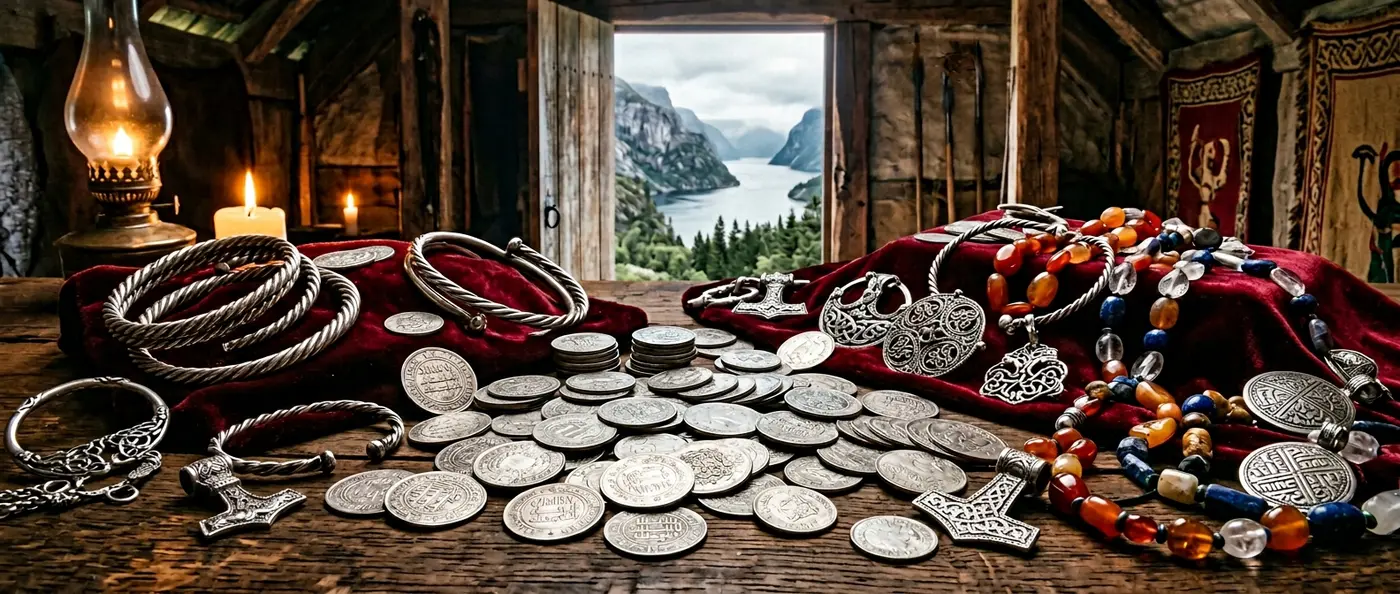
A third of the silver in the Bedale Hoard came from melted Islamic coins. That's the bombshell finding from a 1,100-year-old treasure discovered in northern England — 29 silver ingots that traveled thousands of miles from the Abbasid Caliphate to Scandinavia before ending up buried in Yorkshire soil. New geochemical analysis published in August 2025 proves that raiding was just "part of the picture" — Vikings maintained trade networks that stretched deep into the Middle East.
⚓ The Bedale Treasure Cache
Metal detectorists Stuart Campbell and Steve Casewell struck gold in March 2012. Well, gold and silver. Near the market town of Bedale in North Yorkshire, they uncovered a hoard that would force historians to reconsider how Viking wealth reached England: a golden sword pommel, silver jewelry, and 29 silver ingots worth roughly $70,000 in today's money. The age? About 1,100 years old, placing these treasures squarely in the heart of the Viking Age — the 10th century CE. The discovery was impressive, but the real revelation came recently when researchers led by Jane Kershaw, Associate Professor of Viking Age Archaeology at Oxford University, subjected the ingots to geochemical analysis to trace the silver's origins.
The lab results told a different story. The silver had been crafted from melted Western European coins — expected loot from raids — but also from Islamic dirham. One-third of the ingots matched silver minted in the Middle East, primarily from the Abbasid Caliphate — the vast Islamic empire that stretched from the Arabian Peninsula to North Africa and modern-day Iran and Iraq. "Most of us tend to think of Vikings primarily as raiders, who pillaged monasteries and wealthy sites looking for wealth," Kershaw said. "What the analysis of the Bedale Hoard shows is that this is only part of the picture."
🛤️ Austrvegr: The Eastern Route
How did Islamic coins end up in Viking hands in Yorkshire? The answer lies in the Austrvegr — the "Eastern Way" — a network of trade routes connecting Scandinavia to the Middle East through Eastern Europe's river systems. To acquire the coveted dirham, Vikings traded furs, amber, swords, and slaves — according to Arab chroniclers' accounts. This wasn't casual commerce. It was an organized, long-term system of economic exchange that brought massive quantities of silver into Scandinavia. Swedish Vikings, known as Varangians, sailed down the great rivers of modern Russia — the Volga and Dnieper — reaching the Black Sea and Caspian Sea, from where they extended trade networks toward Baghdad and beyond.
The Scandinavians' eastern expansion was probably less violent than their Atlantic coast adventures. While there was certainly sporadic raiding in the Baltic, no Viking kingdom was established by the sword in the region — the presence there was primarily commercial. The Varangian-Rus dominated Novgorod and Kiev, creating trading posts and proto-state structures that would become the foundations of the medieval Russian state. The very name "Rus" — from which "Russia" derives — is of Scandinavian origin. Two trade treaties between the Rus and Byzantines, preserved in the Primary Chronicle under the years 912 and 945, bear signatures with unmistakably Scandinavian names — proving the ethnic identity of these early traders. Some Varangians ended up in Constantinople, where they formed the Varangian Guard — an elite mercenary unit serving the Byzantine Emperor, famous for their loyalty and fighting prowess. The existence of these Scandinavians as a distinct people in Eastern Europe didn't continue beyond 1050 — they were quickly absorbed by the Slavic population, leaving behind only their name and trade structures.
The Abbasid Caliphate (750-1258 CE) possessed enormous silver reserves, minting millions of dirham — silver coins with Arabic inscriptions. For Vikings, who used silver as the basis of their economic system (weighted by mass, not nominal value), Islamic dirham were ideal: high silver purity and consistent minting quality.
⚔️ Raiders, Traders, or Both?
The one-dimensional image of Vikings as barbaric raiders misses half the story. Vikings were members of Scandinavian communities of seafaring warriors — Danes, Norwegians, Swedes — who operated between the 8th and 11th centuries. At home they were independent farmers, but at sea they were raiders and explorers. The word "víkingr" meant "pirate" in early Scandinavian languages. Their mobilization was largely due to overpopulation at home and the relative weakness of their targets abroad. But raiding was just one face of a complex society. As the Bedale Hoard reveals, the same community that pillaged British monasteries simultaneously maintained trade ties with the Islamic world, exchanged goods in markets thousands of miles away, and incorporated foreign wealth into local economies — bringing Islamic silver with them when they settled in England.
The geographical reach of the Vikings was staggering. In the west, Norwegian colonists settled the Orkney Islands, Shetlands, Faroe Islands, Iceland, Greenland, and reached North America — archaeological finds at L'Anse aux Meadows in Newfoundland prove Vikings crossed the Atlantic around 1000 CE, more than 500 years before Columbus. According to the Saga of the Greenlanders, the first European to sight North America was Bjarni Herjolfsson, whose ship was blown westward around 985 — and subsequently Leif Erikson, son of Erik the Red, led an expedition of 35 men to explore the land that had been spotted. In England, sporadic raids began in the 8th century — the famous attack on Lindisfarne monastery in 793 CE — and escalated dramatically in 865, when the Great Heathen Army, under Halfdan and Ivar the Boneless, sons of the legendary Ragnar Lothbrok, conquered the kingdoms of East Anglia and Northumbria. In the south, they raided coasts of the Iberian Peninsula and Mediterranean. In the east, as we've seen, they established trading posts in Russia and reached Baghdad and Constantinople. On at least four different continents, Scandinavian seafarers left unmistakable and permanent traces.
Maritime Dominance
Long, narrow warships (longships) enabled open-sea voyages and shallow-river navigation — giving Vikings access to both coasts and continental interiors.
Goods Exchange
Furs, amber, swords, and slaves were traded for Islamic silver — commerce documented in both Arabic chronicles and archaeological finds across Scandinavia.
Eurasian Network
From Newfoundland in the west to Baghdad in the east, Vikings created a network of trade and colonization covering a vast geographical expanse.
🌍 A New Picture of the Viking Age
"I like to think about how Bedale — today a quintessentially English market town in North Yorkshire — was, in the Viking Age, at the heart of a much wider, Eurasian Viking economy," Kershaw said. "Vikings weren't just extracting wealth from the local population — they were bringing wealth with them when they raided and settled." The finding reframes the Danelaw — those former Viking regions of England — as something more complex. These weren't isolated barbarian settlements, but nodes in a globalized (by the era's standards) economic network. The wealth circulating in Viking Yorkshire in the 10th century had roots on three continents — Europe, Asia, and through Africa. The Bedale Hoard analysis, published in August 2025, breaks new ground by using geochemical fingerprinting — not just visual analysis — to trace where metal objects originated. This methodology can be applied to hundreds more Viking hoards discovered in England, Scandinavia, and Eastern Europe, revealing the trade networks behind every buried coin.
The Viking Age ended around the mid-11th century: Norway and Sweden no longer had the power for external adventures, Denmark transformed into an organized kingdom that absorbed restless population elements into royal armies, and Olaf II Haraldsson of Norway, before becoming king in 1015, was practically the last Viking leader in the old independent tradition. But their legacy — trade networks, place names, linguistic borrowings, political structures — lives on. And now, thanks to a dusty treasure from a Yorkshire field, we know those northern warriors were simultaneously something much more: merchants in a network that connected Scandinavia to Baghdad, Baltic amber to Mesopotamian silver, and northern furs to eastern spices and silks — creating an early form of globalization that preceded the great discoveries by centuries.