📖 Read more: Vikings in Maine? The Hunt for Hard Evidence
🗺️ The Sagas and the Journey to Vínland
For centuries, the only evidence of Viking trans-Atlantic voyages came from Icelandic sagas — epic poems written in the 13th century, hundreds of years after the events they describe. The Saga of the Greenlanders and the Saga of Erik the Red tell the story of Leif Eriksson and other bold explorers who sailed west from Greenland into the unknown.
The sagas lay out a clear route: two days' sailing west from Greenland to a land of flat stones they called Helluland (likely Baffin Island), then south along forested coasts and pristine beaches they named Markland (probably Labrador), and finally to Vínland — the "land of grapes."
The contradictions tell their own story. The two sagas often contradict each other. They disagree on who first spotted land, who sailed there first, even how many voyages were made. But both agree on one crucial point: Vínland wasn't empty.
⚔️ First Contact Goes Wrong
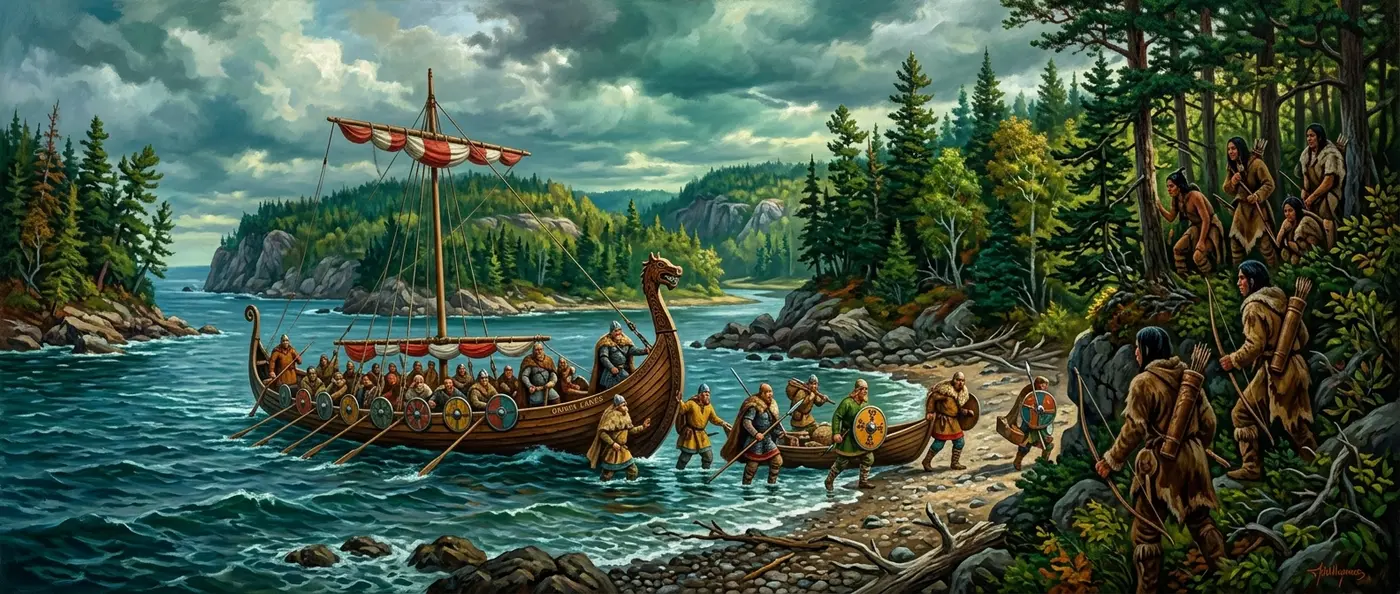
The sagas paint vivid pictures of Viking encounters with indigenous inhabitants, whom they called "Skraelingar" — a derogatory term meaning something like "savages." At first, the two groups traded peacefully. Vikings offered red cloth and milk while the natives brought furs.
The peace didn't last. The Saga of Erik the Red describes a battle that started from a misunderstanding when a Viking bull frightened the natives. The violence that followed was brutal, with casualties on both sides. The Vikings, despite their superior weapons technology, found themselves outmatched.
One of the most dramatic moments involves Freydís, Leif Eriksson's sister. While pregnant, she grabbed the sword of a fallen comrade and faced the attackers alone. According to the saga, she struck her breast with the blade and let out such a terrifying war cry that the natives retreated.
📖 Read more: Bronze Age China: 18 Stab Wounds Tell a Brutal Story
🏛️ The Discovery That Changed Everything
Archaeological confirmation of the sagas came in 1960 when Norwegian archaeologists Anne Stine and Helge Ingstad discovered the settlement at L'Anse aux Meadows. The finds were modest but undeniable: eight sod buildings arranged in three groups, an iron smithy, workshops, and storage areas.
The excavations revealed objects that only Vikings could have brought: iron nails, a bronze cloak pin, and whetstones from Norway. They also found traces of bog iron processing — a technique unknown to the region's indigenous peoples.
Iron Smithy
The first known iron-working facility in North America, where Vikings smelted iron from local bog ore to make nails and tools.
Storage Buildings
Large structures for storing supplies and trade goods, suggesting the settlement operated as a base for further exploration.
Workshops
Spaces for ship repair and tool-making, essential for maintaining the fleet that explored the coastlines.
🔬 Science Confirms the Sagas
In 2021, a breakthrough discovery gave us the exact date of the Viking presence in America. Scientists from the University of Groningen used a new dating method based on a solar storm that occurred in 993 AD.
📖 Read more: Celtic God Sucellus: First Painted Image Ever Found
The cosmic radiation from this storm left a unique "fingerprint" in tree rings worldwide. By analyzing wood from L'Anse aux Meadows that had been cut with metal tools, researchers counted 28 rings from the solar storm marker to the bark. The result? The trees were cut in exactly 1021 AD — precisely 1,000 years ago.
This dating places the voyages around the year 1000, matching the Icelandic sagas almost perfectly. As archaeologist Davide Zori noted: "This shows the sagas are correct within just a decade. That's really impressive."
💡 The Maine Penny Mystery
In 1957, an 11th-century Norwegian silver coin was found in Maine. The "Maine Penny," dating to the reign of Olaf III (1066-1093), has a hole suggesting it was used as jewelry. Archaeologists believe it reached there through Native American trade networks, not from direct Viking visits.
🌍 Why the Colony Failed
The Vikings reached America but couldn't stay. Three problems doomed their settlement. First, their numbers were tiny. Greenland, their launching point, had only 400-500 inhabitants initially and never exceeded 2,000-3,000 even at its peak.
Second, the distance was enormous. The journey from Greenland to Vínland took weeks, making regular communication and resupply nearly impossible. As Kevin McAleese, a museum curator in Newfoundland, noted: "Greenland was weeks away from getting goods to European markets, which made operating the trade network very difficult."
Third, and perhaps most crucial, was indigenous resistance. The medieval sagas are clear: the land had far more inhabitants than the Vikings had brought with them. After repeated conflicts, the Vikings concluded that "though the land might be choice and good, there would always be war and terror from those who dwelt there before them."
⚖️ Vikings vs Columbus: The Difference
📖 Read more: Nebra Sky Disk: World's Oldest Star Map Rewrites History
🗿 Legacy of the First Europeans
The Vikings' brief presence in America didn't reshape history like Columbus's voyages would, but it marked a singular moment. It was the moment humanity completed its expansion around the world, when populations separated for millennia met again in a dense forest on the shores of the North Atlantic.
Today, L'Anse aux Meadows is a UNESCO World Heritage Site. Visitors can see reconstructions of the sod buildings and imagine life in this remote outpost 1,000 years ago. The site's museum houses the few but precious artifacts the Vikings left behind.
The story of Vikings in America teaches us that "discovery" is a relative concept. For the indigenous people who had lived there for thousands of years, there was nothing to discover. For the Vikings, it was a new land full of promise but also danger. For us, it captures an age when uncharted seas connected unknown lands.
The Vikings failed to colonize America, but crossing the Atlantic in open boats — navigating by stars alone — stands among history's boldest journeys. Five centuries before Columbus, they turned the Atlantic from barrier into highway.