📖 Read more: Vikings in Maine? The Hunt for Hard Evidence
⚓ The Art of Norse Shipbuilding
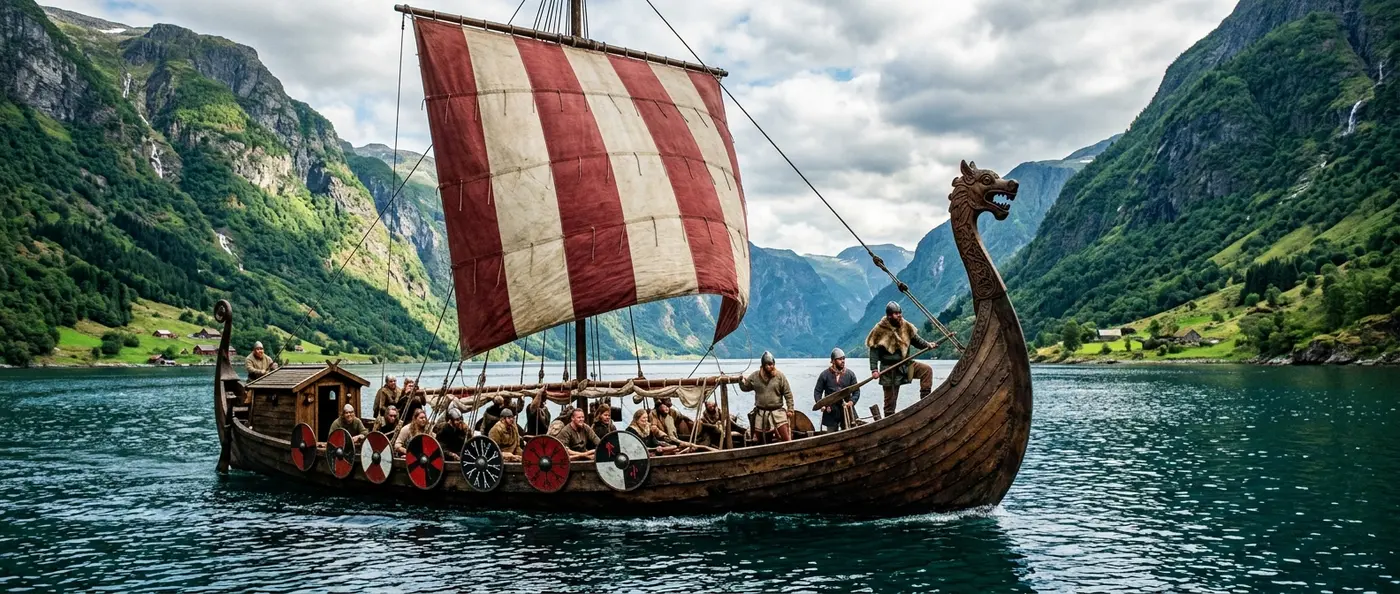
Viking ships were the result of centuries of shipbuilding evolution. From the 8th to 11th centuries, Scandinavian shipwrights perfected a unique construction technique that combined flexibility, speed, and durability. The secret lay in "clinker-built" construction — hull planks overlapped one above the other, creating a light yet incredibly strong vessel.
Shipbuilders used primarily oak for the frame and hull, while preferring pine for the mast. Each ship was built without blueprints — master craftsmen relied on experience and tradition passed down through generations. The result? Vessels that could sail in shallow rivers and open ocean alike.
The ships' keels were shallow and flat, allowing Vikings to navigate rivers just one meter deep. Simultaneously, the flexible hull absorbed wave shocks, making these vessels ideal for long Atlantic crossings. These ships carried them to Greenland and North America.
🛡️ Ship Types and Their Purposes
Vikings didn't build just one type of ship. Each vessel was designed for specific purposes, from war raids to trade voyages and exploration. This variety reflected the diverse needs of a society that lived by and for the sea.
The most famous was the longship (langskip in Old Norse), the warship that became synonymous with Viking raids. Reaching 30 meters in length but only 5 meters wide, these ships were fast and agile. Their shallow draft let them sail up rivers and approach shores other vessels couldn't reach. They could carry 40-100 warriors, depending on size.
For trade, Vikings used knarr — wider and deeper vessels with greater cargo capacity. These ships transported goods, livestock, and colonists to distant settlements. A knarr could carry up to 24 tons of cargo and was perfect for transatlantic voyages. With these ships, Vikings established colonies in Iceland, Greenland, and North America.
Longship - The Warship
Fast and agile, capable of both rowing and sailing. Perfect for surprise attacks and quick escapes. Its shape allowed navigation in rivers and open seas alike.
Knarr - The Merchant
Wider and deeper than longships, designed for cargo transport. With smaller crews but greater range, it was the primary vessel for trade and colonization.
Karve - The Multipurpose
Smaller vessel for coastal navigation, fishing, and short expeditions. Easy to handle, required small crews, and was ideal for daily activities.
🧭 Navigation Without a Compass
How did Vikings cross the Atlantic without compass or modern navigation instruments? The answer lies in a combination of empirical knowledge, nature observation, and perhaps some primitive tools we're only now beginning to understand.
Viking navigators relied primarily on observing the sun and stars. They knew the North Star remained fixed in the northern sky and could calculate latitude from its height above the horizon. During daylight, they tracked the sun's path and used simple wooden instruments to measure its position.
Beyond celestial bodies, Vikings read the sea and weather patterns precisely. They observed currents, water color, waves, and even bird behavior. When they spotted certain bird species, they knew land was near. The smell of the sea, water temperature, and wind direction provided valuable position information.
🔬 Mysterious Navigation Tools
Recent years have brought archaeological evidence of more sophisticated navigation instruments Vikings might have used. The most discussed is the so-called "sunstone" (solarsteinn in Old Norse), mentioned in medieval sagas.
According to recent research, the sunstone may have been a calcite crystal with light-polarizing properties. Even when the sun was hidden behind clouds, the crystal could indicate its position. Experiments have shown that using such crystals, navigators could determine the sun's position with 1-2 degree accuracy even in overcast weather.
A wooden disc discovered in Greenland dates to the Viking era. The disc has engravings resembling an astronomical instrument and may have been used to calculate latitude. Though its exact use is debated, the disc shows Vikings possessed more sophisticated navigation knowledge than historians once thought.
💎 Did You Know?
Vikings named their ships with names like "The Long Serpent," "The Black Raven," or "The Fjord Dragon." The richly decorated prows with dragon heads weren't just for show — they believed these protected the ship from evil sea spirits.
📖 Read more: Vikings: Warriors, Explorers or Merchants?
🗺️ The Great Sea Routes
Vikings created an extensive network of sea routes connecting Scandinavia to three continents. These routes followed carefully planned paths that used favorable currents, winds, and supply points.
The "Northern Route" started from Norway and passed through the Shetland and Orkney islands to Iceland. From there, the boldest continued to Greenland and finally reached North America. This route required crossing the North Atlantic, one of the world's most dangerous seas. Vikings followed it during summer months when weather conditions were most favorable.
The "Eastern Route" led through the Baltic Sea to Russia's great rivers. Vikings sailed the Volga and Dnieper, reaching the Caspian and Black Seas. From there they accessed Constantinople and Eastern markets. This route was vital for trading fur, honey, wax, and slaves.
The "Western Route" followed North Sea coasts to Britain, Ireland, and France. Vikings sailed south to the Iberian Peninsula and entered the Mediterranean, reaching North Africa and Italy. Some sources mention they even reached Jerusalem.
⚓ Sea Route Comparison
🏴☠️ Life Aboard Ship
Daily life on a Viking ship was harsh and demanding. No cabins or enclosed spaces existed — crews slept on deck in leather sleeping bags. When weather turned bad, they erected makeshift tents from sail cloth. Food was simple: dried fish, hard bread, cheese, and beer or water.
Each crew member had specific duties. The captain (styrimaðr in Old Norse) was responsible for navigation and decisions. Rowers alternated in shifts, as rowing for hours was exhausting. When wind picked up, they raised the square sail and everyone rested. There were also specialists for ship maintenance, cooking, and guarding cargo.
Despite hardships, Viking sailors formed strong bonds. They sang, told stories, and played games to pass time. Religion played a major role — they prayed to their gods for safe passage and made sacrifices before sailing. Many ships carried small god statues at the prow for protection.
🌊 The Legacy of Norse Seamanship
Viking navigation techniques influenced seafaring for centuries after their era. The shipbuilding techniques they developed influenced vessel design throughout Northern Europe for centuries. The "clinker-built" method continued in use until the age of great sailing ships.
Today, archaeologists and shipbuilders study Viking ship remains to understand their secrets. Faithful replicas have been built and tested in real conditions. In 1893, a Gokstad ship replica crossed the Atlantic from Norway to America in just 28 days, proving these vessels' seaworthiness.
But perhaps the Vikings' greatest legacy is their spirit of exploration. They were the first Europeans to cross the Atlantic, opening the path for the great discoveries that followed. Their courage to sail unknown seas with primitive means still inspires today. Their ships weren't just transportation — they were keys that unlocked new worlds and connected civilizations.
Modern Reconstructions
Dozens of Viking ship replicas have been built using traditional methods. The "Sea Stallion" in Denmark is a fully functional 30-meter longship that has sailed thousands of miles, proving the design's durability.
Ship Museums
The Viking Ship Museum in Oslo and Roskilde in Denmark house some of the best-preserved vessels. The Oseberg and Gokstad, found in burial mounds, reveal the perfection of Norse shipbuilding craft.