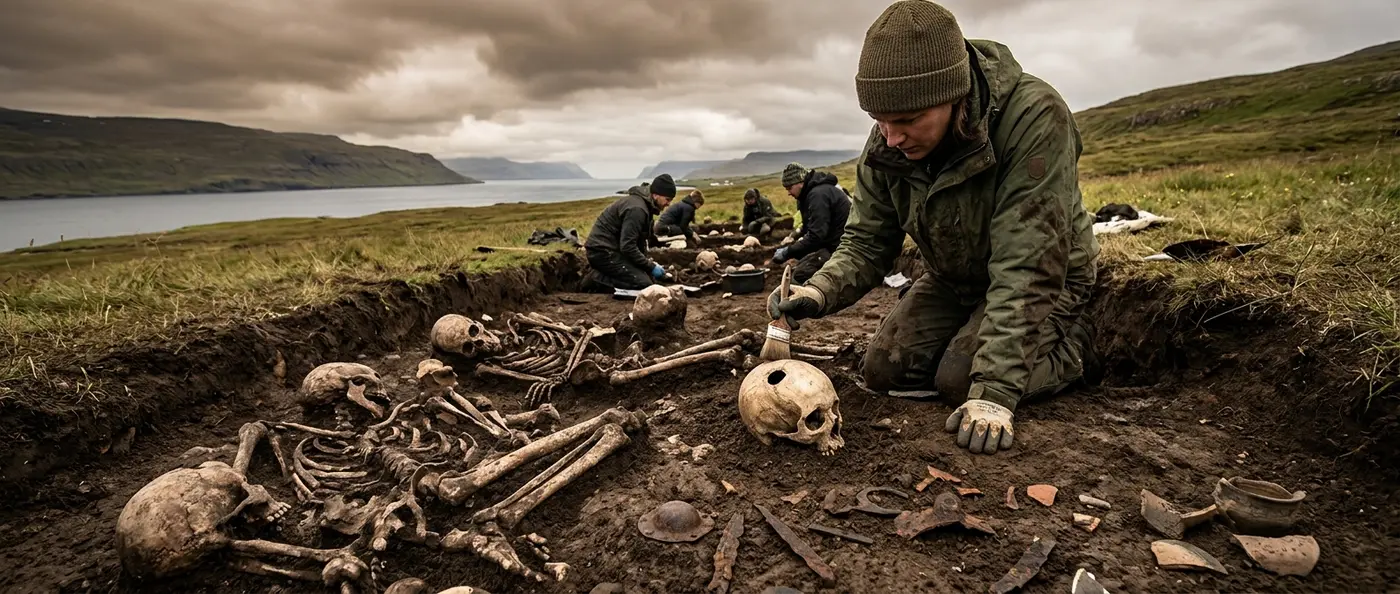
Picture this: 54 headless bodies dumped in a pit, their skulls stacked like trophies nearby. Archaeologists found this grisly scene in 2019 while clearing ground for a new highway near Dorchester, England. Hidden among these executed Vikings was a giant warrior who'd survived medieval brain surgery — only to die centuries later at his captors' hands.
📖 Read more: Viking Chieftain's Tomb Reveals 1,000-Year-Old Secrets
🗿 The Shocking Discovery That Rewrote History
The Ridgeway Hill excavation uncovered one of Britain's largest Viking mass graves. Fifty-four bodies, all young men aged 18-25, had been thrown carelessly into an old quarry pit. Their heads sat in a separate pile, evidence of systematic mass execution rather than battlefield casualties.
Radiocarbon dating placed their deaths between 970-1025 CE, during the bloodiest period of Anglo-Saxon and Viking conflict. Isotope analysis of their teeth confirmed what archaeologists suspected — these men came from Scandinavia, likely Norway and Denmark.
The bodies told an even darker story. Many showed defensive wounds on hands and shoulders, proving they'd tried to fight back despite being unarmed. The absence of personal belongings and clothing suggested they'd been stripped naked before execution.
⚔️ The Bloody Context Behind the Massacre
The year 1000 CE was hell for England. King Ethelred II faced constant Viking raids that pillaged coastlines and demanded massive tribute payments called Danegeld. In 1002, Ethelred ordered the St. Brice's Day Massacre — every Dane living in England was to be executed.
Experts believe the Ridgeway Hill mass grave connects to this event or similar retaliation. The location, near a major road with sea views, was chosen to send a brutal message to other Viking raiders. The method of execution — beheading with sword or axe — was standard for the era. But the sheer number of victims and organized nature of the killings suggests premeditated revenge, not battle aftermath.
Among the 54 victims, one skeleton stood out dramatically. At an estimated 6'3" to 6'5" tall, this man was a true giant for his time, when average male height was around 5'7". Bone analysis revealed he was exceptionally muscular and likely an experienced warrior.
Old surgery scars marked his skull. A circular hole about 2 inches in diameter had been created using trepanation, one of humanity's oldest surgical procedures. Bone around the hole showed healing — this man had survived the operation for months or years.
Trepanation in the medieval Viking world was extremely rare and dangerous. It was typically performed to relieve pressure from head injuries or remove bone fragments after battle. That this warrior survived such an operation speaks to both his toughness and the skill of whoever performed it.
Physical Characteristics
Height 6'3"-6'5", exceptionally muscular build, signs of intense physical activity on bones, death age approximately 25-30 years.
The Surgical Operation
Circular trepanation 2 inches in diameter on skull, healing signs showing survival for months or years after the procedure.
Battle Experience
Multiple healed fractures on ribs and limbs, signs from old battle wounds, enhanced muscle mass in shoulders and arms.
🔬 What Scientific Analysis Reveals
Detailed examination of the skeletons revealed much about these men's lives. Dental analysis showed they had relatively good childhood nutrition, suggesting they came from families with some means. Many had signs of healed injuries, indicating they were experienced warriors.
Strontium isotope analysis of their teeth confirmed they grew up in various parts of Scandinavia. Some came from southern Norway, others from Denmark, and a few possibly from Sweden. This diversity suggests they may have been members of a multinational Viking crew.
The absence of women, children, or elderly people in the grave, combined with the victims' age and physical condition, reinforces the theory that this was a war crew that was captured and executed. The lack of defensive wounds on most bodies suggests this wasn't battle casualties but organized execution of prisoners.
🔍 Unique Findings
The Ridgeway Hill discovery is the second-largest Viking mass grave found in Britain. The largest, with 300+ bodies, was found at Repton in Derbyshire and dates to 873-874 CE. However, the case of the "giant with surgery" is unique in archaeological records.
🏛️ Viking Medicine Revealed
The trepanned skull illuminates Viking medical knowledge. Though often depicted as barbaric warriors, Vikings had developed significant medical practices. Their healers, known as "læknar," combined practical knowledge from battle wounds with traditional therapies.
Trepanation required exceptional precision and anatomical knowledge. The healer had to remove a piece of skull without damaging the brain, probably using a specialized drill or scraper. Patient survival depended on avoiding infection and bleeding.
Scandinavian sagas reference such operations. The Egil Saga describes how a healer opened a warrior's skull to remove bone fragments. Ridgeway Hill proves these stories had roots in reality.
Evidence suggests these 54 Vikings were members of a raiding fleet captured by Anglo-Saxons. The Dorset area was a frequent raid target due to its proximity to the sea and wealthy monasteries. Local forces, exhausted by constant pillaging, may have decided to make an example.
The execution was methodical. Victims appear to have been killed in groups, with their heads carefully placed in a separate pile. This practice had symbolic meaning — in Scandinavian tradition, beheading prevented the dead from entering Valhalla.
The giant warrior with the trepanned skull was probably one of the group's leaders. His size and experience, combined with surviving serious injury in the past, made him a valuable member of any war crew. His execution alongside his companions marks the tragic end of an entire raiding force.
⚔️ Comparison with Other Viking Mass Graves
🗺️ Why This Discovery Matters
Ridgeway Hill upends assumptions about Anglo-Saxon and Viking relations. It shows the English weren't always passive victims of raids but could organize effective defense and brutal retaliation. It also reveals the dark side of this period, where violence and revenge were part of daily life.
For medical history, the discovery of the trepanned skull is equally significant. It adds another example to the few known cases of successful cranial surgery from the Middle Ages. It shows Vikings had access to specialized medical care that could handle even the most serious injuries.
The human dimension of the story is also moving. These 54 men, including the giant warrior who'd survived dangerous surgery, traveled thousands of miles from their homelands to find death in foreign soil. Their stories, lost for nearly 1000 years, now emerge through their bones.
Ongoing research on Ridgeway Hill material promises more revelations. New DNA analysis techniques may reveal family relationships among victims, while further bone study could provide more information about their lives and deaths. Each bone fragment brings these long-dead warriors closer to life.