📖 Read more: Ancient Indian Graffiti Found in Egyptian Royal Tombs
🏺 The Secret Necropolis Strategy
Thutmose I had a problem. Every pyramid built before him had been stripped clean by thieves. The Great Pyramid? Looted. The Step Pyramid? Ransacked. Even the newest royal tombs were getting hit within decades of construction. The pharaohs needed a new playbook.
The solution was brilliant in its simplicity: make the tomb invisible. Instead of building monuments that could be seen from miles away, architects would carve deep into the bedrock behind Deir el-Bahri. The entrance would be sealed and camouflaged after burial. The valley itself — narrow, isolated, with limited access routes — was perfect for the job.
From Thutmose I in 1539 BCE to Ramesses XI in 1075 BCE, nearly every pharaoh of the 18th, 19th, and 20th dynasties built their eternal homes here. The plan worked better than expected. While pyramid robbers could spot their targets from the Nile, tomb raiders had to know exactly where to dig in a valley full of limestone debris and false leads.
Today we know of 62 tombs in the valley, each with unique architecture and decoration. Early dynasty tombs were simple chambers. Later Ramesside pharaohs built underground palaces with dozens of rooms. The evolution mirrors both changing religious beliefs and the growing power of the empire — bigger pharaohs demanded bigger afterlife real estate.
🗿 Underground Palaces Carved from Stone
Building a royal tomb in the Valley of the Kings was like constructing a skyscraper in reverse. Architects had to balance multiple demands: protection from thieves, adequate space for grave goods, and proper decoration to ensure the pharaoh's safe passage to the afterlife. No pressure.
The basic design featured a descending corridor interrupted by deep shafts — traps for would-be robbers. Pillared halls and antechambers led to the main burial chamber, where a stone sarcophagus held the royal mummy. Smaller rooms around the central chamber housed the countless objects the dead king would need in the next life.
Hatshepsut's tomb (number 20) holds the length record — her burial chamber sits almost 215 meters from the entrance and descends 100 meters into the rock. This engineering feat shows the technical skills of ancient Egyptian builders, who created such extensive underground complexes without modern tools. They used copper chisels, wooden mallets, and an intimate knowledge of limestone geology.
The tomb layouts evolved over time. Early 18th Dynasty tombs followed a bent-axis plan, with corridors turning at right angles. Later tombs used straight-axis designs, creating a direct path from entrance to burial chamber. This wasn't just architectural preference — it reflected changing religious beliefs about the sun god's nightly journey through the underworld.
📜 Magic Texts and Divine GPS Systems
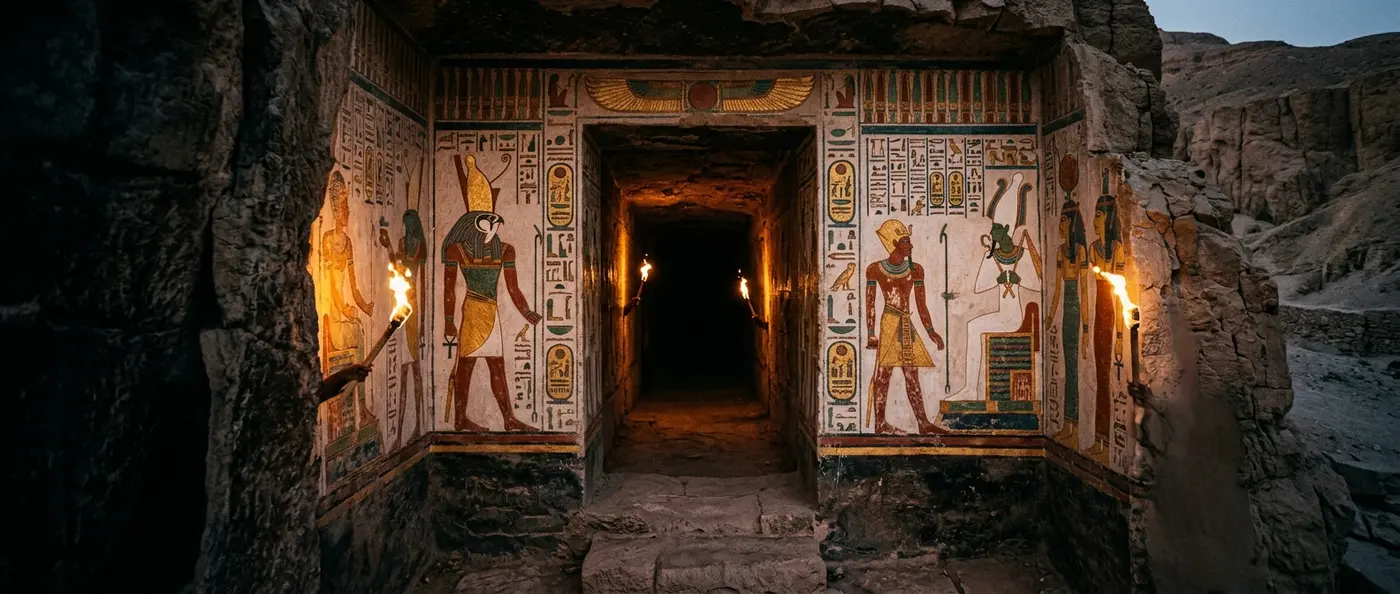
The walls weren't just decorated — they were survival manuals for the afterlife. Every image, every hieroglyphic text had a specific magical purpose: to help the dead pharaoh pass the trials of the underworld and be reborn with the sun god each morning. Think of them as the ultimate GPS system for navigating eternity.
The texts varied from tomb to tomb, reflecting evolving religious beliefs. The "Book of What is in the Underworld" describes the sun's journey through 12 divisions representing the 12 hours of night. The "Book of Gates" presents giant serpents guarding the portals through which the sun must pass, while strange demons either help or hinder the journey.
Other compositions include the "Book of Day" and "Book of Night," showing Nut, the sky goddess, stretched across the heavens. The "Book of the Heavenly Cow" depicts Nut transformed into a cow upon which Ra ascends to the firmament. Astronomical figures decorate the ceilings of many burial chambers, creating a microcosm of the universe inside the tomb.
These weren't just pretty pictures. Each scene was a spell, each god a potential ally or enemy. The pharaoh's ka (life force) would need to recognize the correct passwords, avoid the wrong turns, and align with the proper deities. Get it wrong, and you'd spend eternity wandering lost in the underworld. Get it right, and you'd sail with Ra across the sky forever.
Book of the Underworld
Describes the sun's nightly journey through 12 hours of darkness, with the pharaoh accompanying the god Ra in his solar bark.
Book of Gates
Presents the magical gates the deceased must pass, guarded by monstrous serpents and demons who test the soul's worthiness.
Astronomical Ceilings
Depict the night sky with constellations and deities, creating a cosmic map for eternal navigation through the heavens.
💎 Treasures and the Great Robbery
Despite all precautions, nearly every tomb in the valley was robbed in antiquity. Some were breached partially during the New Kingdom itself, but all were systematically stripped of their contents during the 21st Dynasty. This organized operation had a dual purpose: protect the royal mummies from further desecration and recycle the precious grave goods into the royal treasury.
By Strabo's time (1st century BCE), Greek travelers could visit 40 of the tombs. Later, Coptic monks used some tombs as hermitages, leaving their own inscriptions on the walls. The irony is that only the small tomb of Tutankhamun, who ruled just from 1333 to 1323 BCE, escaped the robbery.
The young pharaoh's tomb, protected by a pile of stones thrown from a later Ramesside tomb, remained intact for over 3,000 years. The magnificent treasures excavated in 1922 and now displayed in the Egyptian Museum in Cairo give a vivid picture of how rich the burial of a great pharaoh at the height of the empire must have been.
📖 Read more: Cleopatra: The Last Pharaoh of Egypt
Howard Carter's discovery changed everything. When he peered through that first hole in 1922 and saw "wonderful things" by candlelight, he was looking at the only intact royal burial from the valley. The 5,000 objects crammed into four small rooms represented just a minor pharaoh's afterlife kit. Imagine what Ramesses II or Seti I took with them.
🔍 Why Did Tutankhamun's Tomb Survive?
Location on the valley floor, combined with debris that covered it from later construction, made it invisible to tomb robbers. Additionally, Tutankhamun was a relatively obscure pharaoh with a short reign, which may have made his tomb a less attractive target for organized looting operations.
⚔️ The Mega-Tomb: Ramesses II's Family Mausoleum
The most impressive and complex structure in the valley is tomb number 5, built to house the numerous sons of Ramesses II (1279-1213 BCE), the greatest king of the 19th Dynasty. This tomb, previously discovered but considered insignificant, was relocated in the late 1980s and partially excavated in the 1990s.
The upper of the tomb's two levels contains a central pillared hall and various corridors leading to dozens of chambers. The scale is unprecedented — more than 120 chambers have been identified so far, making it not only the largest tomb in the Valley of the Kings but possibly one of the largest tombs ever built in ancient Egypt.
The discovery of this massive complex changed our understanding of the valley. It shows that it wasn't just a burial place for kings but also for other members of the royal family. Ramesses II, who had more than 100 sons and daughters, appears to have created an entire underground palace for his descendants.
Kent Weeks, who led the excavation, called it "the find of the century." The tomb's T-shaped layout is unique in the valley. A central corridor lined with pillars leads to a statue of Osiris, while side corridors branch off to burial chambers. Each chamber was designed for a specific prince, with walls decorated with scenes from the afterlife books.
🔬 Modern Technology Meets Ancient Mysteries
The study of the Valley of the Kings has been transformed by new technologies. The Theban Mapping Project has created detailed maps of all known tombs, while techniques like 3D scanning allow digital preservation of wall paintings threatened by humidity and tourism.
Ground-penetrating radar has revealed hidden chambers and passages. In 2015, thermal imaging suggested the presence of hidden rooms behind the walls of Tutankhamun's tomb, sparking speculation about the burial of Nefertiti. While subsequent investigations have been inconclusive, the technology continues to reveal new secrets.
The Giza Project, a massive collection of photographs, drawings, manuscripts, and archives from leading institutions worldwide, has been assembled into an incredible online repository. This collection preserves paintings and inscriptions that have faded, records objects that have been lost or destroyed, and unlocks tombs that are not accessible to the public.
Virtual GIZA 3D reconstructions allow visitors from around the world to tour the valley's wonders and take guided tours of pyramids, temples, and even tombs. While nothing can replace the experience of a personal visit, these digital technologies ensure that the valley's treasures will remain accessible to future generations.
📊 The Valley by Numbers
🌅 The Valley's Eternal Legacy
The Valley of the Kings draws hundreds of thousands of visitors each year to its underground corridors. In 1979, UNESCO included it in the World Heritage List as part of ancient Thebes, along with Luxor, the Valley of the Queens, and Karnak. Each year, hundreds of thousands of visitors descend into the underground corridors to admire art and architecture that survived for millennia.
Beyond its tourist value, the valley hides chambers still waiting to be found. New scanning technologies indicate the existence of still unexplored chambers and corridors. Archaeologists still find ostraca with inscriptions, statue fragments, traces of workshops where craftsmen prepared the tombs.
The Valley of the Kings functions as more than a cemetery. These underground chambers preserve an entire civilization's beliefs about life and death, its artistic achievements, its technical capabilities. Each tomb records the dead it housed and the living who created it — the architects, artists, and workers who carved hard rock into decorated chambers.
The pharaohs' gamble paid off, at least partially. Their pyramids were robbed within centuries. Their hidden tombs lasted millennia. Even stripped of their treasures, these underground palaces preserve something more valuable than gold: the dreams, fears, and beliefs of humanity's first great civilization. In trying to cheat death, they achieved something close to immortality.