📖 Read more: Assyrian Relief: First Image of Jerusalem?
🏛️ Birth of the First Metropolis
Ur was founded around 5500 BCE in southern Mesopotamia, in the region ancient Greeks called "the land between two rivers" - the Tigris and Euphrates. The Sumerians, the first known civilization to develop writing, mathematics, and urban centers, transformed Ur into one of antiquity's most important city-states.
Built on the banks of the Euphrates, the city benefited from exceptionally fertile floodplains that enabled agricultural development. Trade with neighboring Mesopotamia and other regions brought wealth and cultural exchange. By 2600 BCE, Ur had evolved into a bustling metropolis with thousands of inhabitants, organized administration, and impressive architecture.
Its strategic position at the crossroads of trade routes established it as a center of economic and political power. Merchants from India, Persia, and Anatolia flocked to its markets, bringing exotic products like lapis lazuli from Afghanistan, cedar wood from Lebanon, and precious metals from Anatolia.
⚱️ Royal Tombs and Their Mysteries
In 1926, after four years of systematic excavations around the ziggurat, Woolley and his team began discovering small pieces of gold. He resisted the temptation of immediate "treasure hunting" and continued his methodical approach. His patience was rewarded.
During the 1926-1927 excavation season, the team uncovered hundreds of graves from the city's necropolis. Among bronze weapons, they discovered a magnificent golden stiletto with a lapis lazuli handle. Beside it, a golden pouch contained musical instruments also made of gold. Cuneiform inscriptions revealed they had found the tomb of Meskalamdug, likely a king of Ur.
But the most shocking discovery was the mass sacrifices. In the royal tombs, dozens of servants and soldiers had been buried alongside their dead masters. The skeletons were found in orderly rows, still wearing their golden jewelry and holding musical instruments or weapons. The position of the bodies suggests they died peacefully, probably from poison, in a ritualistic act of devotion.
💎 Treasures That Defy Time
The finds from Ur's royal tombs rival those of Tutankhamun's tomb in wealth and artistic value. Among the most impressive artifacts is a golden helmet believed to have belonged to King Meskalamdug, crafted from hammered gold and dating to 2600-2300 BCE.
Queen Puabi's lyre represents a masterpiece of Sumerian art. Decorated with a bull's head made of gold and lapis lazuli, the lyre testifies to the high aesthetic and technical training of ancient craftsmen. The lapis lazuli, which had to be imported from distant Afghanistan, indicates Ur's extensive trade network.
Another remarkable find is the Standard of Ur, a wooden box decorated with shell and lapis lazuli mosaics. One side depicts scenes of peace with banquets and musicians, while the other shows war scenes with chariots and soldiers. It was found near the body of a sacrificed man, indicating its importance as a ceremonial object.
Golden Jewelry
Intricate earrings, necklaces, and diadems made of gold, silver, and precious stones worn by Sumerian rulers.
Musical Instruments
Lyres and harps decorated with gold and lapis lazuli, accompanying the dead on their journey to the afterlife.
Royal Weapons
Golden stilettos, helmets, and shields that symbolized the power and prestige of Sumerian rulers.
🗿 The Magnificent Ziggurat of Ur
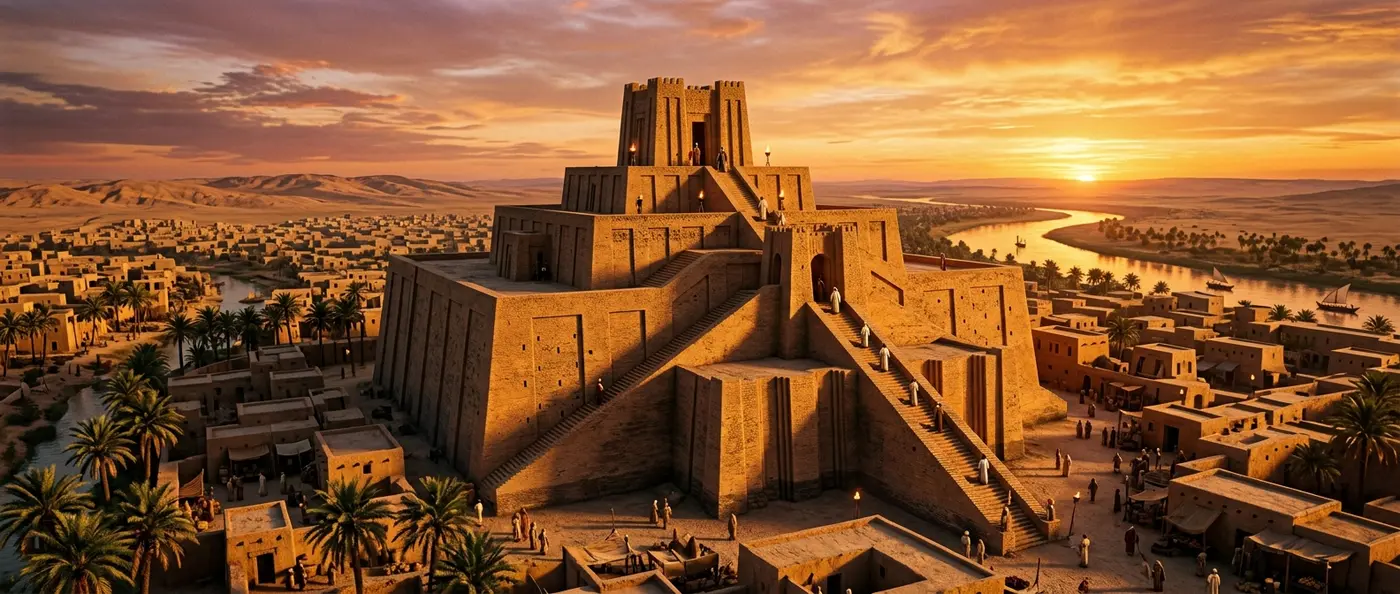
The Ziggurat of Ur, built around 2000 BCE by King Ur-Nammu, stands as one of the best-preserved examples of this type of architecture. This massive stepped pyramid of mud bricks served as a temple dedicated to the moon god Nanna.
The structure, approximately 21 meters high, consisted of three levels, with the god's sanctuary at the top. Monumental stairs led to the upper levels, where only priests had access. The ziggurat was not merely a religious center but also a symbol of the city's power and wealth.
Archaeologists have connected this ziggurat to Ur-Nammu, who built many similar monuments in other Mesopotamian cities during the Third Dynasty of Ur. This period marked a renaissance of Sumerian civilization and the expansion of Ur's influence throughout Mesopotamia.
📖 Read more: Babylonian Astrology: Where the Zodiac Began
🔬 Archaeological Mystery
During the 1922-1934 excavations, Woolley discovered a layer of pure mud 2.5 meters thick beneath the oldest habitation layers. This led him to hypothesize that he had found evidence of the biblical flood, though modern scientists believe it was a local flood.
📜 Legacy of the First Writing
Ur played a crucial role in developing cuneiform writing, the world's first known writing system. Thousands of clay tablets found in the city contain administrative records, legal documents, religious texts, and literary works.
Among the most important texts connected to the region is the Epic of Gilgamesh, considered the world's oldest literary work. Written around 2100 BCE, it predates Hebrew scriptures and contains a flood story remarkably similar to that in the Bible.
In 1872, when George Smith presented his decipherment of tablets from Ashurbanipal's Library in Nineveh containing the Epic of Gilgamesh, it caused an international sensation. This discovery fueled interest in Mesopotamian civilizations and led to intensive archaeological missions from museums and universities in France, Britain, Germany, and the United States.
🌅 Rise and Fall of an Empire
The Third Dynasty of Ur (approximately 2100-2000 BCE) marked the peak of the city's power. Under the leadership of kings like Ur-Nammu and his son Shulgi, Ur became the center of an empire extending across much of Mesopotamia.
Ur-Nammu is also known for the Code of Ur-Nammu, one of the oldest known legal codes, predating the Code of Hammurabi by three centuries. The code contained laws for crimes, family relations, and commercial transactions, revealing a sophisticated society with an organized legal system.
However, around 2000 BCE, the empire collapsed under pressure from invaders from Elam and the Amorites. The city of Ur was destroyed and its population scattered. Although the city was later rebuilt, it never regained its former glory.
📊 Ur by the Numbers
🔍 Modern Discoveries and Ongoing Research
Excavations at Ur continue to reveal new insights about Sumerian civilization. Modern technologies like satellite imaging and geophysical surveys have revealed structures that remain buried beneath the desert sand.
DNA analysis of the royal tomb skeletons shows that Queen Puabi and her attendants came from different genetic backgrounds, suggesting the court drew people from across the region. Chemical analysis of the golden artifacts has traced their origins to mines in Anatolia and the Caucasus.
Unfortunately, modern political instability in Iraq has limited archaeological work and endangered site preservation. Despite these challenges, Ur remains one of the world's most important archaeological sites, offering unique insights into the dawn of human civilization.
The story of Ur reminds us that even the greatest civilizations can vanish, leaving behind only ruins and memories. But through the patient work of archaeologists, these lost cities can emerge from oblivion and teach us valuable lessons about humanity's past, present, and future.