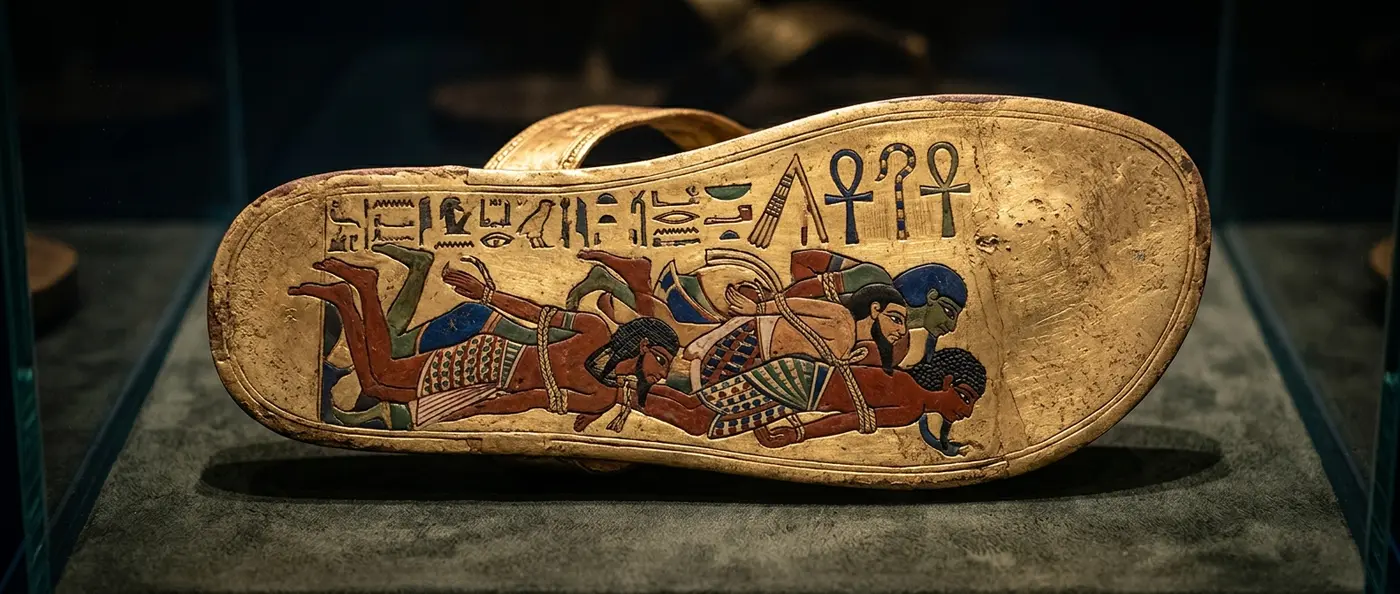
Bound captives writhe beneath golden soles. Every step the boy king took crushed Egypt's enemies underfoot — literally. Among the thousands of treasures crammed into Tutankhamun's tomb, archaeologists found a pair of sandals that turned walking into warfare. The soles depicted tied prisoners and rival nations, transforming the pharaoh's daily stroll into a ritual of domination.
📖 Read more: Nefertiti's Lost Tomb: Hidden Behind Tutankhamun's Walls?
🏺 Discovery in the Pharaoh's Tomb
Howard Carter's team struck gold in 1922. Not just the obvious kind — the dazzling death mask, the golden chariots — but something far more personal. Tucked beneath a basket in the Valley of the Kings lay dozens of pairs of footwear, each designed to carry the young pharaoh through eternity. One pair stood out from the rest.
These weren't your average royal sandals. Measuring 28.4 by 9.2 centimeters — roughly a modern European size 45 — they packed a political punch that would make Machiavelli jealous. Carter's initial cataloging noted their exceptional preservation, though their exact original position remains unclear thanks to ancient tomb robbers who'd shuffled things around centuries earlier.
The construction was masterful. Wood formed the base, layered with tree bark, green leather, and gold fragments over white paint. Three millennia hadn't dulled their message. If anything, time had sharpened it.
⚔️ The Symbolism of Power
Turn these sandals over. The soles tell a story of conquest written in leather and gold. Two bound figures sprawl across each arch, tied with lotus and papyrus — symbols of Upper and Lower Egypt united under pharaonic rule. Eight bows frame the composition: four near the toes, four at the heel, plus bow-shaped straps.
Together, these elements formed the "Nine Bows" — ancient Egypt's shorthand for "everyone who dares oppose us." The bound captives represented the pharaoh's dominance. The Nine Bows were positioned so the king's feet would crush them with every step, turning a simple walk into a declaration of war.
This wasn't unique to Tutankhamun. Egyptian pharaohs had been symbolically stomping their enemies for centuries. But few examples survived with such clarity. The dry desert air and sealed tomb had preserved not just the materials, but the message: absolute power, worn daily.
Whether the teenage king actually wore these sandals in life or if craftsmen made them specifically for his afterlife journey remains unknown. When archaeologists unwrapped his mummy, they found different footwear — gleaming gold sandals and finger coverings that blazed like miniature suns.
🗿 The Nine Bows and Egypt's Enemies
The Nine Bows weren't abstract symbols. They represented real peoples who threatened Egypt's borders: Nubians from the south with their gold and ivory, Libyans from the western desert with their raids and cattle, Asiatics from the northeast with their armies and ambitions. Each bow stood for a specific threat that kept pharaohs awake at night.
Every time Tutankhamun slipped on these sandals, he reenacted Egypt's triumph over chaos. The ritual was embedded in his wardrobe. Power wasn't just about commanding armies or building pyramids — it lived in the smallest details of royal life.
Nubians
Southern peoples who controlled gold mines and trade routes, constantly clashing with Egypt over resources and territory along the Nile's upper reaches.
Libyans
Desert nomads from the west who periodically attacked the Nile Delta, representing the eternal threat from Egypt's most vulnerable border.
Asiatics
Various peoples from Syria-Palestine and Mesopotamia who competed with Egypt for dominance over the lucrative trade routes of the ancient Near East.
💎 Artistry and Construction
These sandals showcase Egyptian craftsmanship at its peak. Multiple materials — wood, leather, gold — demanded different skills from different artisans. The green leather symbolized rebirth and new life. Gold represented divinity and eternity. Nothing was accidental.
📖 Read more: Tutankhamun: The Boy King Who Died Too Young
Placing enemies on the soles wasn't random either. In Egyptian cosmology, feet were the body's most "impure" part. To be trampled underfoot was the ultimate humiliation. The symbolism cut deep.
The technical execution was flawless. Delicate gold work survived three millennia. Leather remained supple. Paint stayed vibrant. These weren't just symbols — they were masterpieces that happened to carry a political message.
👑 Did You Know?
Tutankhamun's tomb contained over 80 pairs of footwear! From everyday papyrus sandals to ceremonial gold slippers, the boy king was prepared for every occasion in the afterlife. Talk about being well-heeled.
🏛️ Legacy of the Symbolic Sandals
Today, these sandals rest in Cairo's Egyptian Museum, still drawing crowds 3,300 years later. The museum's information card notes that the bound captives "refer to the power of King Tutankhamun" and that the Nine Bows are "placed so that the king's feet would step on them, realizing the trampling of Egypt's enemies by the monarch."
They remind us that in ancient Egypt, even the most mundane objects carried profound meaning. Royal power wasn't just expressed through towering pyramids and massive temples — it lived in the smallest details of daily life. A pharaoh's authority extended from his crown to his toes.
These sandals remain one of the most striking examples of how art, religion, and political power intertwined in ancient Egyptian society. After more than three millennia, they still tell the story of a young king who wanted to show his dominance over Egypt's enemies, even in death.
📏 Royal Footwear Comparison
🔬 Modern Studies and Interpretations
Contemporary archaeologists continue studying Tutankhamun's sandals with cutting-edge technology. Material analysis has revealed construction details and sourcing: the leather likely came from desert antelopes, while the gold originated from Nubia's rich deposits — ironically, from the land of one of Egypt's traditional enemies.
These studies help us understand not just ancient Egypt's material culture, but the complex ideologies of power that permeated every aspect of royal life. From monumental architecture to personal accessories, pharaonic authority found expression everywhere.
🌍 Parallels in Other Cultures
Symbolic subjugation of enemies through clothing wasn't unique to ancient Egypt. Many ancient civilizations used similar power symbols. Assyrian kings appeared in palace reliefs trampling their foes. Persian rulers wore enemy imagery on their garments.
But the Egyptian version was particularly sophisticated. Integrating symbolism into everyday objects like sandals shows a deep understanding of symbols and ritual in daily life. This approach later influenced other Mediterranean cultures, including the Ptolemies who ruled Egypt after Alexander the Great.
The practice reveals something universal about power: it needs constant reinforcement. Every step Tutankhamun took in these sandals was a reminder — to himself and anyone who saw them — of who ruled and who submitted.