In 1876, German archaeologist Heinrich Schliemann lifted a golden death mask from the ruins of Mycenae and declared with breathless excitement: "I have gazed upon the face of Agamemnon!" He believed he'd found proof that the Trojan War wasn't myth but historical fact. Today, 150 years later, archaeology paints a far more complex picture of what actually happened at Troy—and whether Homer's epic tales have any basis in reality.
🏺 Agamemnon's Mask: Wrong Date, Right Era
That famous golden mask from Mycenae's Grave Circle A ranks among the most iconic finds in Greek archaeology. Hammered from thin gold foil, it depicts a bearded man's face with pronounced features. The tomb where it was discovered held eight bodies total, five wearing golden masks—clear markers of elite status.
Schliemann's identification hit a chronological wall. The mask dates to around 1500 BCE, based on its artistic style and stratigraphic context. If the Trojan War happened at all—still hotly debated—most scholars place it centuries later, around 1200-1100 BCE. This mask belonged to some Mycenaean ruler who lived 300-400 years before the supposed age of Agamemnon.
But here's what Schliemann got right. The discovery confirms a powerful Mycenaean kingdom existed exactly where Homer placed Agamemnon's seat of power. These Mycenaeans spoke an early form of Greek and built a civilization heavily influenced by Minoan Crete. Their decline coincided with the Late Bronze Age collapse around 1200 BCE—a period of widespread upheaval across the Eastern Mediterranean that saw empires crumble and cities burn.
⚔️ Bronze Age Armor: Fresh Evidence from the Battlefield
A stunning 2023 discovery in the Czech Republic sheds new light on the military equipment of the era traditionally linked to the Trojan War. Near Brno, metal detectorists uncovered fragments of bronze armor dating back 3,200 years to the Late Bronze Age (1600-1200 BCE). Only the second such find in the country.
The haul included a spear point, a sickle, a needle, and numerous bronze fragments. All items had been deliberately destroyed and buried together, likely part of a ritual practice. It took two years of study to recognize one peculiar folded metal sheet as part of a warrior's breastplate.
Archaeologist Aleš Navrátil from the Brno City Museum explains: "Using 3D scanning, we managed to digitally 'unfold' the bent metal sheet and recognize its shape and decoration. The decoration, identified under a microscope, confirmed this was part of body armor."
Bronze armor was reserved for elite warriors of that era, while common soldiers likely wore organic protective gear that doesn't survive in the archaeological record. The museum calls this discovery "extremely rare"—the exact find location remains undisclosed to prevent looting.
🗿 Mycenaean Civilization: The Real Achaeans?
The Mycenaeans were Bronze Age people who inhabited southern Greece after roughly 1750 BCE. They spoke an early form of Greek, proven by deciphered Linear B tablets. Their civilization drew heavily from Minoan Crete, adopting elements of art, architecture, and administration.
Schliemann believed the Mycenaeans were Homer's Achaeans and that his finds proved the Trojan War's historical reality. Indeed, certain Mycenaean sites correspond to kingdoms mentioned in the Iliad. But modern archaeologists place the Mycenaean civilization's collapse around 1200 BCE, during the general Late Bronze Age crisis.
If the Trojan War actually occurred, it may have happened centuries after Mycenae's peak. This creates a chronological puzzle: Homeric heroes are described with Mycenaean characteristics, but the timing doesn't match. One possible explanation is that epic tradition preserved memories from different eras, weaving them into a single narrative.
Linear B Script
Deciphering Linear B proved Mycenaeans spoke Greek, confirming their connection to later Greeks and validating aspects of Homeric tradition.
Cyclopean Walls
The massive fortifications at Mycenae, attributed by ancients to mythical Cyclopes, testify to the kingdom's power and wealth.
Maritime Trade
Mycenaean pottery found across the Mediterranean, from Cyprus to Sicily, proves extensive trade networks and seafaring capabilities.
📜 The Bronze Age Collapse
Around 1200 BCE, the Eastern Mediterranean world plunged into chaos. Within decades, major empires and civilizations collapsed or shrank dramatically. Mycenae, Troy, the Hittite kingdom, numerous Syro-Palestinian cities—all suffered destruction. Even mighty Egypt faced attacks from the mysterious "Sea Peoples."
What triggered this collapse? Climate change, earthquakes, internal wars, economic crisis, nomadic invasions—scholars propose them all. The answer likely lies in how these crises fed off each other, toppling one kingdom after another.
In this context of widespread upheaval, a war between a Greek alliance and a city in Asia Minor seems entirely plausible. Troy (modern Hisarlik in Turkey) was indeed a significant city that was destroyed and rebuilt multiple times. Layer VIIa, dating to around 1180 BCE, shows signs of violent destruction that could correspond to a siege.
🔥 Troy's Archaeological Layers
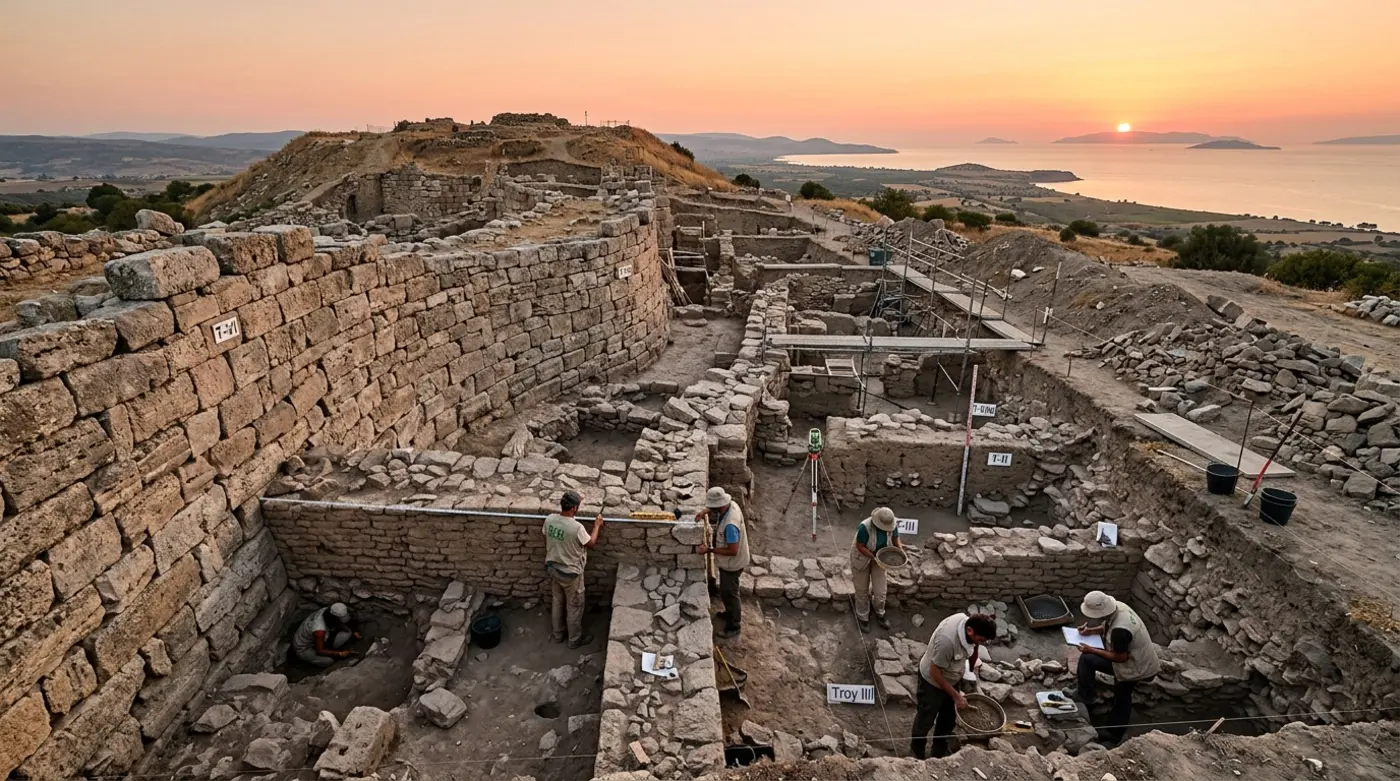
The archaeological site of Troy contains nine main occupation layers, from the Early Bronze Age (3000 BCE) to the Roman period. Layer VI (1700-1250 BCE) was a prosperous city with strong walls, while VIIa (1180 BCE) shows destruction by fire and possible siege.
🏛️ From Myth to History: What Archaeology Actually Tells Us
Archaeology can't prove the Trojan War happened exactly as Homer describes it. We haven't found inscriptions mentioning Achilles, Hector, or the Trojan Horse. What it can tell us is that the Homeric epics contain elements reflecting real historical conditions.
The Iliad's geography is remarkably accurate. Many cities it mentions existed during the Mycenaean period. Descriptions of weapons, chariots, and battle tactics match archaeological finds. Even details like bronze weapons and the absence of iron align with the Late Bronze Age.
Simultaneously, the epics contain anachronisms showing they developed over a long period of oral tradition. Social practices, political institutions, and technologies from different eras coexist in the narrative. It's like a palimpsest where each generation of storytellers added their own elements.
💡 Conclusions: History Behind the Myth
Homer's Trojan War weaves together historical memories, mythological drama, and centuries of poetic embellishment. However, archaeology shows the story's core—a conflict between Mycenaeans and a city in northwestern Anatolia—could be based on real events.
"Agamemnon's" mask, while not belonging to the mythical king, reminds us that Mycenae was indeed a powerful kingdom with a warrior tradition. New armor finds from the Czech Republic show the Late Bronze Age was a period of intense military conflict across Europe. And Troy's archaeological site confirms the city suffered destructions that could correspond to sieges.
Perhaps the most important lesson is that the distinction between myth and history isn't always clear-cut. Ancient peoples preserved their memories through oral tradition, transforming them into epics and legends. Archaeology can help us separate the historical core from mythological elaboration, but both are valuable for understanding the past.
📊 Myth vs Archaeology
As new discoveries emerge and fresh technologies are applied to studying the past, our understanding of the Trojan War continues evolving. What remains constant is the fascination this story holds—whether as myth or history—for our imagination across millennia.